
 Español
 English



Even if a bulk custom Java card project passes initial sample testing, various issues may still arise when production is scaled up to several thousand cards. A single prototype card may confirm that the chip, applet, and basic functions work properly. Still, it cannot fully demonstrate whether the entire manufacturing and personalization process can be executed consistently and reliably. A “pilot batch” allows companies to bridge this verification gap by manufacturing a specific number of cards using the exact materials, chip configurations, applet versions, encoding processes, and quality control procedures that will be employed in final production.
For a smart card manufacturer, a pilot batch is not merely another “sample approval” phase; it is a critical test to verify whether the entire customized Java card solution is ready for repeatable, large-scale production.
Pilot Batch: The Bridge Between Sample Approval and Actual Production
A customized Java card project involves more than simply selecting a chip and confirming that the application program runs. The finished card must seamlessly integrate hardware, operating system configurations, application software, card structure, personalization processes, and communication capabilities with external card readers or systems.
In the early stages of development, these elements are often tested separately. For example, a prototype card may successfully execute an authentication command, but that does not guarantee the same application will continue to function properly after personalization, card assembly, and mass production.
For this reason, a pilot production batch differs fundamentally from routine sample testing. It verifies whether manufacturers can accurately replicate the approved design under the production conditions they expect for actual orders.
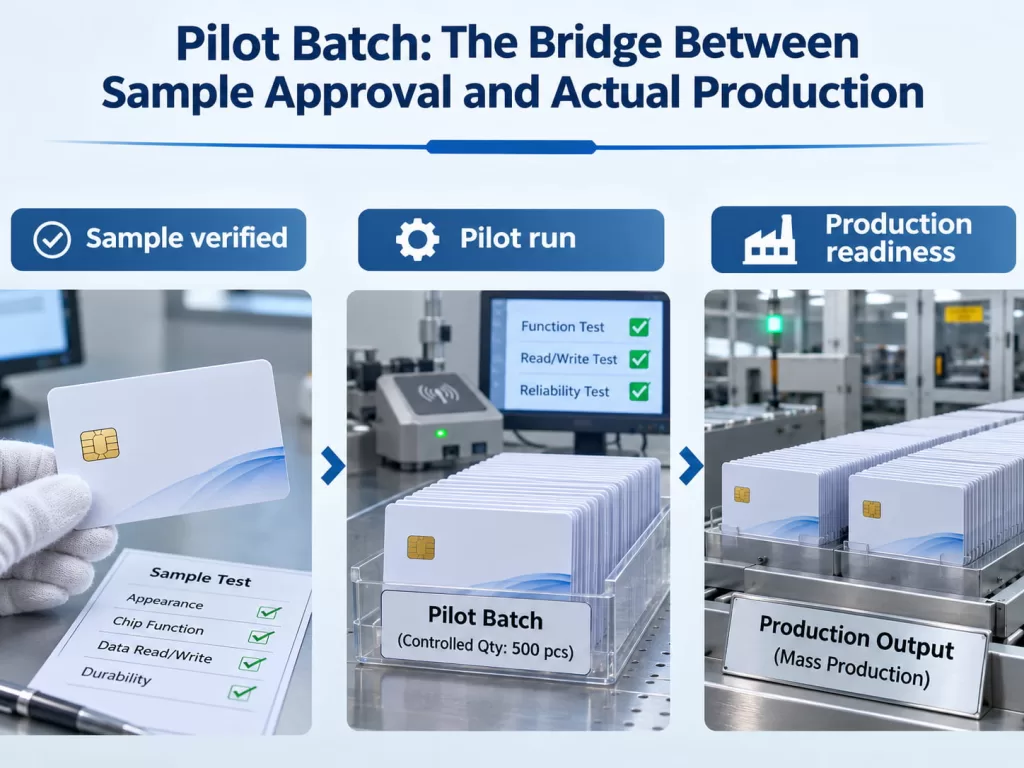
What is the difference between samples and pilot production batches?
| Comparison | Sample | Pilot Batch |
|---|---|---|
| Main purpose | Confirm design and basic functions | Validate production readiness |
| Quantity | Usually a few cards | A limited production quantity |
| Production process | May use engineering or manual procedures | Uses the intended production workflow |
| Testing focus | Appearance, chip selection, basic functionality | Functionality, personalization, consistency, and quality |
| Expected result | Design approval | Mass-production approval |
The main difference lies in what each stage is intended to verify.
For example, a sample can demonstrate that a single Java card can store a private key and perform signing operations. However, the trial production batch goes a step further, aiming to verify whether multiple cards can maintain consistent performance during personalization.
Samples demonstrate a design’s feasibility; pilot batches, by contrast, verify whether manufacturers can produce that design stably and consistently at scale.
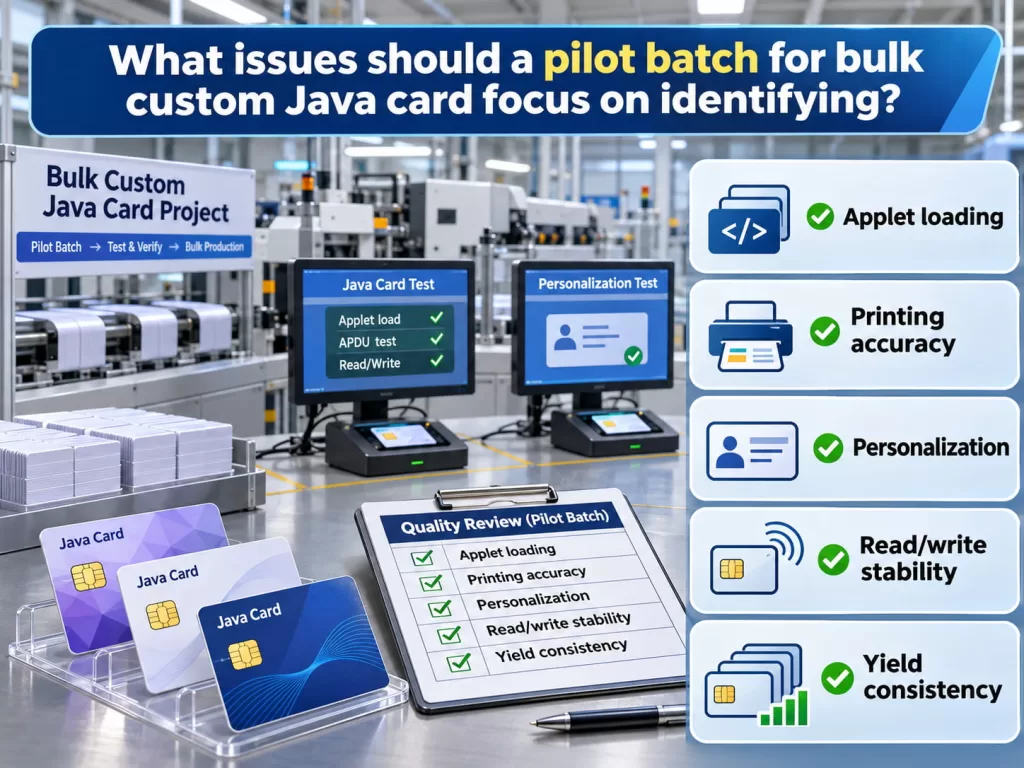
What issues should a pilot batch for bulk custom Java card focus on identifying?
The core value of a pilot batch is identifying issues that may not have surfaced during initial development. Such issues often arise at the interfaces between different production stages.
For bulk custom Java card orders, manufacturers should focus on three key areas: application functionality, production and personalization, and finished card consistency.
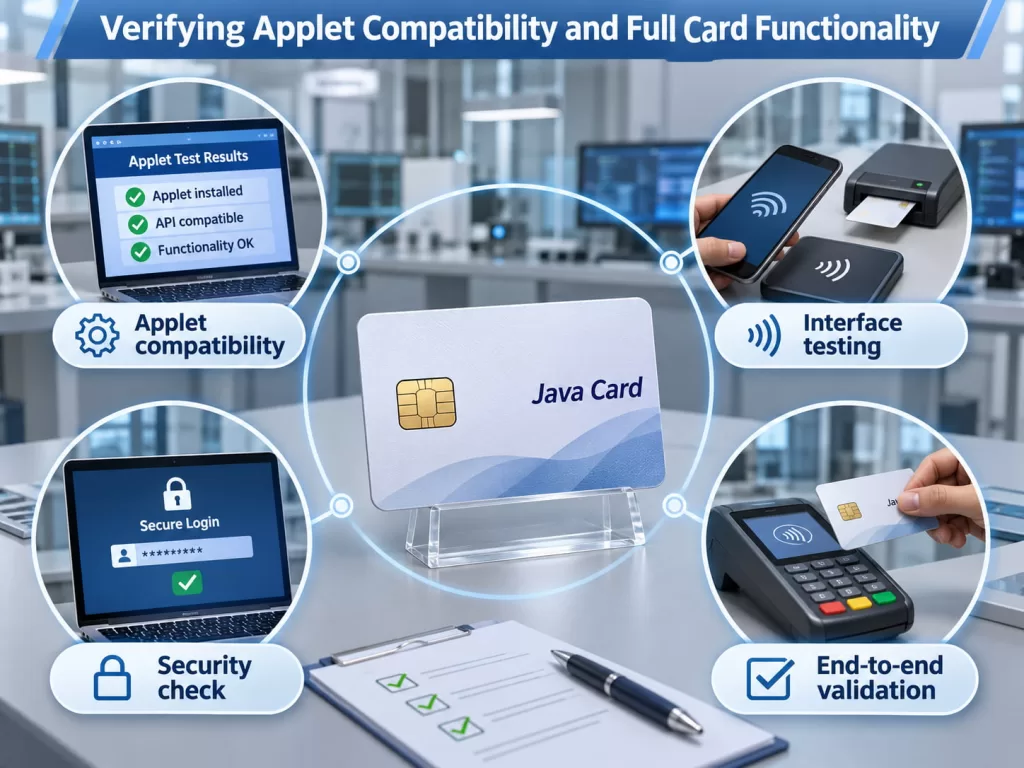
Verifying Applet Compatibility and Full Card Functionality
The primary task is to confirm that the chips in actual production support the complete application configuration.
Java Cards may function normally during preliminary testing, but additional applets, encryption features, or personalized data may introduce issues. Pilot batches allow for comprehensive testing of the complete configuration before full-scale production begins.
Key checkpoints include:
- Applet Installation: Verify that the required CAP files load and install correctly.
- Encryption Functions: Verify key generation, authentication, and digital signature operations.
- Storage Capacity: Confirm there is sufficient space to accommodate application data, certificates, and personalized information.
- Interface Compatibility: Test contact or contactless communication with the target card reader.
- Application Performance: Check whether key commands and transaction flows operate stably and consistently.
For example, testers must evaluate a government ID card that integrates authentication and digital signature functions after installing all applications and completing the personalization configurations. Testing individual Applets in isolation does not prove that the entire card configuration can function properly in tandem.
Verifying the Accuracy of Production, Personalization, and Encoding
Software functionality is only one aspect of production readiness. The physical card and its personalized data must also comply with established technical specifications. During the trial production phase, the manufacturer verifies that various components—such as the card substrate and the embedded chip—work together as intended.
| Production Area | What the Pilot Batch Should Verify |
|---|---|
| Card construction | Dimensions, material, lamination, and appearance |
| Chip and antenna | Chip integration and contactless communication, where applicable |
| Printing | Logo, layout, serial numbers, and variable information |
| Personalization | Correct applet, keys, certificates, and individual data |
| Encoding | Correct credential values and successful read-back verification |
For example, in an access control project, each card must contain a unique credential ID. During the pilot production batch, manufacturers must verify that the encoding system assigns the correct numbers, eliminates duplicates, and ensures that the printed information matches the electronic credential data.
This is especially important for bulk Java card orders; if a minor error occurs during personalization and is not detected in time, it may be repeated across many cards.
When Can a Custom Java Card Project Enter Mass Production?
Completing a pilot production run does not mean mass production can begin immediately. The project team must first evaluate the pilot production results against the initial project requirements.
If the manufacturer identifies issues such as mini-program compatibility problems or errors in personalized data during the trial production phase, they must determine the root causes and correct the production process before accepting any formal production orders. The manufacturer can then use a standardized production process to reliably replicate the specified configuration at scale.
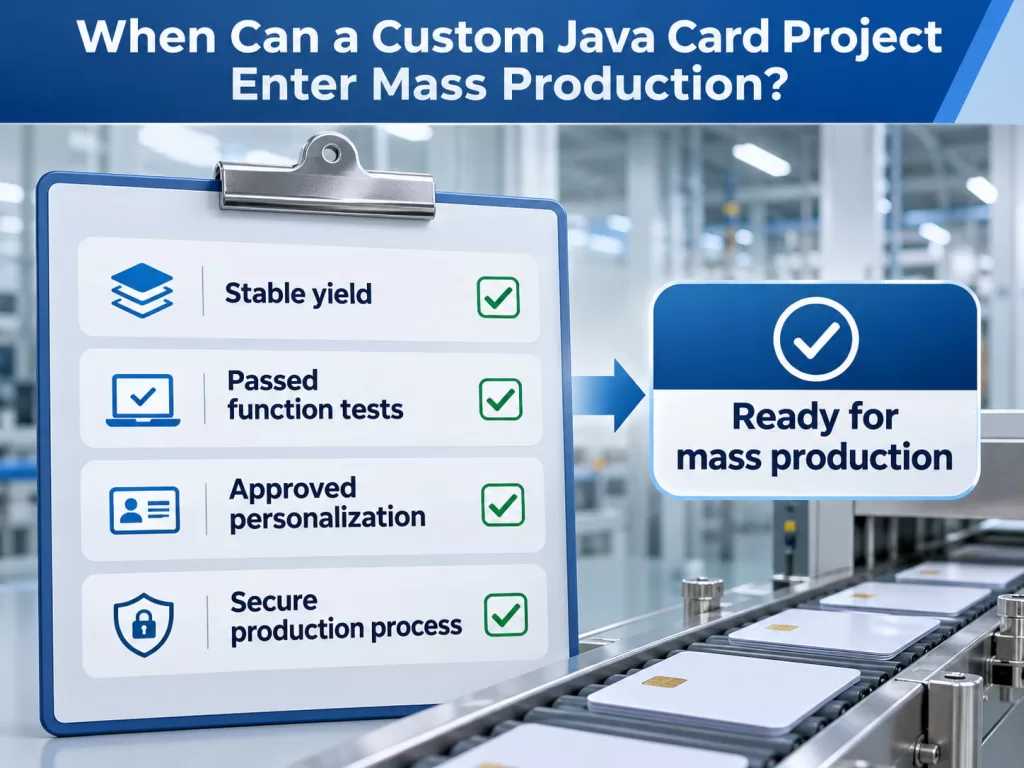
Resolving Key Issues Before Placing a Production Order for Custom Java Cards
Before mass-producing Java cards, the following four aspects must be verified:
1. Technical Verification: All required applets, encryption functions, and communication interfaces operate correctly on the selected chip.
2. Personalization Verification: Keys, certificates, card numbers, and all application data have been correctly written to the card and validated.
3. Manufacturing Verification: Card materials, printing processes, chip integration, and the appearance of the finished product all comply with established specifications.
4. Quality Verification: Comprehensive inspection procedures, production records, and traceability mechanisms are in place.
Not all issues require restarting the entire project. For example, minor printing adjustments may only require updating the production specifications, whereas issues involving unsupported encryption functions may require replacing the chip or modifying the application. However, critical technical and security issues must be resolved and retested before production is approved.
Establishing Repeatable Standards for bulk custom Java card Production
Once a pilot production batch is approved, its verified configuration should serve as the benchmark for mass production.
This includes the Java Card chip model, applet version, card structure, personalization parameters, encoding rules, and inspection standards. Any subsequent changes that may affect functionality or quality must undergo rigorous review, and arbitrary modifications are strictly prohibited. Therefore, a successful pilot production not only yields a batch of qualified cards but also establishes a practical production benchmark that helps effectively control quality as order volumes increase.
Reducing Production Risks and Improving Product Consistency
For bulk custom Java card projects involving 300,000 to 500,000 cards, pilot production is essential because sample testing alone cannot prove the entire solution can support large-scale production.
Samples can only verify basic design and functionality. In contrast, a pilot production batch allows for comprehensive validation of the actual production process, including applet installation, encryption operations, card structure, personalization, encoding, and quality consistency.
The core principle is simple: before applying the production process to high-volume orders, first validate the complete card product and production process on a limited scale. This not only reduces avoidable production risks and improves product consistency but also builds greater confidence for both the manufacturer and the customer before full-scale production.