
 Español
 English



When selecting the J3R452 Java smart card, the ISO/IEC 7816 and ISO/IEC 14443 Type A/B standards determine how the card communicates with an external card reader. ISO/IEC 7816 covers contact-based interfaces (i.e., the card must be inserted into the reader), while ISO/IEC 14443 Type A and Type B define contactless communication, allowing the card to communicate when brought near an RF reader.
The NXP J3R452, based on the SmartMX3 P71D600 platform, supports both interfaces: the ISO/IEC 7816 contact interface using the T=0/T=1 protocol, and the ISO/IEC 14443 Type A/B interface for contactless operation. This makes it ideal for use in desktop smart card readers, contactless terminals, and system environments that require support for both communication methods.
However, this does not mean that every project needs to use both interfaces simultaneously. The specific configuration depends on the existing reader infrastructure and the end-use scenarios of the cards.
Practical Functions of ISO 7816 and ISO 14443 Type A/B
These two standards serve different communication environments. ISO/IEC 7816 requires physical contact between the card and the reader, while ISO/IEC 14443 supports communication without inserting the card into the terminal.
When deploying the J3R452 Java smart card, this distinction affects reader selection, terminal compatibility, card configuration, and application testing. Although both interfaces can access Java Card applications, the card reader must support the corresponding communication methods and protocols.
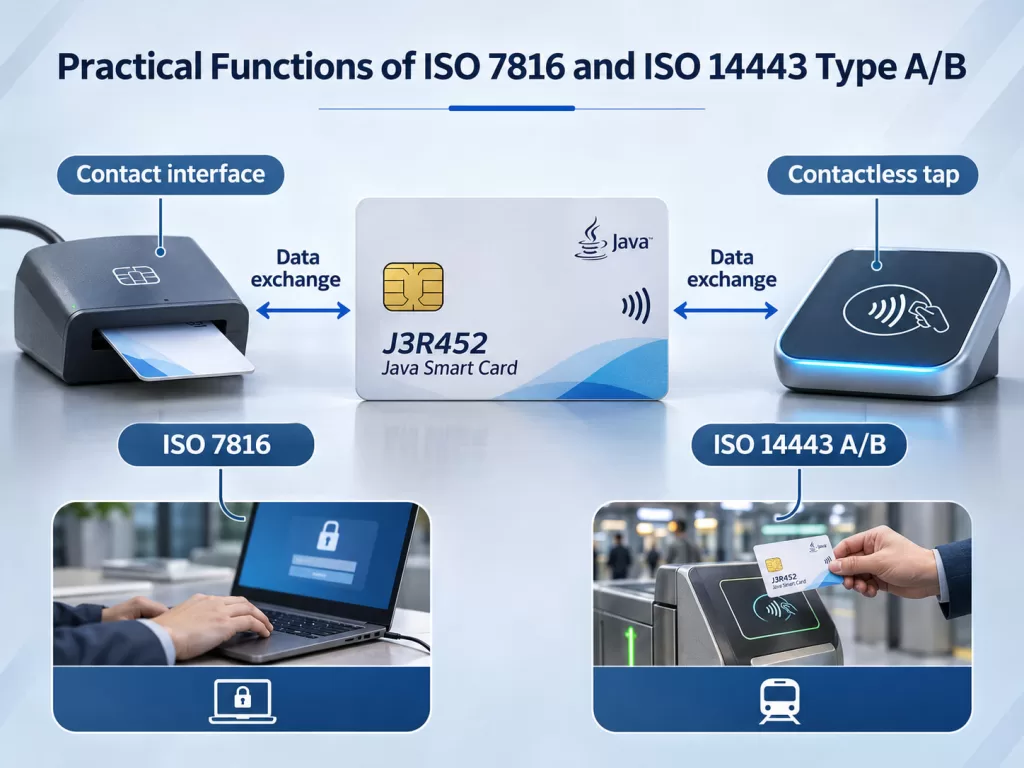
ISO/IEC 7816: Contact Communication via Smart Card Readers
ISO/IEC 7816 defines standards for contact-based integrated circuit (IC) cards. Its electrical and transmission requirements cover power supply, signal exchange, and communication between the card and the interface device. ISO/IEC 7816-3 specifically defines the electrical interfaces and transmission protocols, including the T=0 and T=1 protocols.
In practical deployments, this interface is used when the card must be physically inserted into the reader. Common application environments include:
- Government authentication terminals;
- Desktop-level PKI and digital signature systems;
- Banking and EMV contact terminals;
- Enterprise authentication workstations.
The NXP J3R452 contact interface supports T=0 and T=1 communication. Therefore, compatible card readers must support the corresponding contact protocols and the APDU commands the application uses.
ISO/IEC 14443 Type A/B: Contactless Communication
ISO/IEC 14443 defines communication specifications for contactless proximity cards. Unlike the contact-based operation of ISO 7816, the reader communicates with the card via a radio frequency (RF) field, without physical insertion.
This standard defines two distinct contactless communication technologies: Type A and Type B. Because their activation and communication processes differ, verify that a reader supports the specific card type you use when selecting a reader. The J3R452 Java Card supports both Type A and Type B standards, with a nominal contactless communication rate of up to 848 kbit/s (per ISO/IEC 14443-4).
- Common application scenarios include:
- Contactless payment terminals;
- Government electronic ID cards (eID) and identity verification;
- NFC-based identity authentication;
- Transportation and access control systems.
The ISO/IEC 14443-4 standard defines the block transfer protocols used by Type A and Type B cards. For Java Card applications that communicate via APDUs, the card reader must support the corresponding contactless protocols and application-layer communication.
What type of card reader is required for the J3R452 Java Smart Card? Is a dual-interface configuration mandatory?
Determine the interface configuration based on the reader environment, not the other way around. For example, the requirements for a government identity verification project using a desktop reader are entirely different from those for a contactless payment or access control system project. Because the J3R452 supports both contact and contactless communication, it can adapt to projects that require integration with different reader infrastructures. However, the card’s interface capabilities must match the customer’s existing readers and software.
The following comparison can serve as a reference for practical selection:
| Deployment Environment | Required Reader | Relevant Interface |
|---|---|---|
| Desktop identity verification | Contact smart card reader | ISO/IEC 7816 |
| PKI and digital signatures | PC/SC-compatible contact reader | ISO/IEC 7816, T=0/T=1 |
| Contactless payment | Compatible payment terminal | ISO/IEC 14443 Type A/B |
| NFC identity authentication | Compatible NFC reader | ISO/IEC 14443 Type A/B |
| Systems using both insertion and tap-based operations | Contact and contactless readers | Dual interface |
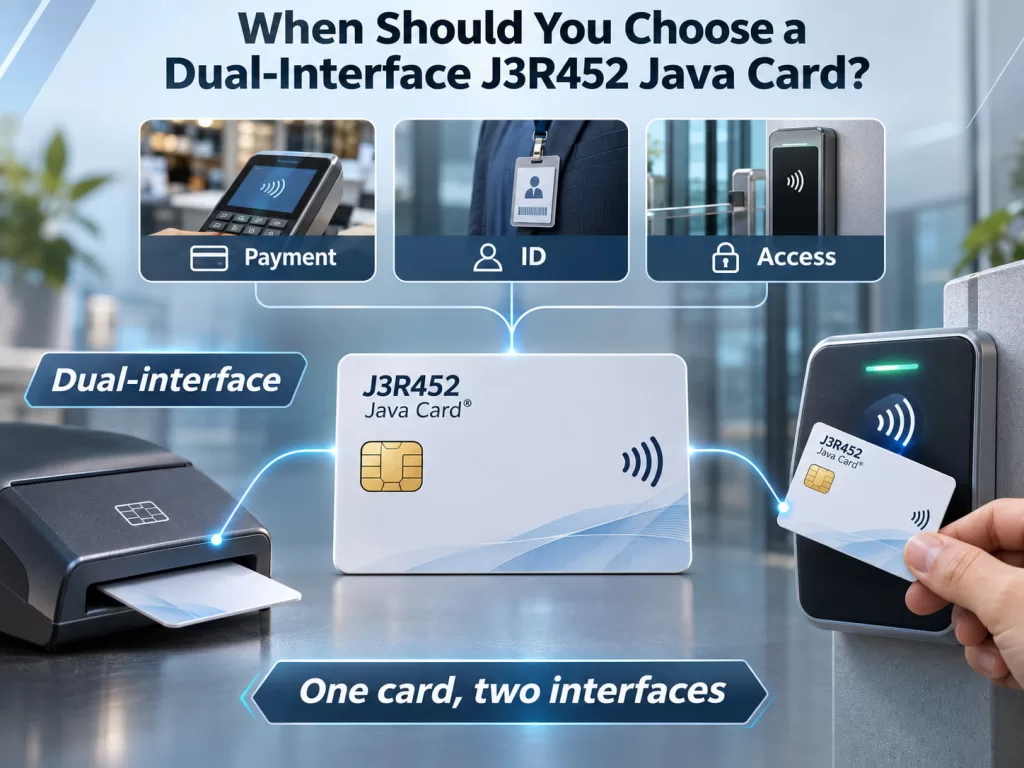
When Should You Choose a Dual-Interface J3R452 Java Card?
A dual-interface configuration is ideal when the same credential must work in both contact and contactless environments. For example, government ID cards can support digital signatures via contact readers at office workstations and identity verification via contactless readers at public service terminals.
Similarly, bank cards may need to support contact operations within existing infrastructure as well as contactless transactions at payment terminals.
However, not all J3R452 application scenarios require dual-interface functionality.
- If a project involves only inserting the card, contact communication may be sufficient.
- If users only need to tap the card (contactless), contactless communication may be sufficient.
- If you need support for both reader environments, select a dual-interface configuration.
Even if dual-interface support is available at the chip level, this does not necessarily mean every applet is configured to operate via both methods. Therefore, comprehensive validation of the applications, card operating system, and reader integration is essential.
How to Verify the Interface of a Finished J3R452 Java Smart Card?
Although the relevant data sheets confirm that the J3R452 platform supports the ISO/IEC 7816 and ISO/IEC 14443 Type A/B standards, this does not prove that a finished card with personalized configuration will communicate properly with the customer’s card reader. Therefore, include interface verification in the production acceptance process. Test the actual card configuration using a compatible card reader; approval should not be based solely on the chip model.
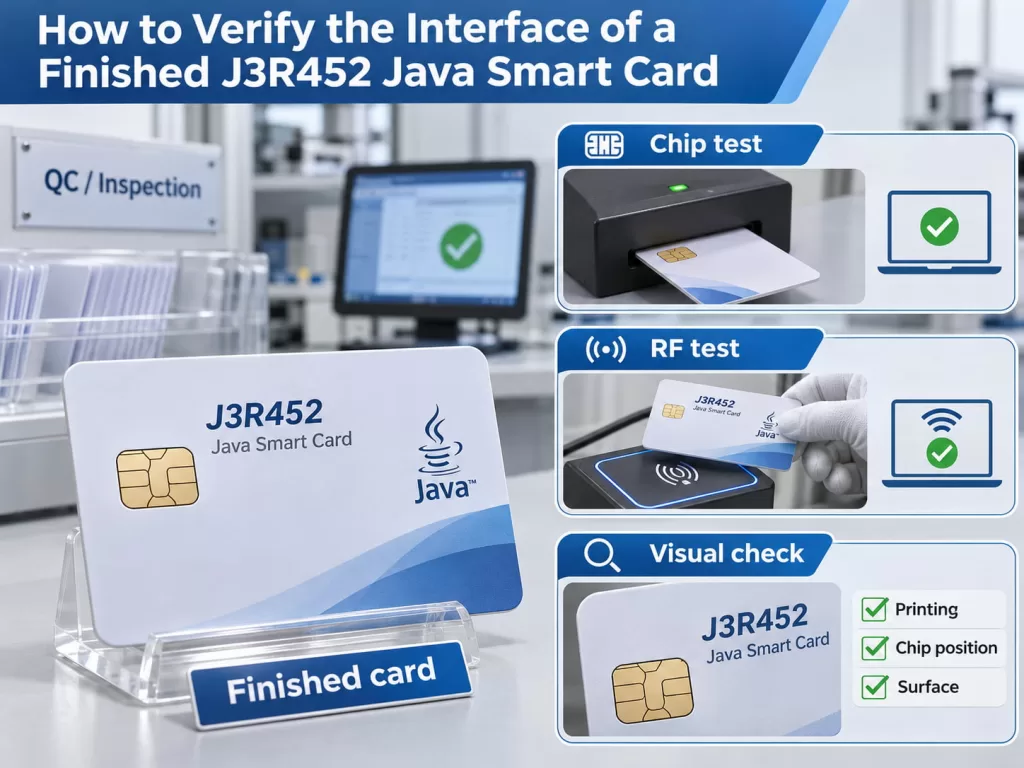
Test Contact and Contactless Communication Separately
For dual-interface J3R452 cards, DCCO recommends conducting two separate tests.
Contact Interface Verification
- Insert the card into a card reader compliant with ISO/IEC 7816.
- Verify that the card reader can power the card and receive the card’s ATR.
- Verify T=0 or T=1 communication.
- Use the Application Identifier (AID) to select the desired applet.
- Execute typical APDU commands and verify that the returned responses are as expected.
Contactless Interface Verification
- Hold the card near a card reader compliant with the ISO/IEC 14443 standard.
- Verify that Type A or Type B activation is successful.
- Verify the activation of the contactless protocol and APDU interactions.
- Select the desired applet and execute typical commands.
- Repeat the above tests using the card reader models employed in the actual deployment.
If the project requires compatibility with both Type A and Type B, acceptance testing should cover both card reader environments.
Deployment of ISO 7816 and ISO 14443 Type A/B
For the J3R452 Java smart card, ISO/IEC 7816 defines contact-based communication via plug-in smart card readers, while ISO/IEC 14443 Type A/B supports contactless communication via radio frequency (RF) readers.
The J3R452 Java Card supports both standards, making it suitable for application scenarios involving desktop authentication, PKI, government identity verification, contactless services, and any other scenario requiring simultaneous use of both interfaces.
The selection criteria for practical applications are as follows:
Contact-only environments: Use a card reader compliant with ISO/IEC 7816.
Contactless-only environments: Use a card reader compliant with ISO/IEC 14443 Type A/B.
Mixed environments: Select and validate a dual-interface configuration.
ISO standards define communication capabilities; successful card reader integration and application testing ensure the card is ready for deployment.