
 Español
  English


NFC Java Card improves security in smart access control applications by protecting access credentials, enabling dynamic identity verification, and supporting secure application management. Unlike traditional contactless cards that mainly store fixed identification data, NFC smart card combines secure chip technology with Java Card architecture to perform security operations within a protected environment.
By integrating secure hardware, cryptographic authentication, and programmable applications, NFC Java Card strengthens three critical areas of access control security: how credentials are protected, how identities are verified, and how security functions are managed throughout the card lifecycle.
NFC Java Card Establishes a Secure Foundation for Access Credentials
The security of an access control system starts with how identity credentials are stored and processed. In many traditional contactless cards, the card mainly stores identification data and transfers it to an external reader or system for verification. This approach creates a dependency on external security mechanisms and increases the importance of protecting stored information.
NFC Java Card changes this security model by integrating a secure microcontroller environment that allows sensitive operations to be performed inside the card. Instead of exposing authentication data directly, the card processes security-related information internally and only provides the necessary verification results.
Hardware-Based Security Processing Architecture
The Secure Element within an NFC smart card provides a trusted environment for managing sensitive data, including cryptographic keys and authentication credentials. Security functions are executed within this protected hardware area, separating critical operations from general card communication.
This architecture improves credential security by ensuring that:
- Cryptographic keys remain protected inside the chip
- Sensitive authentication data is not directly exposed
- Security operations are performed in a controlled environment
By moving security processing from external systems into the card itself, NFC Java Card reduces the risk associated with credential leakage and creates a stronger foundation for smart access control authentication.

Strengthening Access Verification Through Dynamic Authentication
Protecting credentials alone is not enough for a secure access control system. The system must also determine whether the presented card is authentic and whether the access request comes from a trusted source.
Traditional access cards often rely on fixed identifiers or static authentication data. Since the same information is repeatedly used during communication, attackers may attempt to capture and reproduce these credentials.
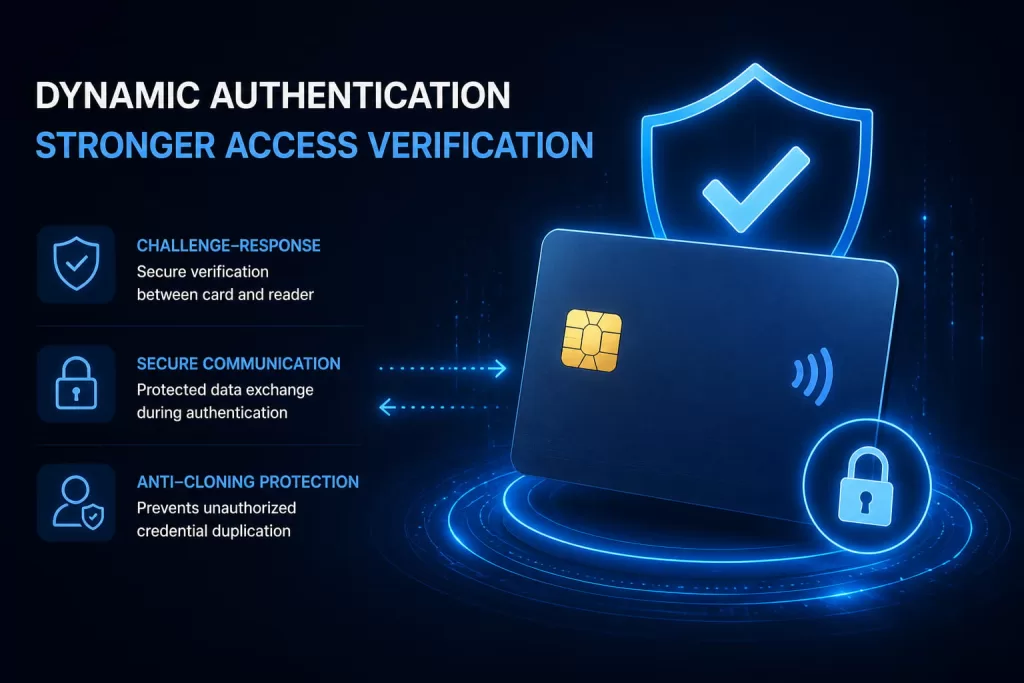
NFC smart card improves this process by introducing dynamic authentication methods based on cryptographic verification. Instead of simply checking stored card information, the access system verifies whether the card can generate a valid security response.
Replacing Static Identification with NFC Java Card Cryptographic Verification
During an authentication process, the reader sends a request to the NFC Java Card. The card then uses internal security functions to calculate a response, which the access control system verifies before granting permission.
This process allows the system to confirm the card’s authenticity without revealing sensitive security information.
Through cryptographic authentication, an NFC smart card can support:
- Challenge-response verification between card and reader
- Secure communication during authentication
- Protection against unauthorized credential duplication
This approach changes access control from simple card recognition to trusted identity verification. The system no longer depends only on whether a card contains the correct data, but whether the card can complete a secure authentication process.
Enhancing Security Management Through Applet Isolation and Lifecycle Control
Beyond credential protection and identity verification, NFC Java Card improves access control security through its programmable application architecture. Unlike fixed-function cards, Java Card technology allows multiple secure applications to operate on the same card while maintaining independent security controls.
This capability enables organizations to manage different security functions within one card without creating unnecessary interaction between applications.
NFC Java Card Applet Isolation Supports Independent Security Functions
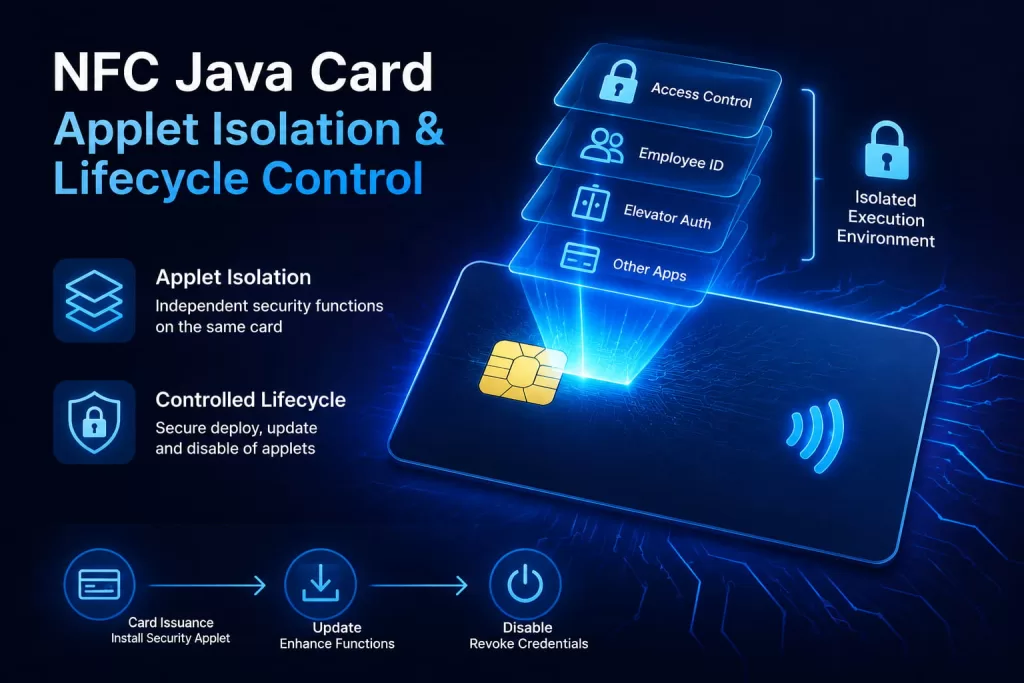
NFC smart card can run multiple Java Card applets, with each application having its own storage area, permissions, and execution environment.
For example, a single card may include applications for access control, elevator authentication, employee identification, or other secure functions. These applications can operate independently, preventing one application from directly affecting another.
Applet isolation improves security management by separating different functions and reducing the impact of potential application-level issues.
Controlled Application Lifecycle Management
NFC Java Card also supports secure application management throughout the card lifecycle. Authorized administrators can deploy, update, or turn off specific applets based on changing security requirements.
For example, access control providers can install a dedicated security application during card issuance, update application functions when security policies change, or turn off applications when credentials are no longer valid.
This capability allows organizations to maintain long-term security management without replacing the entire card infrastructure.
NFC Java Card Strengthens Smart Access Control Security
The security improvement of NFC smart card comes from the combination of secure hardware architecture, dynamic authentication mechanisms, and programmable application management.
NFC Java Card creates a comprehensive security framework for smart access control systems. Sensitive credentials are protected through secure hardware processing, identity verification is strengthened through cryptographic authentication, and security functions can be managed through isolated Java Card applications and lifecycle control. Together, these capabilities enable a more reliable and adaptable approach to modern access control security.
For modern smart access control systems, security is not only about preventing unauthorized entry. It requires a complete framework that protects identities, verifies trust, and manages security functions throughout the card lifecycle. Through these capabilities, NFC smart card provides a more advanced approach for building secure and scalable access control solutions.