
 Español
  English


To avoid duplicate credential IDs on a 125kHz proximity card, simply printing different numbers on the card surface is not enough. First, define the credential format used by the access control system and assign non-overlapping ID ranges. Then encode each card using a controlled production database. Before writing data, we must verify the uniqueness of each credential to be encoded; after encoding, we perform readback verification to ensure the facility code, card number, bit structure, and printed number match the production records.
For high-volume orders, we treat the numbering process as a controlled credential management procedure:
Credential Format → Facility/Site Code → Reserved ID Range → Duplicate Check → Card Encoding → Readback Verification → Production Records
This process prevents the reuse of previously issued numbers and ensures that every 125 kHz RFID card delivered to the customer contains the intended credential values.
The Uniqueness of 125kHz Proximity Card Credentials Begins with the Numbering Architecture
The primary question is not merely “What number should be printed on the card?” but rather: What complete credential value will the access control system recognize as unique?
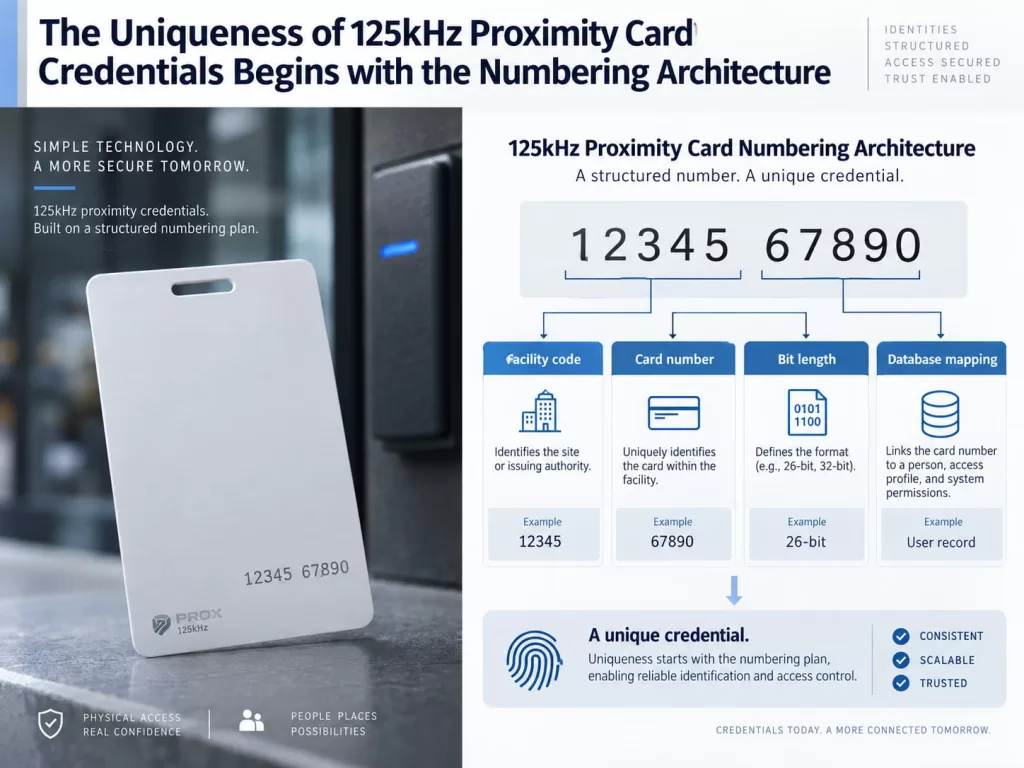
A single 125kHz Proximity Card may contain multiple numbers serving different purposes. These include the transponder identifier assigned by the manufacturer, the encoded access control credential data, and the decimal number printed or laser-engraved on the Card’s surface. Do not treat these values as interchangeable. For access control projects, the relevant credential ID typically depends on the format required by the card reader and access control system.
Determine the Credential Format Before Assigning Numbers
A common example is the Wiegand protocol-based credential format, in which the transmitted credential data includes a facility code (or site code), an individual card number, and parity information. HID’s documentation also clearly distinguishes between the programming format, facility code, and starting credential number when customers order credentials.
If two cards have different facility codes, they are not considered identical credentials, even if the card numbers printed on their surfaces are the same. Conversely, if two cards that look different transmit the same credential data to the access control system, this may result in duplication.
Therefore, we define uniqueness based on the complete credential structure, such as:
Format + Facility Code + Credential Number
rather than simply verifying the numbers printed on the Card’s surface. Before beginning production, we require the customer to provide or confirm the following information:
- The required credential format;
- The site code;
- The starting credential number;
- The required quantity;
- For additional cards, the range of previously issued credential numbers;
- Whether the encoding ID needs to be printed, laser-marked, or presented as a barcode.
These parameters will constitute the numbering specifications for that production batch.
Assigning ID Ranges Before Encoding Begins
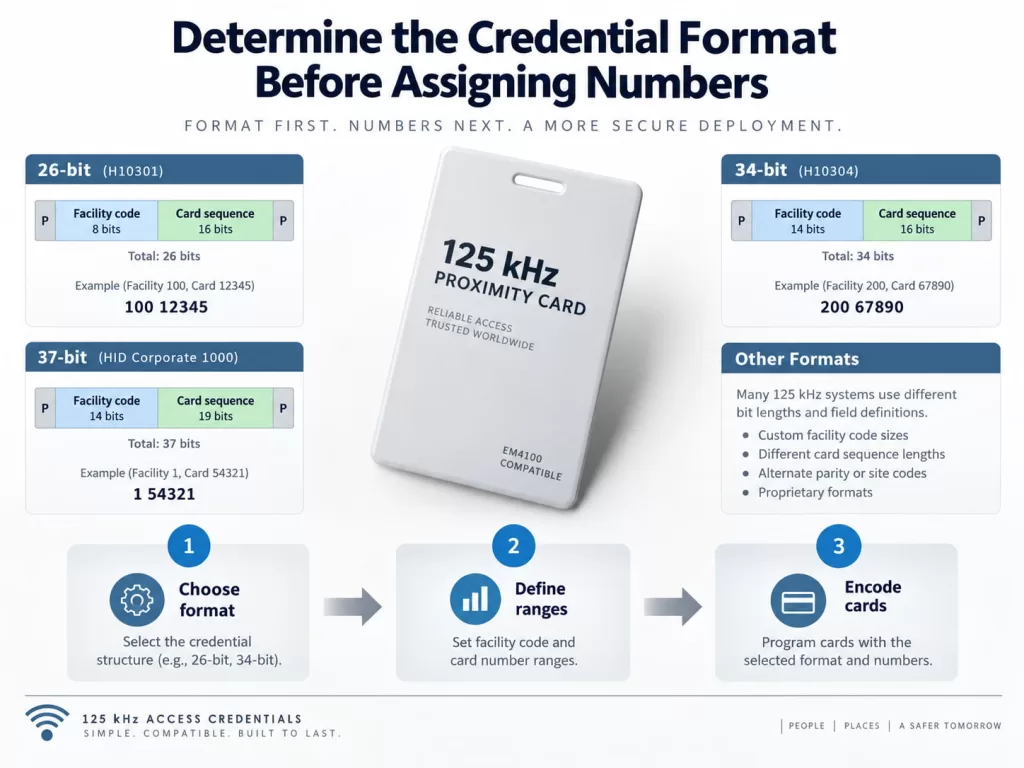
For projects involving 10,000 cards, we do not wait until each Card reaches the encoding station to generate individual certificate numbers. Instead, reserve the entire number range before production.
For example:
Project A → Site Code 118 → Certificate Numbers 20001–30000
We record this number range as “allocated,” so we cannot reassign it to another order batch using the same certificate namespace.
For repeat orders, we verify the next production number range based on historical production records. If cards with numbers 20001–30000 have already been issued, subsequent batches may start at 30001 rather than restarting at 20001.
Certain 125 kHz RF tags also differ at the chip level. For example, EM Microelectronic’s EM4200 chip uses a fixed 40-bit data field within its EM4100-compatible encoding structure, whereas Microchip’s ATA5577C series offers a read/write EEPROM and configurable encoding features. Therefore, the numbering process must accommodate both the RFID chip technology and the credential format required by the customer’s system.
Duplicate Detection and Encoding Verification Must Be Incorporated into the 125kHz Proximity Card Production Process
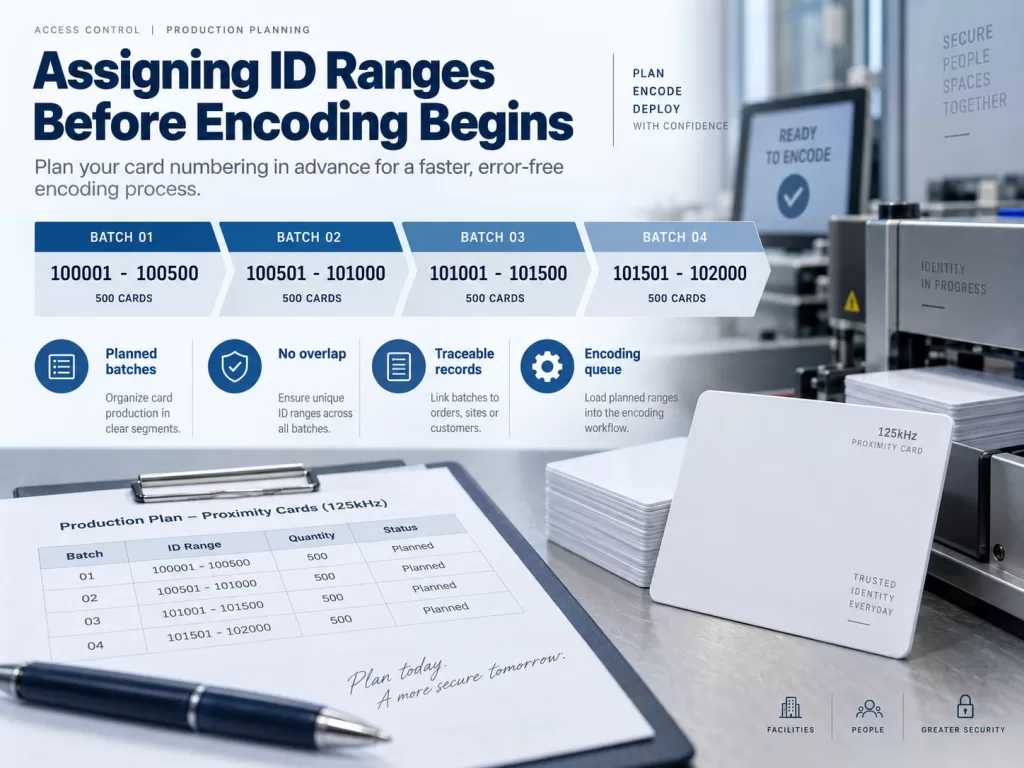
While assigning a separate number range can prevent most number conflicts, this alone is not sufficient to guarantee absolute reliability. Production control measures must also detect duplicate entries, programming errors, and mismatches between production data files and the final proximity cards.
Detecting Duplicates Before Writing Credential Data
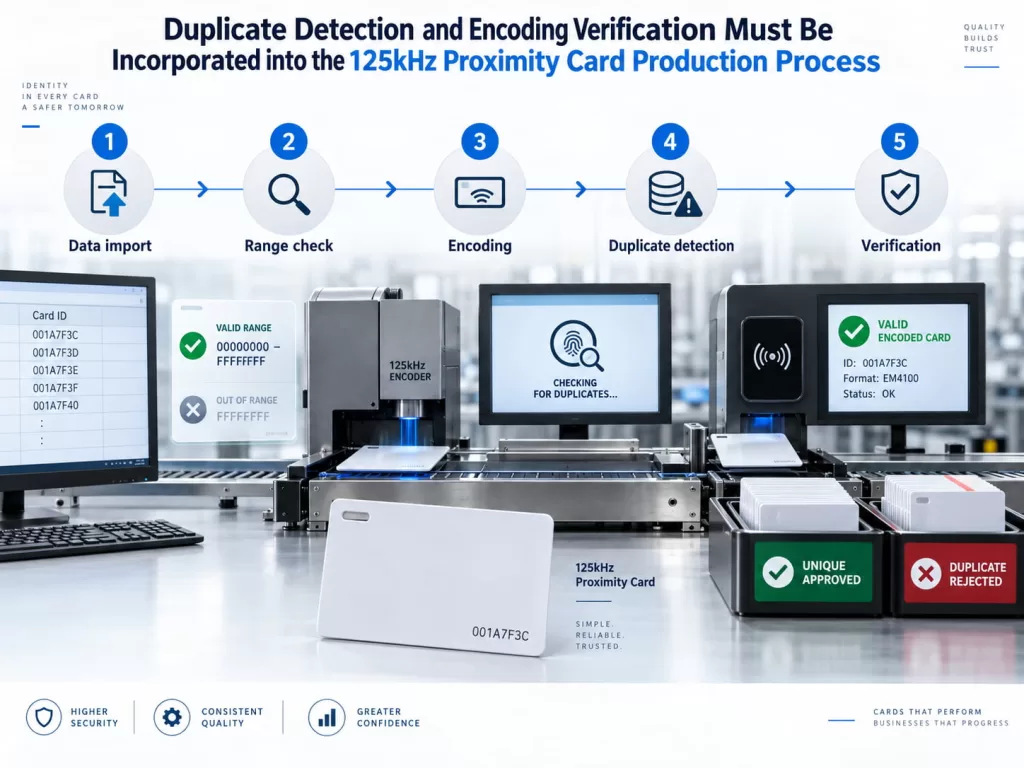
Before encoding, compare each piece of credential data to be written against the current production batch data and the manufacturer’s historical issuance database. We will employ the following logical checks:
The comparison process should cover all fields used to establish uniqueness in the target system. Depending on the credential format, these fields may include:
Voucher Format + Location/Site Code + Card Number
If the production file to be processed unexpectedly contains the following sequence:
- Site 118 / Card Number 20481
- Site 118 / Card Number 20482
- Site 118 / Card Number 20482
- Site 118 / Card Number 20483
The system should then intercept and reject the second occurrence of card number 20482 before any duplicates enter the final production stage. The same control mechanism should apply to different purchase orders. Otherwise, even a new batch with completely consecutive numbers could still duplicate a credential issued six months prior.
Verifying Encoded 125kHz RFID Card Credentials Through Re-reading
Encoding verification primarily addresses the following questions:
Does the credential actually contained in the finished Card match the credential scheduled for writing by the production system?
The result “programming command executed successfully” alone is not sufficient for verification. After encoding is complete, place the Card on a compatible verification reader or encoding workstation to read the data it transmits. Then decode the read data according to the specified credential format and compare it with the production records.
The verification process should be as follows:
Expected Credential → Card Encoding → Read Card → Decode Read Values → Compare → Pass or Reject
For Wiegand-type credentials, the verification process should confirm the applicable bit structure, site or facility code, credential number, and any parity checks or formatting rules. We perform 100% re-read verification on batches of encoded access control credentials, rather than relying solely on small-scale statistical sampling. Then, link the physical card numbers to the verified electronic credentials in the production records. This ensures traceability when customers place subsequent orders for replacement cards, additional cards, or similar 125 kHz RFID cards.
How to Number 125kHz Proximity Cards to Avoid Duplicate IDs?
The safest way to prevent duplicate credential IDs is to manage 125kHz proximity cards as controlled credentials, rather than simply treating them as numbered plastic cards.
Start by confirming the format of the card readers and access control system. Next, we define a facility code or site code, reserve a range of non-overlapping credential numbers, and cross-reference this range against the current order and previously issued credentials.
The correct sequence of operations is as follows:
Access control format → Site/facility code → Unique ID range → Database duplicate check → Data writing → Readback verification → Number verification → Batch logging
For large-scale 125kHz proximity card writing and customization projects, this method provides the traceability needed to prevent overlapping credential number ranges, detect duplicate IDs before shipment, and ensure each finished card matches the credential information originally assigned to it.