
 Español
  English


In the context of government identity verification applications, a Java Card is much more than just a physical credential. It serves as a secure identity container, a service platform, and a long-term public trust asset. The key advantage of a Java Card for government identity verification lies in its balance. It combines security, flexibility, and standards-based controls, aligning perfectly with the needs of modern public-sector identity verification projects. Therefore, security, support for multiple applications, remote management, and mobile extensibility have consistently been among the most reliable technical advantages in government identity verification.
Java Card for Government Identity Authentication Must Support Multiple Policy Objectives
Modern ID cards are rarely used for a single purpose. Today, it may serve as a legal proof of identity; tomorrow, it may function as a digital signature tool; and in the future, it may even serve as a card for accessing public services. If the platform cannot support this growth, card-issuing authorities will be forced to undertake costly reissuance or system replacement.
Java Card helps solve this problem by enabling cards to be programmable and easy to manage. It creates a secure foundation upon which governments can build and expand services without having to discard the original credentials. In this context, the four most important technical advantages are:
- Secure authentication
- Coexistence of multiple applications
- Remote Management
- Mobile Extensibility
It is precisely these capabilities that enable Java Card for government identity authentication to play a vital role in real-world identity authentication deployments.
Secure Authentication of Java Card for Government Identity Authentication
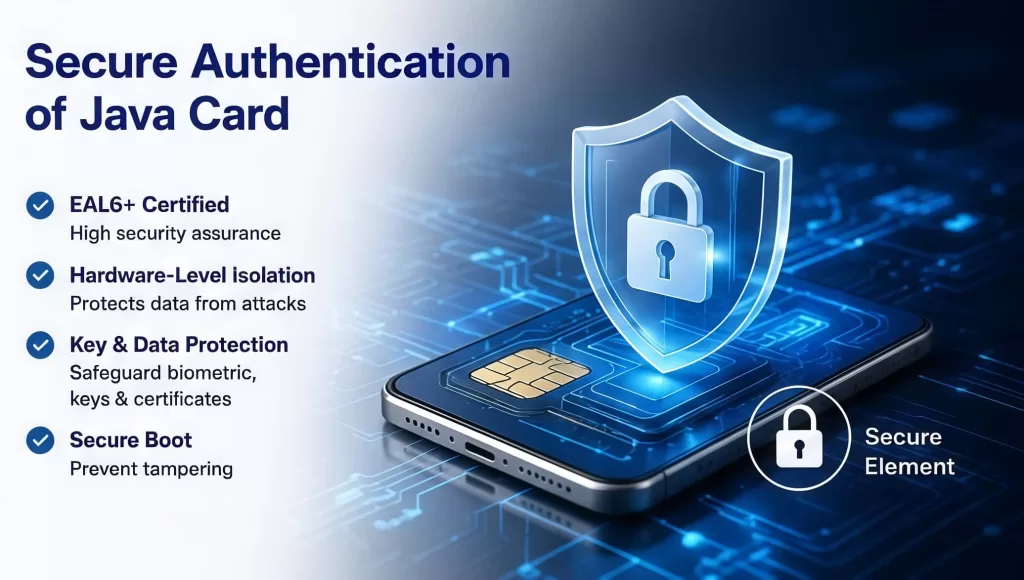
The primary technical advantage of Java Card for government identity authentication is its secure authentication, which supports EAL6+ security certification and provides protection against side-channel attacks, key protection, and secure boot mechanisms. In the public sector, identity authentication systems must meet extremely high security requirements. Java Card must protect biometric data, private keys, and certificates, keeping them in a highly secure state that ensures both data availability and permanent protection against data leaks.
Government identity authentication projects require evidence that the platform’s design and evaluation effectively prevent tampering, disclosure, and unauthorized access. Smart card manufacturers build and test Java Card–based secure elements against extremely rigorous security standards, which is one of the main reasons governments and organizations trust them for identity authentication projects.
Implementing Hardware-Level Isolation
The true advantage of Java Card for government identity authentication lies not only in software control but also in the combination of software rules with hardware-level isolation. This isolation helps protect sensitive data from side-channel attacks, tampering, and unauthorized inspection. In practical terms, the Java Card platform stores the most sensitive identity information directly inside the chip, allowing the system to use that data securely while making it extremely difficult for attackers to extract it. For government identity authentication, this is precisely the trust model that card-issuing authorities require.
Coexistence of Multiple Applications: One Card, Multiple Services, Strict Isolation
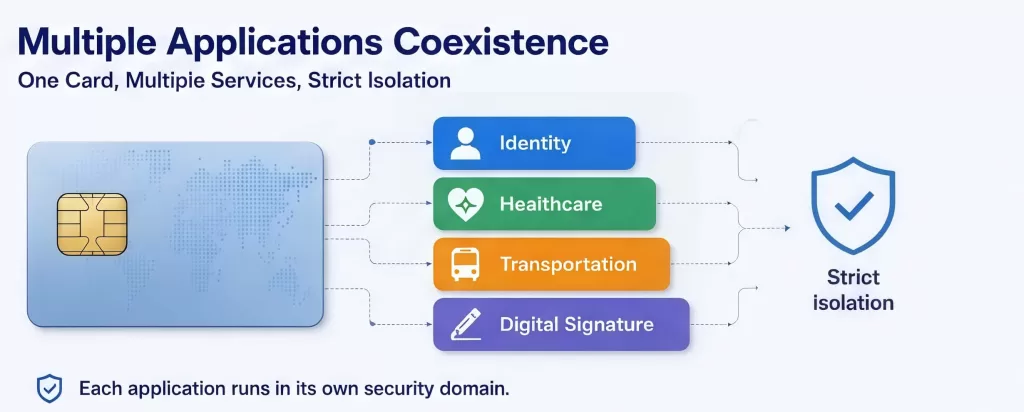
The second core technical advantage is multi-application coexistence. Java Card was originally developed to let multiple applications run on the same card while keeping each application securely separated from the others. A single card may need to support functions such as identity verification, health insurance access, public transportation services, or certificate-based digital signatures. A Java Card used for government identity authentication can achieve all of this without any interference between applications. Each applet runs within its own security domain, and platform rules govern how data is shared, accessed, and protected.
Strict data isolation for government identity Java Cards
In government identity systems, different data domains must remain separate. Even if a single physical card stores identity, health, and transportation data, those functions still need to stay separate and not interfere with one another. Java Card’s security application model was built specifically to support this kind of functionality. It provides robust isolation between microprograms, enabling each service to run within its own independent security space. This assures card-issuing authorities that expanding services will not compromise the integrity of the core identity.
Remote Management: OTA Updates Reduce Reissuance Costs
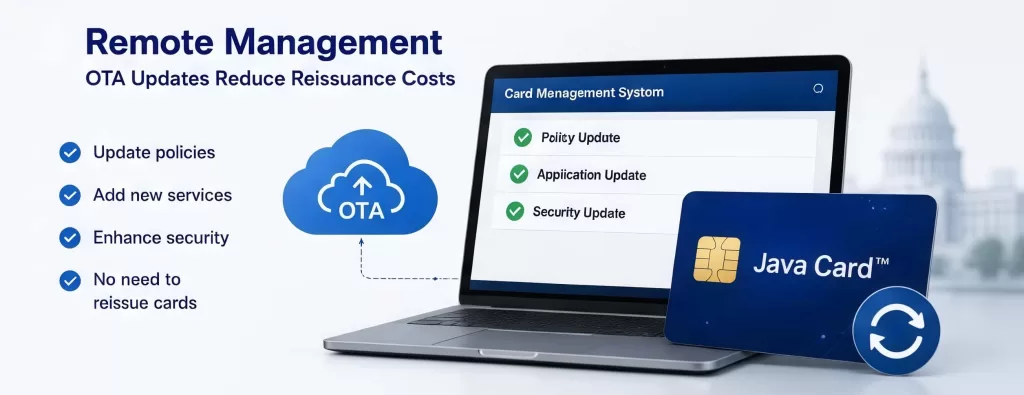
The third core technical advantage is remote management, particularly the OTA update capability. This is one of the most valuable features of government ID Java Cards, as it enables card issuers to update policies, add services, or enhance security without replacing the physical cards. This is crucial in nationwide ID systems. If policies change or new services are required, the government should not have to reissue millions of ID cards. With secure remote management, identity cards can be upgraded and modified after issuance.
Why Does OTA Capability Transform the Operational Model?
OTA management transforms cards from static objects into managed service platforms. Issuing authorities can upgrade security policies, deploy new applications, or adjust service logic without the need for large-scale replacements. This reduces costs, minimizes operational disruptions, and makes projects more flexible. This is particularly valuable in large-scale government environments with high public expectations.
Mobile Extension: Transforming Identity into Mobile-Based Credentials
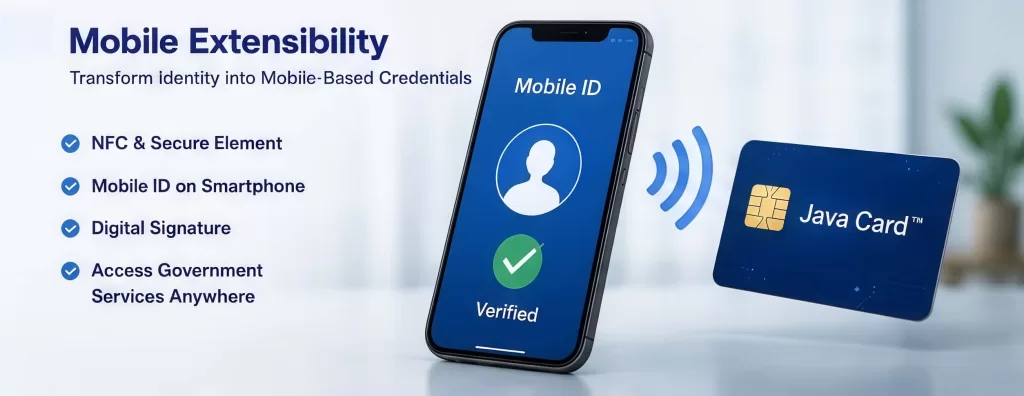
The fourth core technical advantage is mobile extension. Government identity is no longer limited to physical cards. Java Cards for government identity authentication can be extended to mobile devices via secure elements and NFC architecture, turning smartphones into electronic identity credentials.
Mobile identity management creates a more flexible and convenient user experience. Governments can not only rely on physical cards but also support users in establishing digital identities on their smartphones. This enables online real-name authentication, digital signature workflows, and contactless access to government services. This does not replace physical cards; rather, it extends the identity recognition system to the mobile domain.
Comprehensively Meeting the Security and Service Requirements of a Digital Government
The core technical advantages of Java Card for government identity authentication are clear. First, it provides a robust security foundation, including highly reliable protection, hardware-level isolation, and reliable key protection for biometric data, certificates, and private keys. Second, it supports the coexistence of multiple applications, allowing services such as identity verification, healthcare, and transportation to run on a single secure card while maintaining strict isolation. Third, it supports remote management capabilities via OTA updates, thereby reducing the costs and disruptions associated with nationwide card reissuance. Fourth, it extends identity verification to the mobile domain through NFC and secure element integration, paving the way for implementing mobile identity credentials.