
 Español
  English


Java Smart Cards represent one of the most advanced forms of secure card technology, combining programmable application functionality with hardware-based security mechanisms. However, the ability to execute applications is only one part of a complete smart card solution; equally important is how those applications are installed, managed, updated, secured, and removed throughout the card’s lifecycle.
This is where GlobalPlatform management capabilities come into play.
For Java Card manufacturers, GlobalPlatform provides a standardized framework that enables secure application management on the Java Card platform. It defines how applications, security domains, keys, and card resources are controlled after the card has been manufactured and deployed. A standard Java Smart Card equipped with GlobalPlatform capabilities is more than just a programmable card; it is a secure and flexible platform that supports the long-term evolution of applications.
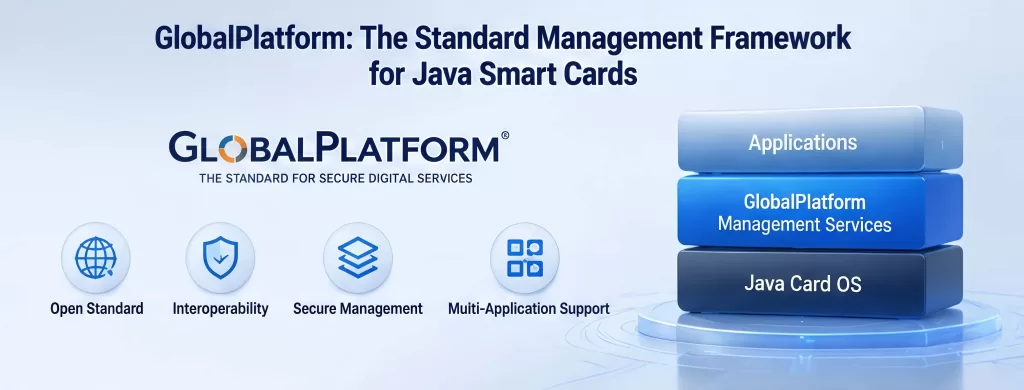
GlobalPlatform: The Standard Management Framework for Java Smart Cards
Java Card provides a secure execution environment that allows applets to run on the card. However, managing these applications requires a standardized security framework.
Without a unified management system, every card issuer or application provider would have to develop their own independent methods for loading applications, installing services, controlling access rights, updating software, and managing security credentials. GlobalPlatform addresses this challenge by providing a common architecture for secure card management.
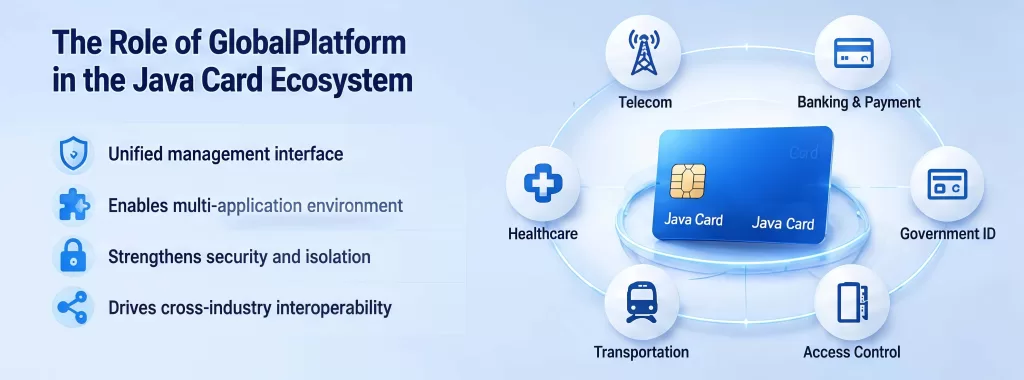
The Role of GlobalPlatform in the Java Card Ecosystem
GlobalPlatform works in tandem with Java Card technology to build a complete smart card platform. Java Card defines the application execution environment, programming model, and secure memory management.
GlobalPlatform, meanwhile, defines application lifecycle control, security domain management, secure communication, and post-issuance management. These technologies complement each other, enabling Java Smart Cards to support complex applications while maintaining strict security controls. GlobalPlatform ensures that each application runs securely without affecting other applications stored on the same card.
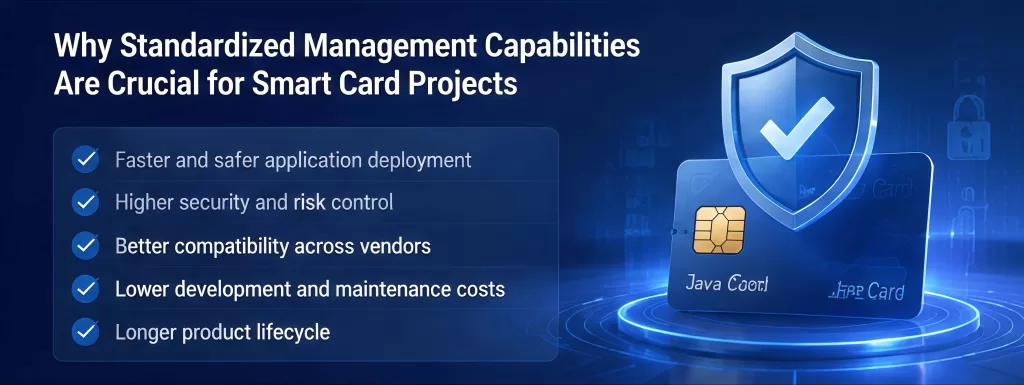
Why Standardized Management Capabilities Are Crucial for Smart Card Projects
Large-scale smart card deployments often remain in operation for many years.
During this period, organizations may need to:
Add new services;
Replace obsolete applications;
Update security policies;
Switch application providers.
If cards lack standardized management capabilities, physical replacement might be required whenever requirements change. However, GlobalPlatform-compliant Java smart cards support controlled lifecycle operations after card issuance. This reduces operational costs, the need for card replacement, and deployment complexity. For professional Java Card manufacturers, GlobalPlatform compatibility is a critical capability, as it enables customers to build sustainable smart card systems rather than just short-term card products.
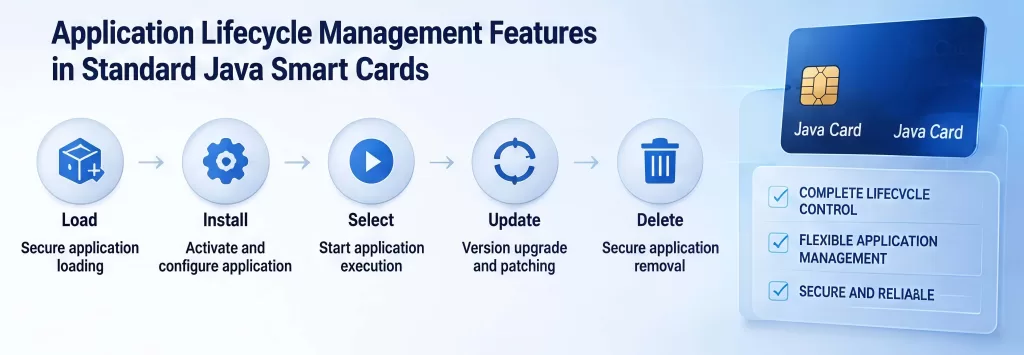
Application Lifecycle Management Features in Standard Java Smart Cards
Application lifecycle management is one of GlobalPlatform’s core functions. Standard Java smart cards must provide security mechanisms to govern the entire process of an application’s existence, from initial installation to final deactivation. Lifecycle management processes typically include loading, installation, and registration. These features allow relevant organizations to maintain full control over applications throughout the smart card’s lifecycle.
Secure Application Loading and Installation
A primary requirement for programmable smart cards is the ability to load applications securely. GlobalPlatform defines mechanisms that allow authorized entities to install applications on the card while preventing unauthorized software deployment. During the application loading process, the Java smart card verifies the application’s authenticity, authorization status, and secure communication state. This prevents attackers from installing malicious applications that could compromise the smart card’s security.
Security Domain Management and Cryptographic Key Control
Security is the foundation of all Java smart card applications. While application lifecycle management dictates how software is installed and controlled, GlobalPlatform’s security domain management ensures that every operation is performed under strict authorization. From the perspective of a professional Java smart card manufacturer, the security domain architecture is one of the key features distinguishing enterprise-grade smart cards from ordinary programmable cards.
A secure smart card must not only execute applications but also control:
Who can manage applications;
What operations different entities can perform;
How cryptographic keys are stored and used;
How secure communication channels are established.
GlobalPlatform provides the framework necessary to achieve these objectives.
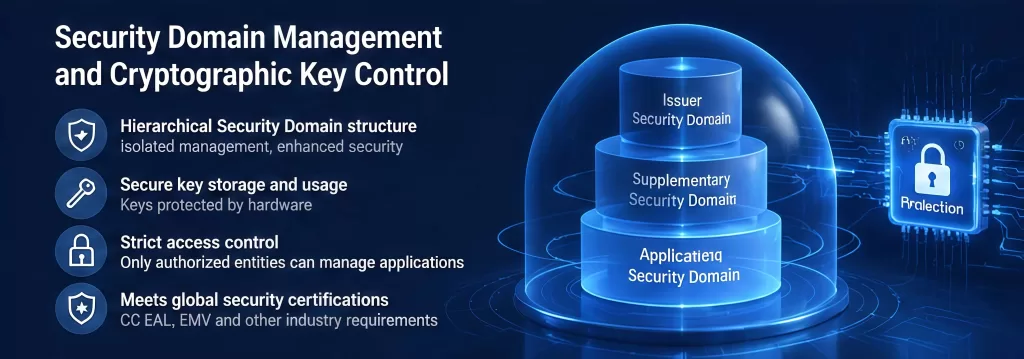
Security Domain Management for Different Application Providers
Standard Java smart cards may support applications from multiple organizations. These organizations need to manage their own applications without accessing sensitive information belonging to other parties. GlobalPlatform addresses this requirement through “Security Domains.” A security domain acts as a secure management environment used to control:
Application ownership;
Authentication privileges;
Secure communication channels;
Cryptographic keys. This architecture allows multiple service providers to share the same physical smart card while maintaining strict security isolation.
Secure Key Management Across the Card Lifecycle
Cryptographic keys are among the most valuable assets stored within a smart card. If a key is compromised or tampered with, it can impact user authentication, transaction security, digital signatures, and identity verification. Consequently, GlobalPlatform provides standardized key management functions, covering:
- Key generation;
- Key loading;
- Key replacement;
- Key updating;
- Key deletion.
Professional Java smart card manufacturers must ensure that key management processes operate within a secure environment. During the subsequent operational phase, authorized entities can update keys without exposing sensitive information.
GlobalPlatform Empowers Java Smart Cards with Security and Flexibility
Java smart cards have evolved beyond simple secure storage devices into programmable security platforms capable of supporting multiple applications, managing sensitive credentials, and adapting to changing service requirements. GlobalPlatform provides the key management framework that enables these capabilities.
From the perspective of a professional Java Card manufacturer, the core GlobalPlatform management functions included in standard Java smart cards are:
Secure application loading and installation, ensuring authorized applications can be deployed safely;
Application lifecycle management, supporting application activation, suspension, updating, and deletion;
Security Domain management, ensuring different application providers can operate securely within the same card environment;
Cryptographic key management, protecting sensitive security credentials throughout the card’s lifecycle;
Secure communication channels, enabling trusted interaction between management systems and the smart card;
Remote management capabilities, supporting post-issuance updates and large-scale deployments;
Multi-application management, allowing multiple independent services to coexist securely on a single card.
These functions enable organizations to build smart cards that are secure and reliable at issuance while remaining adaptable to operational needs over many years.