
 Español
  English


Institutional-grade crypto asset custody involves more than protecting private keys. The more critical questions are: Where are the signing permissions stored? Who activates those permissions? And can compromising a single employee, server, or device transfer assets? MPC technology solves this problem by distributing signing permissions across multiple key shards. The system no longer stores the entire private key in a single location; instead, multiple participants collaborate to generate valid blockchain signatures.
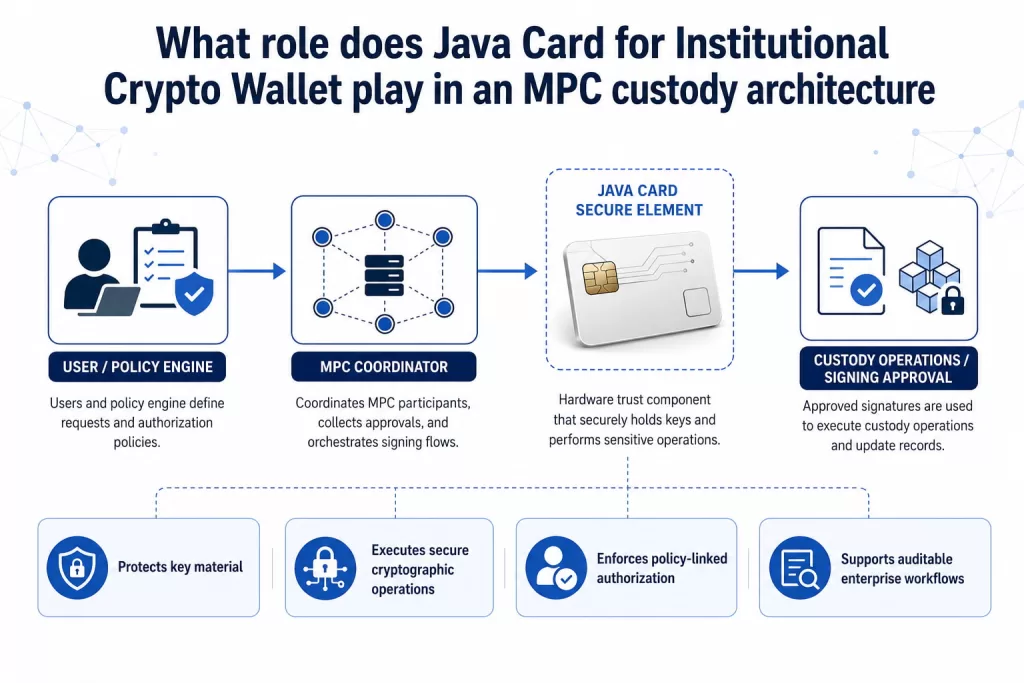
Java Card for institutional crypto wallet complements this architecture by establishing a tamper-resistant hardware security boundary around MPC participants, protected credentials, or transaction approval workflows.
In summary:
Java Card can indeed be integrated with MPC custody solutions, but the integration model must align with the specific MPC protocol and the institution’s security architecture.
What role does Java Card for Institutional Crypto Wallet play in an MPC custody architecture?
Java Card-based cryptocurrency wallets can support institutional-grade custody in three main ways.
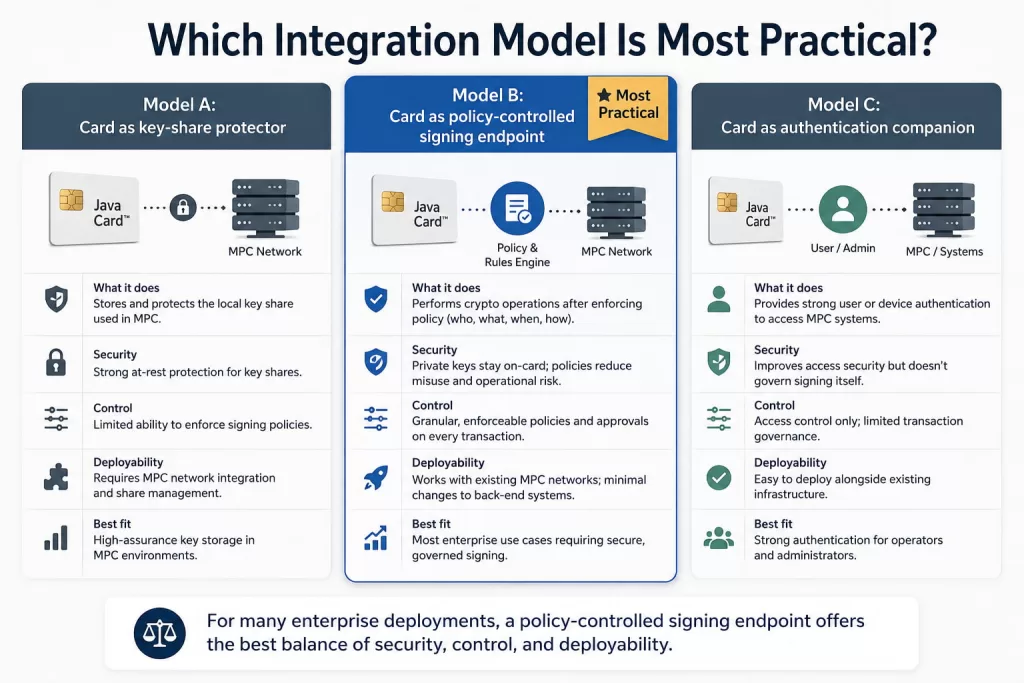
The first and most advanced model involves storing MPC key shares within the Java Card.
Its simplified architecture is as follows:
MPC Share A – Server/HSM
+
MPC Share B – Java Card
↓
Threshold Signature
↓
Blockchain Transaction
In this design, the complete blockchain private key does not need to reside on the Java Card. Instead, the card protects only one share and performs the cryptographic computations required of that participant. Its main advantage is robust hardware isolation. Even if the connected computer is compromised, an attacker cannot directly extract the MPC share from the card. However, this model has high technical implementation requirements. Therefore, the signature support provided by the Java Card standard alone may not meet these needs.
A second, simpler model involves using Java Card to protect access to MPC shards stored in other secure environments.
For example:
Transaction request → Java Card authentication → Activate MPC shards → Perform MPC signature
In this model, Java Card protects the wrapping key, authentication credentials, or authorization keys, rather than directly participating in threshold cryptographic operations.
The third model uses Java Card purely as an authentication factor for institutional transaction approval.
For example:
Create transaction → Policy approval → Authorize employee to use Java Card → Verify approval → Execute MPC signature.
In this model, MPC shards are not stored on the card. Instead, the Java Card serves as a hardware wallet security tool to verify the employee’s identity and physical possession.
For many organizations, this is the easiest model to deploy because it separates transaction authorization from blockchain signing while adding an additional layer of hardware-based approval security.
Which Integration Model Is Most Practical?
These three architectures offer different security features.
| Java Card Role | MPC Share on Card | Complexity | Main Benefit |
| Direct MPC participant | Yes | High | Maximum key-share isolation |
| MPC-share protection | Possibly outside card | Medium | Hardware-controlled activation |
| Transaction approval card | No | Low–Medium | Strong user authorization |
For organizations that develop and host their own infrastructure, direct participation in the MPC process may provide the strongest hardware isolation. However, organizations using existing commercial MPC platforms should first confirm whether the service provider supports custom hardware and participants.
This matters because MPC systems do not follow a unified standard for signature workflows. Different platforms may vary in the following aspects:
- Threshold algorithms;
- Number of participants;
- Signature rounds;
- Recovery mechanisms;
- Server architecture.
Therefore, the most practical deployment approach is typically not to force Java Card integration into the MPC’s core mathematical operations.
Instead, organizations can adopt the following combination:
Use MPC to implement distributed signing;
Use Java Card to implement hardware-based authorization;
Use a policy engine for transaction control.
This architecture enables effective separation of duties while reducing development complexity.
Five Technical Criteria to Verify Before Using Java Card for MPC in Enterprise-Grade Cryptocurrency Wallets
Before selecting Java Card for enterprise-grade custody, DCCO recommends evaluating the following five requirements.
Standard 1: Does the card support the required blockchain algorithms?
Different blockchain networks use different cryptographic algorithms. Common requirements include: ECDSA, secp256k1, EdDSA/Ed25519, and other elliptic curve schemes.
While some Java Cards claim to support ECC, they may not support the specific curves or operations a project requires. Therefore, verify parameters such as curves, key lengths, signature algorithms, scalar and point operations, and secure random number requirements with the manufacturer. This is particularly important for Bitcoin and Ethereum-related applications.
Standard 2: Does the MPC protocol require non-standard cryptographic operations?
Direct participation in MPC may require mathematical operations not exposed by the standard Java Card API. For example, the card may need to support:
- multi-round computations;
- custom curve operations;
- commitment generation;
- protocol-specific precomputations.
In such cases, standard applets may not meet the requirements.
The project may require customized Java Card development, proprietary cryptographic extensions, native security features, etc., and this technical requirement should be clarified during the card selection phase.
Standard 3: Is the expected signing performance within an acceptable range?
Enterprise-level MPC signing processes may involve multiple rounds of communication. When Java Card is directly involved, each round may need to follow the following path:
MPC server → Host → Java Card → Host → MPC server
Compared with pure server-based signing, this may add latency.
For institutional fund transfers or controlled asset transfers, this may be acceptable, as security takes precedence over millisecond-level performance. However, in high-frequency trading environments, this could become a limiting factor. Therefore, evaluate the complete signing workflow rather than relying on a single ECC performance metric.
Standard 4: What Exactly Does the Java Card Authorize?
Protecting key fragments alone is not enough.
Institutions should clearly define which transaction details the Java Card actually authorizes. This may include:
Wallet ID;
Transaction hash;
Destination address;
Asset type;
Transaction amount;
Policy ID.
Without an appropriate transaction-binding mechanism, malware could generate valid signatures for unintended transaction requests. Therefore, for institutional-grade custody, the security architecture must protect both the signing keys and the transaction intent.
Standard 5: How should a lost or damaged Java Card be handled?
Recovery mechanisms are a key requirement in MPC design.
Even if an employee loses a Java Card, the institution must have controlled means to restore signing capability. Viable solutions include:
an MPC threshold mechanism that tolerates the absence of a single participant;
secure encrypted backup shares;
share refresh or redistribution;
issuance of a replacement card;
a formal institutional recovery process.
The Java Card should enhance the MPC model, not introduce a new single point of failure. Therefore, establish recovery plans before issuing the card.
Can a Java Card for institutional crypto wallet be integrated with an MPC custody solution?
Yes. A Java Card for institutional crypto wallet can integrate with an MPC custody solution, but the specific architecture depends on the card’s role.
There are three primary implementation methods:
- Store an MPC key share on the Java Card and have the card participate directly in the threshold signature process.
- Use the Java Card to protect or unlock MPC key shares stored elsewhere.
- Use the Java Card as a standalone hardware authentication factor, while the MPC infrastructure performs blockchain signature operations.
Direct participation in MPC computations provides the strongest key-share isolation but also requires the greatest engineering effort. The Java Card must support the specific cryptographic operations and interaction modes required by the selected MPC protocol.
For many organizations, the third architecture may offer the best balance.