
 Español
  English


The SLE4428 smart card can certainly serve as an access control credential—provided the access control system is compatible with its security model and contact-based operation.
The SLE4428 is not a microprocessor-based smart card with advanced encryption and authentication capabilities, but rather a contact-based card; Its core configuration includes 1 KB of EEPROM storage, irreversible byte-level write protection, and a 2-byte Programmable Security Code (PSC). According to the original technical specifications, its data storage area is organized into a 1024 × 8-bit structure, with each byte equipped with an independent protection bit.
For scenarios such as office environments, hotels, and membership management—where cards primarily store identifiers, access permission levels, or configuration data—these features enable a simple, cost-effective system architecture. Therefore, access control is a suitable application scenario for the SLE4428 contact-based smart card.
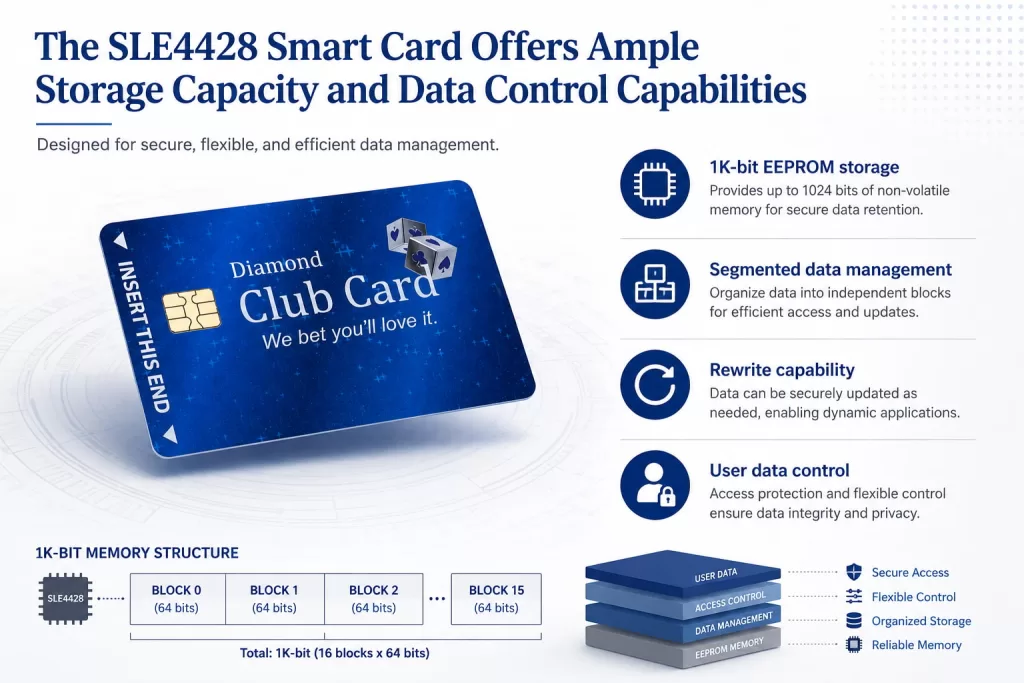
The SLE4428 Smart Card Offers Ample Storage Capacity and Data Control Capabilities
One reason the SLE4428 smart card suits many basic access control applications is its simple, straightforward storage architecture.
The chip provides 1,024 bytes of EEPROM and supports byte-level addressing. As a result, data can be organized into clearly defined fields based on the specific requirements of the access control application. Additionally, the original chip specifications allow for irreversible write protection to be applied to each byte via corresponding protection bits. Once protection is enabled, the data in that byte can no longer be altered.
This feature is particularly useful in closed-loop access control systems, as cards in such systems do not need to run complex software. The card reader reads the required credential data and sends it to the backend access control controller, which then determines whether to grant access.
Irreversible Write Protection Helps Safeguard Fixed Credential Data
For such applications, write protection is one of the SLE4428’s most practical features.
During card personalization, smart card manufacturers or system issuers can write information that must remain unchanged and activate the corresponding protection bits.
Typical examples include:
- Issuer identifier;
- Card serial number information;
- Employee ID number;
- System configuration fields.
This reduces the risk of accidentally altering these values during subsequent use.
However, write protection should never be confused with encryption. Write protection maintains data integrity by preventing modification, but it does not automatically ensure data confidentiality. Distinguishing between the two is crucial when evaluating the card’s overall access-control security performance.
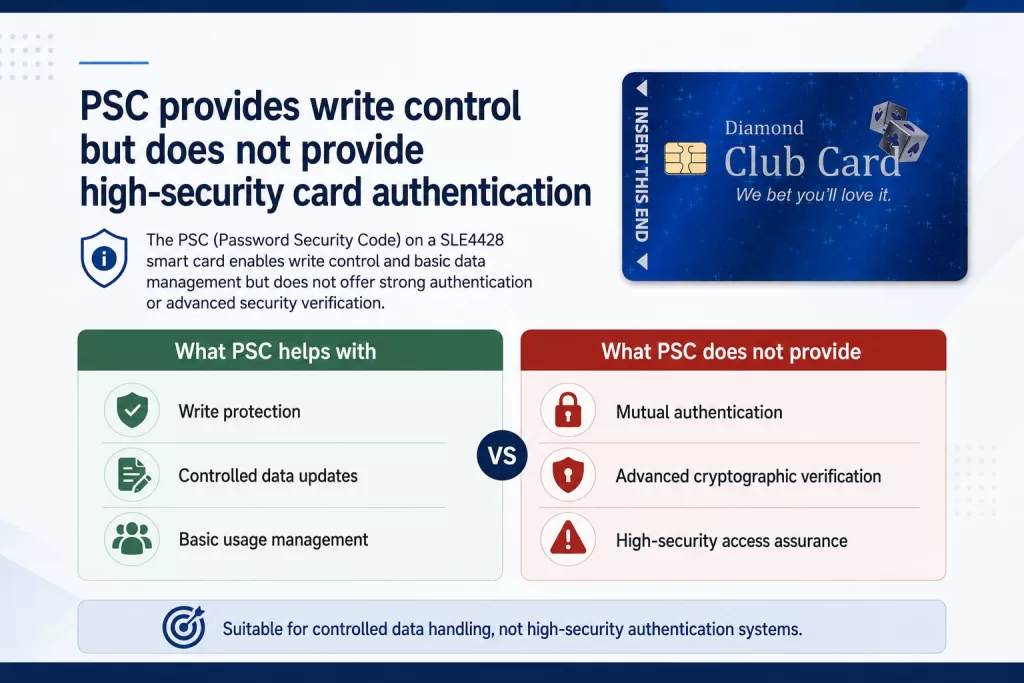
PSC provides write control but does not provide high-security card authentication
The SLE4428 includes a 2-byte Programmable Security Code (PSC).
If the PSC is not successfully validated, the card will not allow normal EEPROM write or erase operations. The original specification also implements an error counter that allows for up to eight validation attempts; once this limit is exceeded, subsequent PSC validations are locked out.
This is very useful for basic access control systems. However, there is a significant limitation that should directly influence chip selection:
The PSC primarily protects the memory from modification; it does not prevent reading the card’s general-purpose data storage area.
The SLE4428 specification stipulates that, apart from the PSC itself, the card’s memory contents can still be read even if the PSC is not entered correctly. Successful PSC authentication enables only EEPROM erase and write functions. This means access control system designers should not store highly sensitive confidential information in the SLE4428’s general-purpose data storage area under the mistaken assumption that the PSC will prevent extraction.
How does this affect access control security?
Consider two different system designs.
System A: Backend-Controlled Access
Card Storage:
Employee ID: 008527
The card reader retrieves this identifier and sends it to a secure access control server. The backend system performs the following checks:
- Whether the credential is valid;
- Which access points are permitted;
- What time restrictions apply;
- Whether the credential has been revoked.
In this architecture, the SLE4428 performs quite well because the card primarily serves as a data carrier, while the backend system retains core control.
System B: High-Security Authentication Relying Solely on the Card
This system requires the card to prove its authenticity through an encrypted “challenge-response” authentication mechanism before granting access. The SLE4428 is not designed for this type of model. It is a secure storage card, not a CPU-based cryptographic smart card.
It lacks the application execution environment and modern cryptographic authentication architecture characteristic of secure microprocessor cards. Therefore, the SLE4428 should not be considered equivalent to Java Card, secure CPU cards, or modern cryptographic access credentials. The security level should be aligned with the threat model.
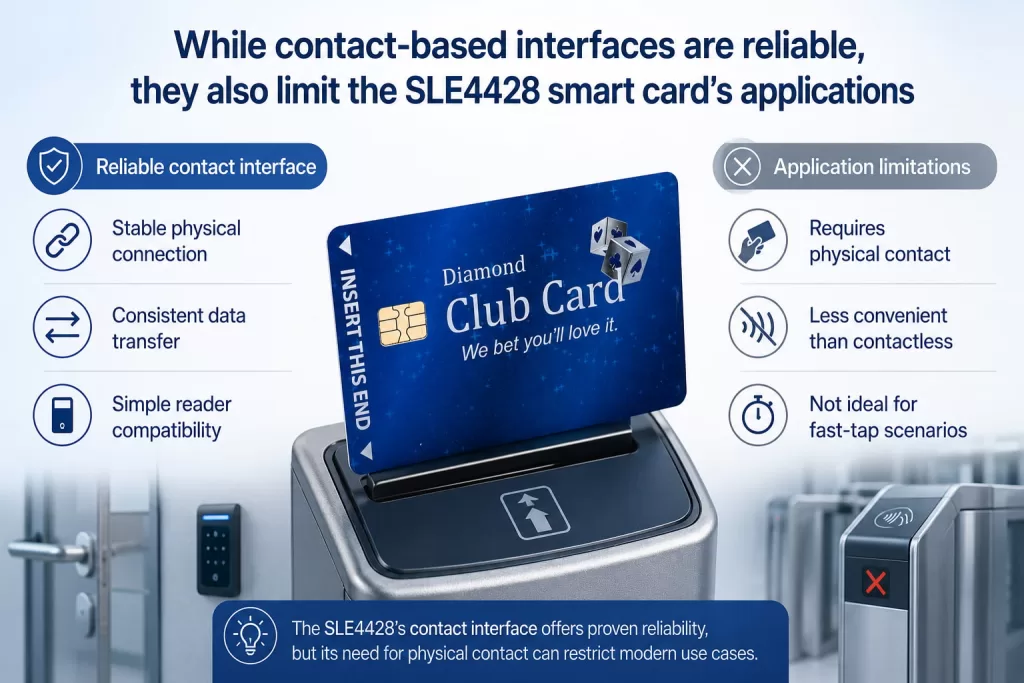
While contact-based interfaces are reliable, they also limit the SLE4428 smart card’s applications
The SLE4428 contact smart card uses a physical contact interface and synchronous serial communication, and is compatible with the ISO/IEC 7816 contact layout standard. Its original specifications define a three-wire serial bus and an ISO 7816-compatible contact configuration.
This directly impacts the user experience in access control systems.
Unlike contactless credential cards, which you can use by holding them near a reader, the SLE4428 card must make physical electrical contact with the terminal. This approach is well-suited for the following application scenarios:
- Hotel room systems using insert-type card readers;
- Device authorization;
- Internal employee terminals;
- Membership management systems;
- Controlled workstation access;
- Existing access control systems equipped with contact-compatible card readers.
In these scenarios, contact-based operation simplifies system integration by eliminating the need for radio frequency (RF) antennas or contactless signal tuning.
Limitations of the SLE4428 Smart Card’s Contact Interface
However, at high-traffic entry points, the insertion process can be inconvenient.
For example, at a building entrance, hundreds of employees may need to pass through in a short period. Compared to requiring each user to insert a card into a reader, contactless credential cards based on感应 technology typically provide a smoother, more natural access experience.
Furthermore, contact-based systems rely on clean and mechanically reliable electrical interfaces. Because both the reader contacts and the card module are physical components, system designers must account for normal wear and tear, contaminants, and ongoing maintenance.
Therefore, SLE4428 cards are generally better suited for environments with moderate user traffic where insert-based operation is acceptable, and existing card readers already support this card type. If fast, contactless access is a core requirement, projects should start with a contactless credential architecture rather than forcing the SLE4428 into scenarios that exceed the original intent of its interface design.
SLE4428 Smart Card for Access Control Systems
Yes—the SLE4428 smart card suits closed-loop access control systems requiring basic to moderate security, particularly where systems already use contact card readers and rely on backend authorization mechanisms.
Its key advantages are clear:
- 1 KB of EEPROM provides ample storage space for identifiers, access categories, and application data;
- Byte-level addressing supports flexible organization of credential data;
- Irreversible write protection ensures that fixed information cannot be tampered with;
- A 2-byte PSC (Programmable Security Code) restricts unauthorized write and erase operations;
- An ISO/IEC 7816-compliant contact interface ensures excellent compatibility with existing contact terminal infrastructure.
These features make the SLE4428 contact chip smart card an ideal solution for access control, hotel key cards, membership systems, and related closed-loop applications.