
 Español
 English



Yes. A government ID Java Card can support digital signatures, healthcare access, and secure login on a single card—provided the selected chip supports the necessary applications, encryption functions, storage capacity, and communication interfaces. The key to this design is structuring these services as collaborating applications that remain independently controlled, rather than merging all functions into a single, unrestricted program.
Java Card technology allows multiple applets to coexist within the same security unit, while the GlobalPlatform standard provides application management and Security Domain isolation capabilities. (Reference: Oracle Java Card Specification)
As a smart card manufacturer, we believe the core design challenge is ensuring each service’s security while assigning appropriate permissions and preventing applications from disclosing sensitive information when working together.
Government ID Java Card Can Support Three Services Through Independent Applications
These three services serve distinct purposes and should not automatically share the same data or authorization rules. Authentication verifies the cardholder’s identity, while digital signatures authorize specific documents or transactions. Healthcare systems use authentication to confirm a person’s identity or eligibility for medical services. Secure login features also verify users’ identities before granting them access to government or institutional systems.
A multi-application Java Card can integrate these functions into a single card, but each application should have clearly defined functions.
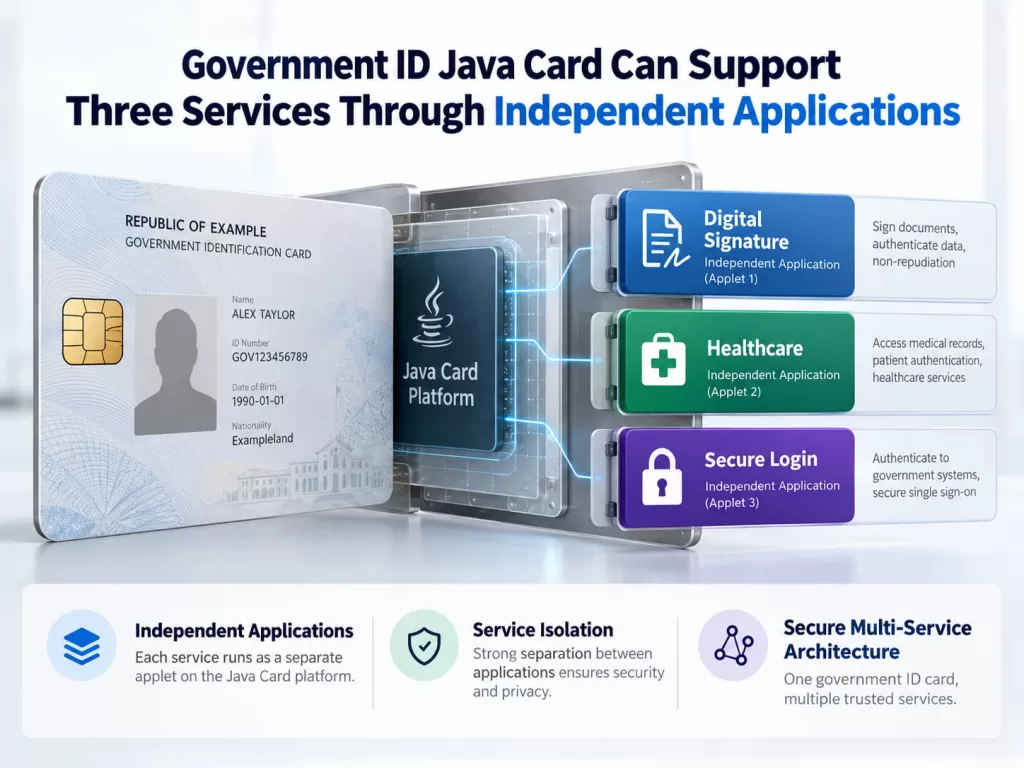
How Do Digital Signatures, Healthcare Access, and Secure Login Coexist?
An architecture for their coexistence might look like this:
| Application | Primary Function | Main Security Requirement |
|---|---|---|
| Identity applet | Verify identity credentials | Controlled access to identity data |
| Digital signature applet | Sign documents or transactions | Protected private keys and appropriate user authorization |
| Healthcare application | Authenticate patients or verify eligibility | Restricted access to healthcare-related credentials |
| Secure login application | Authenticate users to online services | Challenge-response or certificate-based authentication |
The Java Card Runtime Firewall helps isolate individual applets and their data. Unless a sharing mechanism explicitly permits it, one applet typically cannot access another applet’s objects. This mechanism lets multiple applications coexist without automatically granting one service access to another’s sensitive information.
Furthermore, government ID Java Cards do not need to store all medical records. In many deployments, the card stores only credentials or identifiers, while healthcare providers keep detailed medical records in secure backend systems. The Java Card verifies the user’s identity or supports authorized transactions, while the backend system determines which records the user can access.
PIN Authentication and Access Permissions Must Be Aligned with Each Service
Supporting multiple applications is only part of the design. You also need to determine who can perform each operation, under what conditions, and what level of authentication is required.
The risks associated with digital signatures differ from those of conventional identity verification. Similarly, the authorization level required to access a specific healthcare service may differ from that required to access sensitive medical information. Applying a single set of authorization rules uniformly across all services would either compromise security or create unnecessary barriers for users.
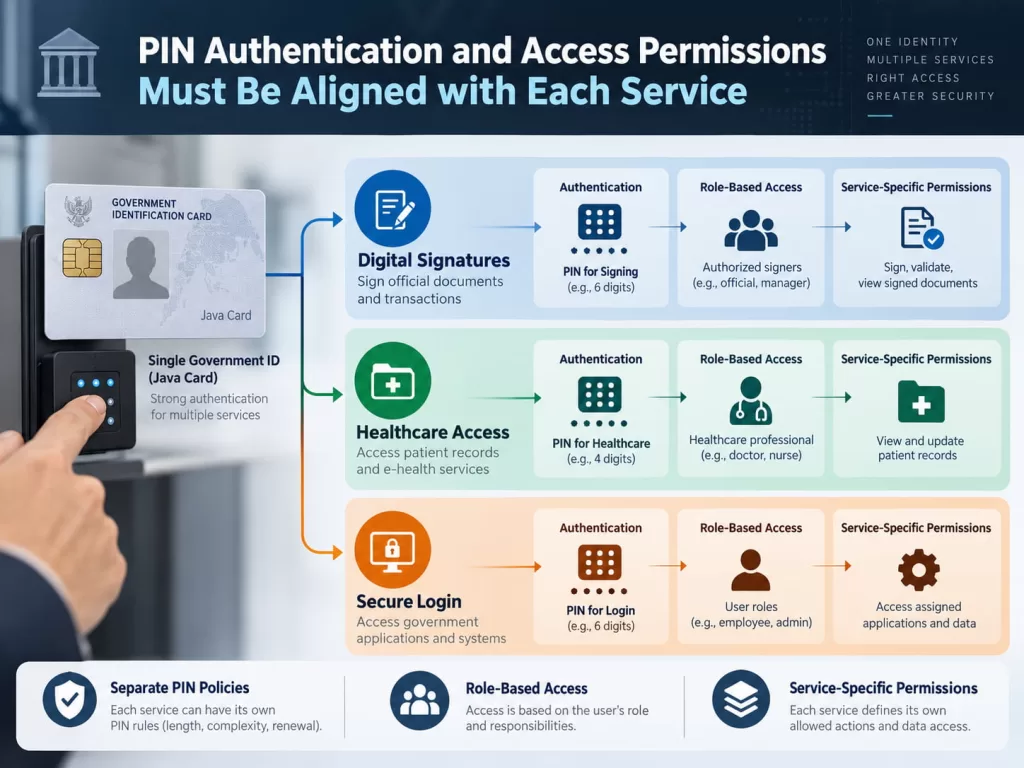
Do Digital Signatures Require Separate PIN Verification?
Not all digital signatures require separate PIN verification, but applications must follow the project’s authentication policies.
For example, government ID cards may require the cardholder to verify their PIN before using the private key. The applet can also limit PIN attempts. If a user enters the wrong PIN too many times, the applet can lock them out of further attempts. Java Card provides mechanisms for implementing PIN verification and related access controls. (Reference: Oracle Java Card Applet Development Guide)
A key distinction is that verifying the cardholder’s identity and authorizing a specific operation are two distinct concepts.
Even if users have already verified their identity through a government portal, they may still need to enter a PIN before signing a document or transaction. This extra step adds another layer of control before the system uses the private key. Specific requirements depend on the applicable legal framework, signature type, card-issuing authority, and system security policies.
What factors must be confirmed before issuing a government ID Java card?
The final decision depends on the overall deployment scenario, not just the number of applets. Although some Java cards may theoretically support multiple applications, they remain unsuitable if they lack the required cryptographic algorithms, storage space, interface configurations, or relevant certifications.
Our portfolio of customized Java Card development solutions covers NXP JCOP, Infineon SECORA/SLE, and various domestic chip platforms to meet different security, regulatory, and application requirements. However, we must select the most suitable platform based on the specific government project’s technical specifications.
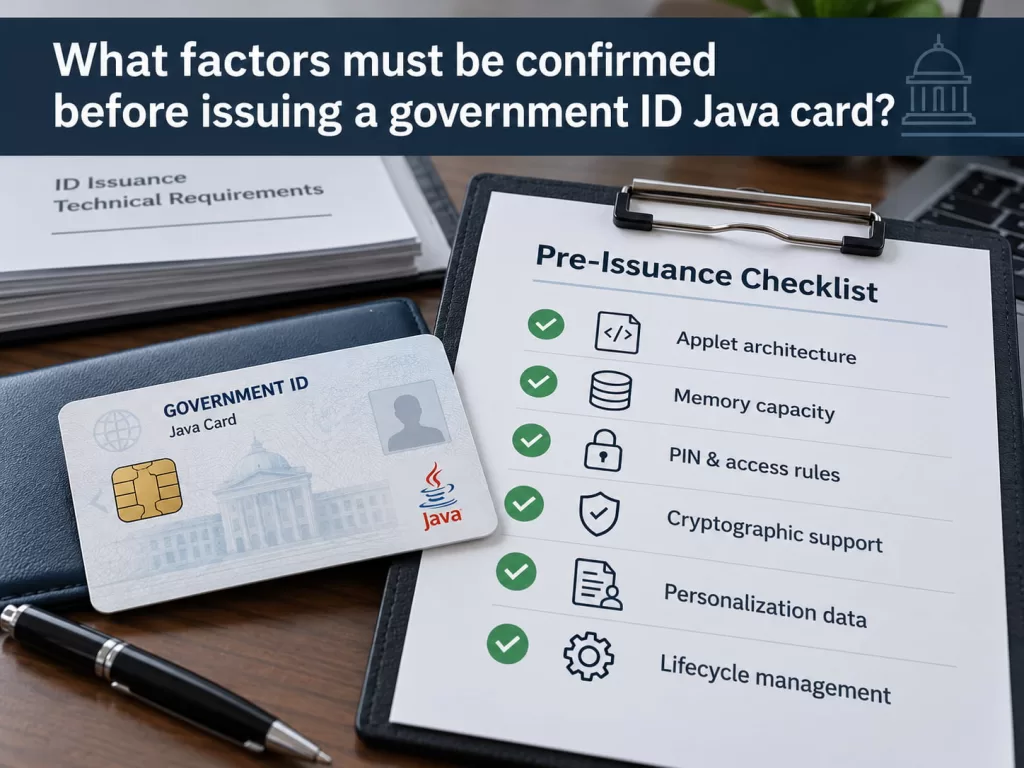
Before going into production, the following items must be verified:
- Storage Capacity: Ensure sufficient persistent storage and runtime memory to accommodate all applications, keys, certificates, and application data.
- Cryptographic Technologies: Support the required signature algorithms, authentication methods, and key lengths.
- Interfaces: Support contact, contactless, or dual-interface operations and be compatible with the intended end devices.
- Application Management: Includes appropriate isolation mechanisms, access rules, and update permissions.
- Testing: Successfully complete functions such as authentication, signature generation, healthcare authentication, and secure login on the target card.
These functions should be tested in conjunction with one another, rather than tested separately as standalone applications. For example, updating a healthcare application should not affect the digital signature function; similarly, a successful login should not give the user unauthorized access to data from other applications.
Government ID Java Card Supporting Multi-Application Operation
When a government Java card’s hardware and software architecture supports multi-application operation, the card can implement multiple functions—such as digital signatures, access to healthcare services, and secure login—on a single medium.
Key requirements include: security independence between applications, authorization mechanisms for specific services, sufficient encryption and storage resources, and end-to-end verification capabilities. By clarifying these requirements before chip selection and applet development, Java card manufacturers can help project teams build government ID cards that support multiple services, ensuring functions such as identity verification, healthcare services, and digital signatures aren’t conflated into a single, unrestricted security permission.