
 Español
  English


The NXP P71 JCOP 4.5 J3R452 Java Card is based on the SmartMX3 P71D600 secure microcontroller platform and runs the JCOP 4.5 operating system. It supports the Java Card 3.0.5 Classic and GlobalPlatform 2.3.1 standards, features contact and contactless interfaces, advanced cryptographic technologies, and PUF-based hardware security features, and provides about 450 KB of application storage. These features make it superior to traditional low-capacity Java Card platforms for projects that require both security and application flexibility. However, that doesn’t necessarily make it the best fit.
For projects requiring only a single, small authentication applet and contact-based communication, a low-capacity Java Card may be sufficient, at a lower cost and with a simpler implementation process. In contrast, projects such as government identity platforms, digital currency wallets, PKI certificates, or multi-application cards are better suited for the J3R452 Java Card.
As a professional smart card manufacturer, we believe that selection decisions should be based on the following five practical criteria:
Required security level;
Application and memory requirements;
Cryptographic technology requirements;
Communication interfaces;
Lifecycle and future scalability.
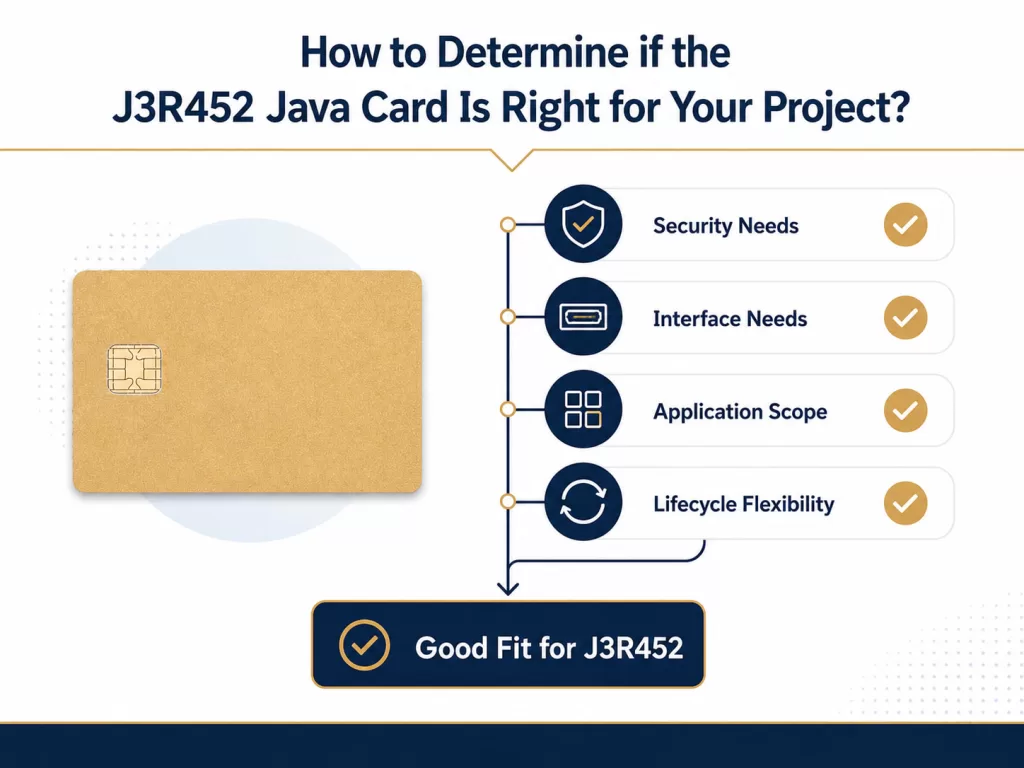
How to Determine if the J3R452 Java Card Is Right for Your Project?
Before comparing specifications, let’s first understand the J3R452’s features. First, understand where the J3R452 fits within the Java Card product family.
It is not merely a high-capacity version of older JCOP cards.
The NXP J3R452 Java Card combines the newer JCOP 4.5 software environment with the P71D600 secure hardware platform. Its architecture supports:
Java Card 3.0.5 Classic;
GlobalPlatform 2.3.1;
SCP01, SCP02, and SCP03 security channels;
Delegated Management;
PUF (Physically Unclonable Function)-based security;
ISO/IEC 7816 contact-based communication;
ISO/IEC 14443 Type A/B contactless communication;
High-capacity application deployment.
NIST’s cryptographic validation records show that JCOP 4.5 running on the P71D600 is an NXP Java Card operating system environment based on the Java Card 3.0.5 and GlobalPlatform specifications, featuring validated RSA and ECDSA implementations. The JCOP 4.5 module has also received FIPS 140-3 Level 3 certification.
This makes the platform particularly well-suited for the following six applications:
- Government identity authentication;
- Financial credentials;
- PKI authentication;
- Digital signatures;
- Digital currency wallets;
- Secure Internet of Things (IoT) authentication;
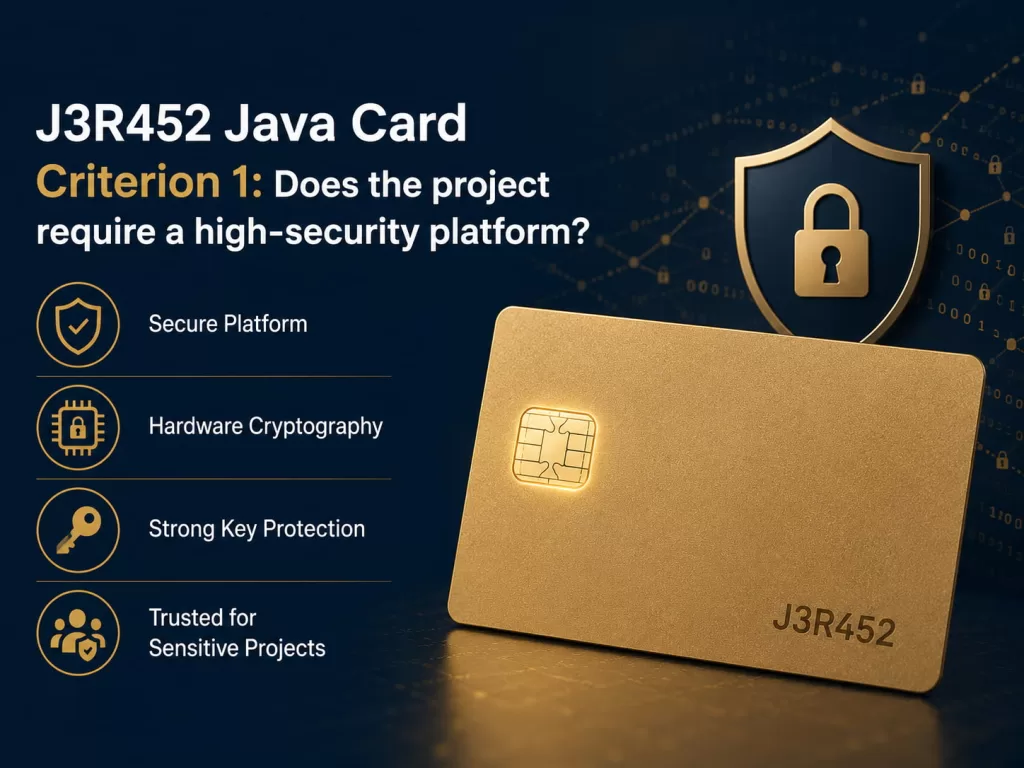
J3R452 Java Card Criterion 1: Does the project require a high-security platform?
Security should be the primary selection criterion, as it determines whether a simpler Java Card platform is sufficient to meet the requirements. The J3R452 platform combines JCOP 4.5 with a variety of security mechanisms, including PUF technology and advanced security application management features. The J3R452 configuration complies with the Common Criteria EAL6+ platform security standard, while the P71D600 JCOP 4.5 cryptographic module has been certified to FIPS 140-3 Level 3.
PUF is particularly important in projects requiring stronger hardware-based identity binding. PUF technology does not rely on stored software identifiers but instead utilizes the chip’s physical characteristics to generate device-specific features. The J3R452 Java Card is a particularly suitable choice when a smart card serves as a security anchor rather than merely a carrier of application data.
Typical use cases include:
Government electronic ID cards (e-ID)
PKI certificates
Digital currency or hardware wallets
Industrial or Internet of Things (IoT) authentication
If an application requires only basic card recognition functionality or runs low-risk, small applets, it is not particularly necessary to choose the J3R452 solely because it offers higher security specifications.
Criterion 2: Do You Really Need About 450 KB of Application Storage?
The second major consideration is application size.
The NXP P71 JCOP 4.5 J3R452 Java Smart Card provides approximately 450 KB of storage space for application deployment. Compared to the 40K, 80K, 150K, or 180K Java Card configurations commonly used in simple deployments, this offers developers significantly more space. This capacity advantage matters most when a single card must support multiple applets.
For example:
| Project Architecture | J3R452 Suitability |
| One small authentication applet | May be excessive |
| PKI + digital signature | Suitable |
| e-ID + PKI + healthcare applet | Highly suitable |
| Payment + identity applications | Highly suitable |
| Large multi-application government card | Strong candidate |
| Future applets expected after issuance | Strong candidate |
The key consideration goes beyond current memory usage. Projects should calculate the sum of the following:
Operating system/application overhead + existing CAP files + certificates/keys + user data + future expansion requirements.
Take a government ID card as an example. Its initial functions might include national identity verification, digital signatures, and PKI authentication.
If the project later adds features such as healthcare credentials, transportation services, social security functions, and physical access control, the additional memory headroom becomes valuable. In contrast, if a customer’s app requires only 30 KB and has no plans for future expansion, choosing a 450 KB platform would leave unused capacity and may not improve the app’s performance.
J3R452 Java Card Criterion 3: Does the project require modern or diverse cryptographic algorithms?
Cryptographic requirements are often the strongest reason to migrate to J3R452.
This platform supports a wide range of modern cryptographic features, including:
- AES-128/192/256;
- RSA up to 4,096 bits;
- ECC up to 521 bits;
- SHA-256/384/512;
- EdDSA using Ed25519;
- and other secure cryptographic features depending on the configuration.
The NIST Validation Database lists certified RSA and ECDSA implementations for JCOP 4.5 on the P71D600. Additionally, including Ed25519 is particularly important for modern digital signature and secure identity applications, as it supports efficient elliptic curve signatures.
Therefore, buyers should clarify their cryptographic configuration requirements before selecting a chip:
| Requirement | J3R452 |
| AES-256 | Suitable |
| RSA-2048 | Suitable |
| RSA-4096 | Suitable |
| ECC-based PKI | Suitable |
| Ed25519 signatures | Suitable |
| Multiple cryptographic schemes on one card | Strong fit |
However, stronger algorithm support is only valuable if it is actually used in applications. If existing card applications are limited to the mature RSA-2048 architecture and there are no plans to migrate algorithms, a lower-performance JCOP card may be sufficient.
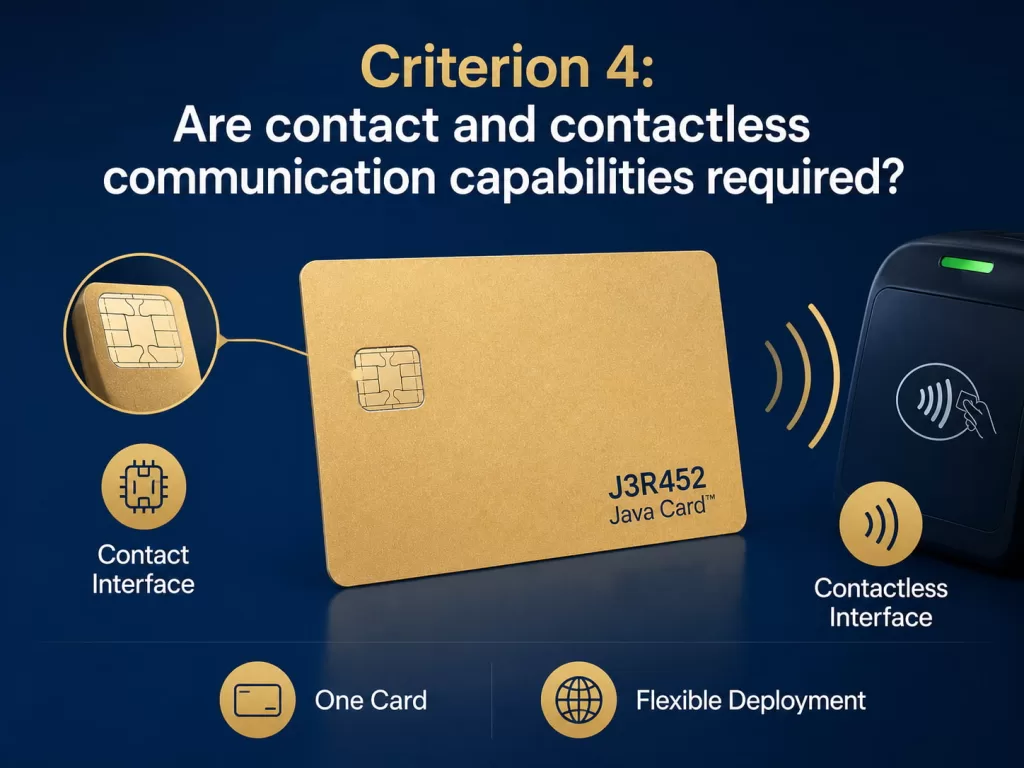
Criterion 4: Are contact and contactless communication capabilities required?
The fourth guideline focuses on practical application needs rather than purely technical aspects.
The J3R452 Java smart card supports both of the following communication methods:
- ISO/IEC 7816 contact communication;
- ISO/IEC 14443 Type A/B contactless communication.
For the J3R452 configuration, the maximum contactless communication rate is 848 kbit/s, and the maximum contact communication rate is 688 kbit/s. This dual-interface architecture enables the J3R452 Java card to adapt to scenarios where a single credential must operate in different terminal environments. For example:
Government ID cards:
The contact interface can support secure desktop operations or administrative management, while contactless communication supports citizen-facing authentication.
Bank cards:
The contact functionality supports traditional payment terminals, while the contactless interface supports “tap-and-go” transactions.
Enterprise credentials:
One interface supports workstation authentication, while the other supports physical access control.
Therefore, the decision-making approach is very clear: applications requiring only contact functionality versus those requiring simultaneous support for both contact and contactless functionality.
Project teams should also note that selecting a dual-interface chip is only one step in the implementation process. The final card requires proper antenna design, RF tuning, contact module integration, reader compatibility testing, and finished card validation. The dual-interface chip alone does not automatically guarantee excellent contactless performance.
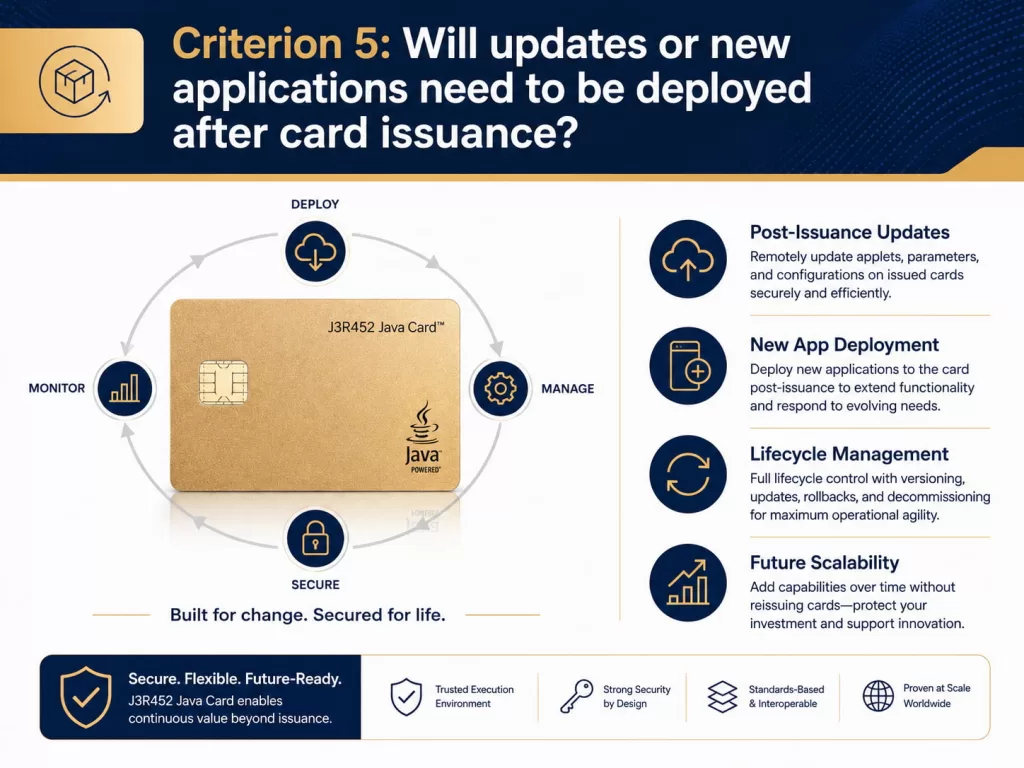
Criterion 5: Will updates or new applications need to be deployed after card issuance?
The fifth guideline pertains to lifecycle management.
This aspect is often overlooked during chip selection. A card’s validity period can last five, eight, or even ten years. During this time, an organization may need to install new microprograms, update existing applications, replace management keys, change application ownership, and so on.
The J3R452 supports all features specified in the GlobalPlatform 2.3.1 standard, including SCP03, delegated management, and advanced application management capabilities. The J3R452 Java card’s lifecycle management capabilities also include the ability to “execute load file upgrades.” This is particularly important for systems involving multiple stakeholders.
The GlobalPlatform management mechanism controls these applications and their associated security domains through an established authorization structure. This means the NXP J3R452 Java card is well suited for projects where functional expansion or evolution is expected after initial card issuance.
Is the J3R452 Java Card Right for Your Project?
When a project requires multiple advanced features at once, the J3R452 Java Card is the ideal choice—not just because it belongs to the newer or higher-capacity JCOP platform series.
Its key advantages include:
JCOP 4.5 architecture;
SmartMX3 P71D600 secure hardware;
Java Card 3.0.5 Classic standard;
GlobalPlatform 2.3.1 standard;
Approximately 450 KB of application storage capacity;
Security mechanisms based on PUF (Physically Unclonable Function);
Support for RSA, ECC, AES, and Ed25519 algorithms;
Support for contact and contactless communication;
Advanced post-issuance application management capabilities.
The five key selection criteria can be summarized as follows:
| Selection Criterion | Choose J3R452 When… |
| 1. Security | The card acts as a high-assurance security anchor |
| 2. Memory | Multiple or large applets require substantial capacity |
| 3. Cryptography | Modern RSA/ECC/Ed25519 or diverse algorithms are needed |
| 4. Interfaces | Contact and contactless operation are both required |
| 5. Lifecycle | Applications or keys may need secure post-issuance management |
Therefore, the most suitable applications for this product include:
National electronic ID cards;
Electronic passports and government identity authentication platforms;
High-end PKI cards;
Digital signature certificates;
Financial smart cards;
Digital currency hardware wallets;
Multi-application government cards.