
 Español
  English


In the contact card, “stability” is not a single metric but typically encompasses four aspects:
read/write reliability, chip durability, long-term platform security, and supply chain reliability.
Infineon’s contact card emphasizes high durability, a 10-year service life, flexible card architecture, and mature technology; its broader range of security controllers emphasizes supply reliability and future-proof security technology. Fudan’s contact card business focuses on a rich and extensive lineup of domestically produced chips, mature market segments, and stable supply capabilities for financial and transportation applications.
The stability of Infineon chips is typically reflected in durability, long product lifespans, and secure architectures. In contrast, the stability of Fudan chips is more evident in market maturity and supply reliability.
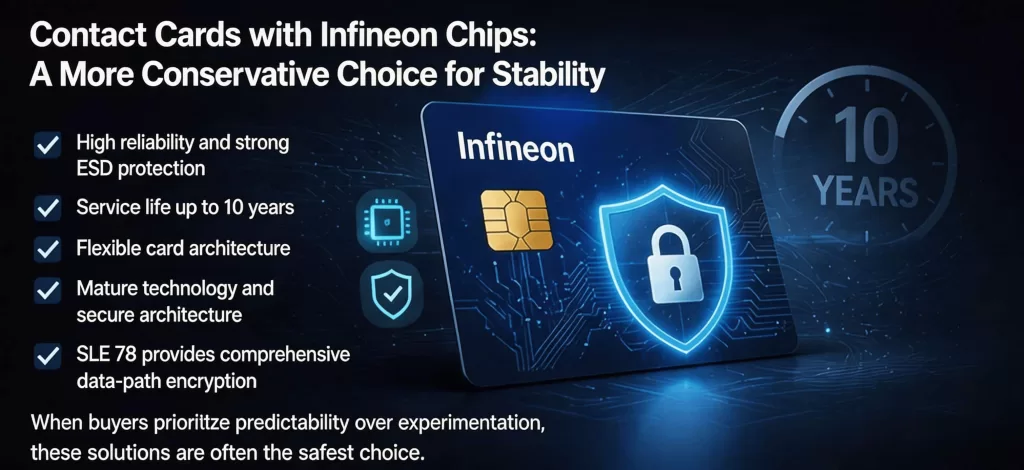
Contact Cards with Infineon Chips: A More Conservative Choice for Stability
Infineon developed its contact-based module portfolio to meet the security and reliability demands of smart cards while helping manufacturers optimize their contact card designs. Key features include high reliability, a service life of up to ten years, flexible card architecture, and mature technology. It offers high reliability, strong ESD protection, mature module manufacturing processes, and a service life of up to ten years.
This is critical because card programs do not fail only when the chip is damaged. Programs can also fail when cards become unstable due to repeated use, inconsistent personalization settings, or excessive pressure from card readers. Infineon’s contact cards are clearly capable of effectively mitigating these risks. For e-passport and e-residence permit applications, Infineon’s SLE 78 provides comprehensive data-path encryption, including CPU-based processing, which adds an extra layer of assurance for the long-term operation of authentication and government applications.
When buyers prioritize predictability over experimentation, these solutions are often the safest choice.
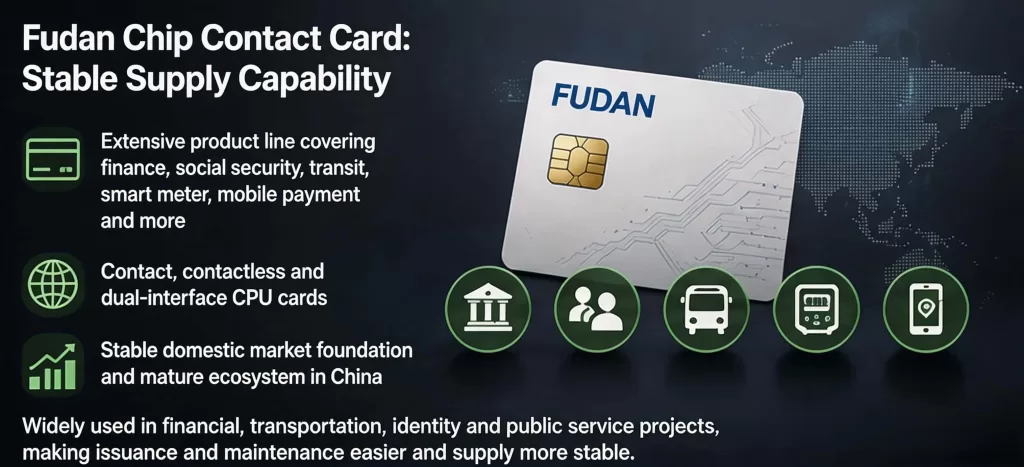
Fudan Chip Contact Card: Stable Supply Capability
Fudan’s smart card business is extensive and mature, with publicly available products and solutions covering bank cards, social security cards, smart transit cards, smart meter solutions, and mobile payment-related products. Its chip series itself encompasses contact, contactless, and dual-interface CPU cards, giving manufacturers greater flexibility when building different types of contact smart card solutions.
The company’s own reports also indicate a stable domestic market foundation in China. From a production standpoint, once a chip series has proven itself in the target ecosystem, manufacturers can scale card projects much more easily and with greater confidence. Fudan’s advantage lies not only in its breadth of products but also in its familiarity with the ecosystem. For domestic financial, transportation, identity verification, and public service projects in China, this makes Fudan’s chip contact cards easier to issue and maintain, and ensures a stable, long-term supply.
What really sets them apart?
Contact cards equipped with Infineon chips prioritize stability through a conservative, engineering-driven approach. They focus on product robustness, lifespan, manufacturing flexibility, and security architecture. The core of these contact cards lies in high reliability, robustness, a service life of up to 10 years, and field-proven quality.
Fudan’s stability is more market-driven. Its strength comes from extensive deployment across well-established application scenarios in China and from years of continuous use in sectors such as finance, social security, and transportation. Their chip series is not only technically suitable but also operationally sustainable in real-world issuance projects.
In contact smart cards with Infineon chips, “stability” typically refers to greater hardware durability and more conservative security policies. In contrast, for contact smart cards using Fudan chips, “stability” generally implies greater confidence in local supply and broader alignment with the Chinese market.
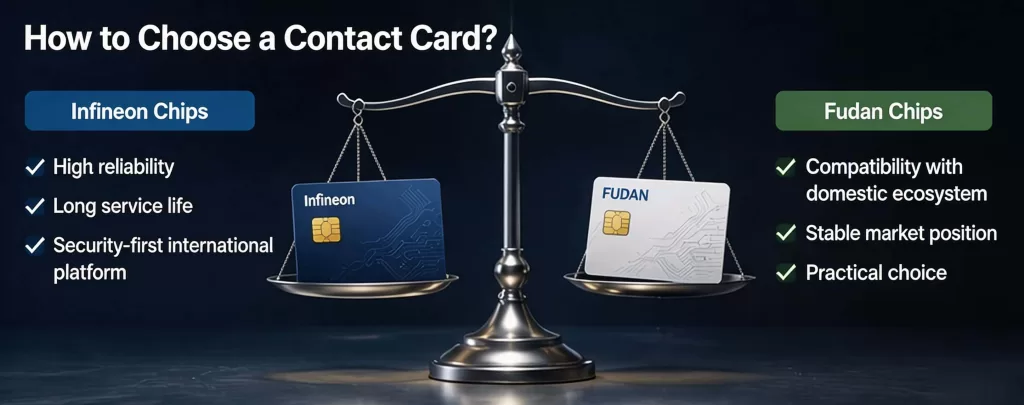
How to Choose a Contact Card?
When making a selection, the key is not which chip is better, but which chip can ensure the stability of the entire process—from customization and testing to packaging, shipping, and daily on-site use. Contact cards equipped with Infineon chips are clearly designed to support flexible manufacturing and a secure supply chain, while offering long service life and high-yield reliability in use.
Fudan’s advantage lies in its chips being widely adopted in numerous mature projects across China. Stable products are easier to procure and validate, and they align more readily with local deployment practices. When organizations have already deployed a card series across applications such as bank cards, social security cards, transit cards, and access control systems, manufacturers can leverage proven operating models, streamline implementation, and reduce overall project risk.
When making a selection:
- If high reliability, long service life, and a security-first international platform are the top priorities, then Infineon chips are typically the better choice.
- If compatibility with the domestic ecosystem and a stable market position are the top priorities, then contact cards using Fudan chips are typically the more practical choice.
Different Strengths in Stability
Both contact cards, manufactured with Infineon and Fudan chips, remain stable, but their strengths lie in different areas. Infineon chips excel in robustness, service life, and security architecture. Fudan chips, on the other hand, offer advantages in compatibility with the local ecosystem, mature application coverage, and stable supply in sectors such as finance, transportation, and social security.