
 English
  Español


The 125 kHz RFID card remains one of the most widely used low-frequency cards today, offering organizations a fast, stable, and easily deployable method for the proximity identification of individuals or objects. Furthermore, it boasts rapid read speeds, performs exceptionally well in controlled-access environments, and can be deployed at scale without a complex technical ecosystem.
This is the true reason why 125 kHz RFID cards continue to feature prominently in high-security projects. Security systems do not always require the most technologically advanced cards on paper; rather, they require cards best suited to the operational environment. For many access control, time and attendance, parking, and identity verification systems, low-frequency cards provide precisely the range, simplicity, and convenience required. They avoid unnecessary complexity while ensuring reliability in day-to-day operations.
125 kHz RFID Card in Real-World Deployment
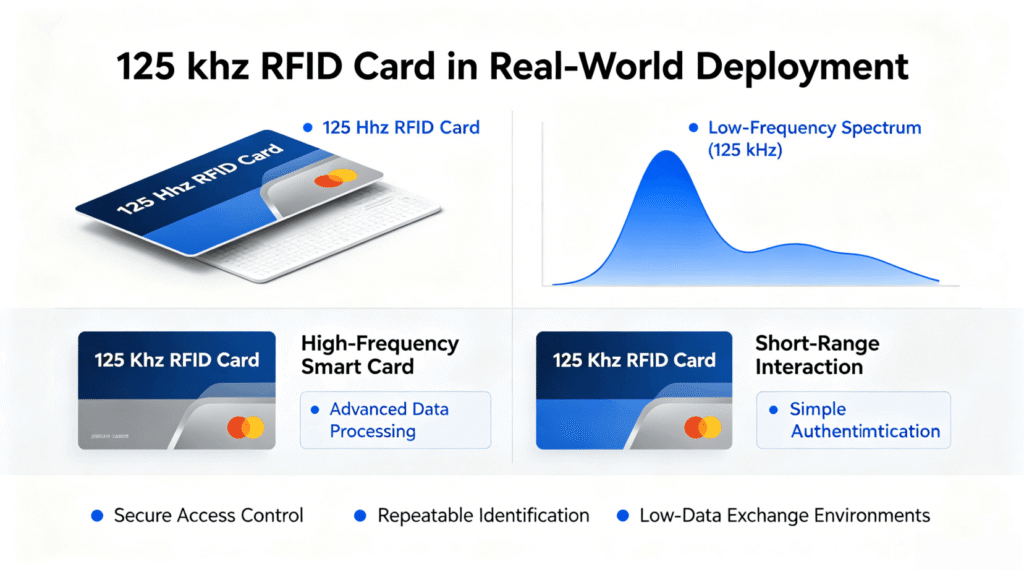
125 kHz RFID cards operate within the low-frequency spectrum and are typically utilized for proximity identification. Unlike high-frequency smart cards, which may support more advanced data processing, 125 kHz cards are specifically designed for short-range interactions and simple authentication tasks; consequently, they are particularly well-suited for scenarios where the primary requirements are secure, repeatable identification rather than the exchange of large volumes of data.
In practice, a card reader powers the card when it comes within a certain range; the card then transmits its unique identifier back to the system. This mode of interaction is straightforward to understand, facilitating both troubleshooting and maintenance. For organizations managing a large volume of users or access points, this simplicity is paramount, as it significantly reduces operational uncertainty.
Why Are 125 kHz Cards So Stable?
The stability of 125 kHz RFID cards is one of the most significant factors driving their widespread adoption. Low-frequency communication is generally less sensitive to minor misalignments in orientation, ensuring consistent performance even when users cannot position their cards perfectly against the reader every time. This is a crucial advantage, as real-world users often approach card readers under less-than-ideal conditions. The 125 kHz card meets this specific need head-on, delivering an excellent user experience, minimizing read failures, and offering exceptional stability.
Cost, Deployment, and Lifecycle Advantages of 125 kHz RFID Card
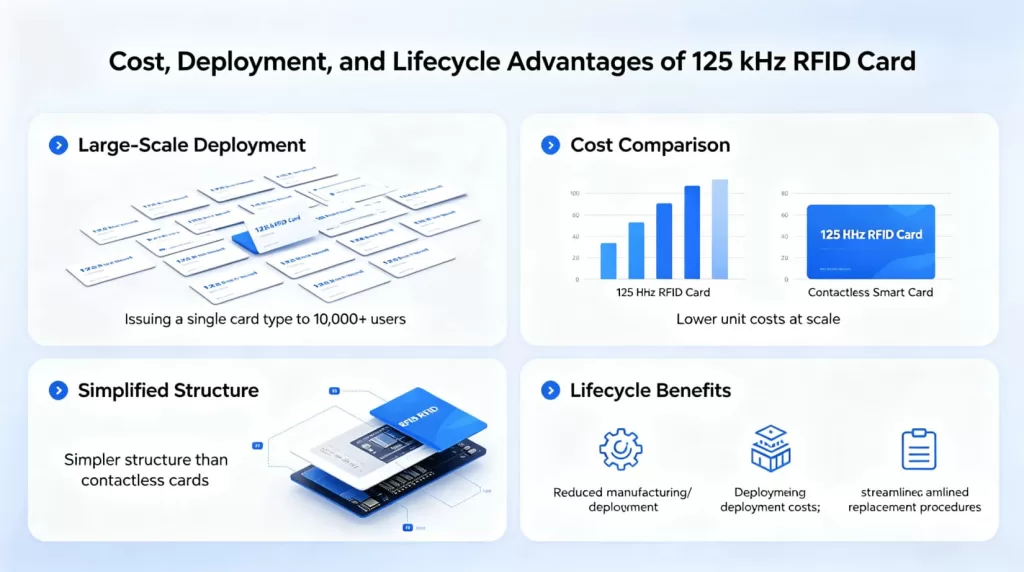
Another primary reason for the widespread adoption of 125 kHz RFID cards lies in their cost-effectiveness. In large-scale deployments, organizations may issue a single card type to thousands—or even hundreds of thousands—of individual users. At this scale, distinct differences emerge regarding unit costs, customization options, and card replacement procedures. The structure of 125 kHz cards is typically simpler than that of contactless smart cards. This helps reduce both manufacturing and deployment costs while still meeting the application’s core requirements.
The deployment process for low-frequency cards is generally easier than that of their more complex alternatives. The system uses a straightforward architecture, reader requirements stay clearly defined, and the cards behave in a highly predictable way. This makes pilot projects easier to test and full-scale rollouts easier to manage. This ease of deployment also reduces the likelihood of integration delays. Both the product and security teams can operate within a clear operational model. This minimizes friction and shortens the path from initial planning to actual implementation.
125 kHz Cards: The Preferred Low-Frequency Choice in These Industries
Enterprise access control systems are among the best examples of the value offered by 125 kHz cards. Office environments require credentials that activate quickly at entry points, are easy to issue to employees and visitors, and can be centrally managed by security teams. 125 kHz RFID cards fit these requirements perfectly. They are also convenient for employees to use daily. This is a crucial point; even if a credential is technically sound, if it is inconvenient to use, it will ultimately lead to user frustration. Low-frequency cards effectively avoid this issue.
Hospitality, Property Management, and Parking:
Hotels, residential communities, and parking systems also benefit from the short-range and user-friendly characteristics of 125 kHz cards. These environments typically require high turnover rates, streamlined onboarding processes, and reliable performance in daily use. Low-frequency cards are ideally suited to meet these demands. In these sectors, cards are often issued to temporary users, residents, visitors, staff, or seasonal workers. The simplicity of 125 kHz RFID cards makes these workflows significantly easier to manage.
Industrial and Operational Environments:
Factories, warehouses, and industrial sites typically prioritize robust and reliable identity credentials. The key advantage of 125 kHz cards in these settings is their ability to facilitate controlled access and rapid authentication without overcomplicating the system.
The Most Widely Adopted Low-Frequency Card
125 kHz RFID cards remain the most widely adopted type of low-frequency card because they address real-world challenges with a practical, proven approach. It offers a host of advantages, including short-range identification, stable user interaction, ease of deployment, and low lifecycle costs. For high-security projects that prioritize access control over complex smart card functionality, it strikes the perfect balance between simplicity and reliability. 125 kHz cards deliver a dependable, proximity-based RFID experience—making them ideally suited for access control, time and attendance systems, parking management, hospitality, industrial facilities, and other operational environments where consistency is paramount.