
 English
  Español


For banks, payment service providers, and card issuers, selecting the right security element is one of the most important decisions when developing EMV debit or credit card programs. The chosen chip must not only support secure payment applications but also deliver reliable performance throughout the card’s entire lifecycle. The J3R150 Java Card is a secure Java Card platform that enables card manufacturers and issuers to develop EMV-compliant payment cards featuring robust security, flexible application management, and reliable long-term performance.
Unlike traditional fixed-function chips, the Java Card platform allows developers to deploy secure payment applications within a standardized environment. This provides financial institutions with greater flexibility in managing payment applications, authentication services, and future service expansions.
The Role of the J3R150 Java Card in EMV Payment Card Issuance
An EMV debit or credit card is more than just a physical card with embedded hardware; it is a secure payment platform that combines the following technologies:
- Secure chip technology;
- Payment applications;
- Encryption keys;
- Cardholder data;
- Issuer configuration;
- Transaction security mechanisms.
The J3R150 Java Card provides a secure foundation for operating these key functions.
Traditional payment cards are designed for fixed use cases. However, modern financial services increasingly demand flexibility. Banks may need to offer a variety of payment applications, additional authentication services, loyalty programs, digital identity features, and future financial services. The Java Card platform provides the flexibility required to meet these evolving needs. Developers do not need to design an entirely new chip architecture for each application; instead, they can deploy secure applets within the Java Card environment.
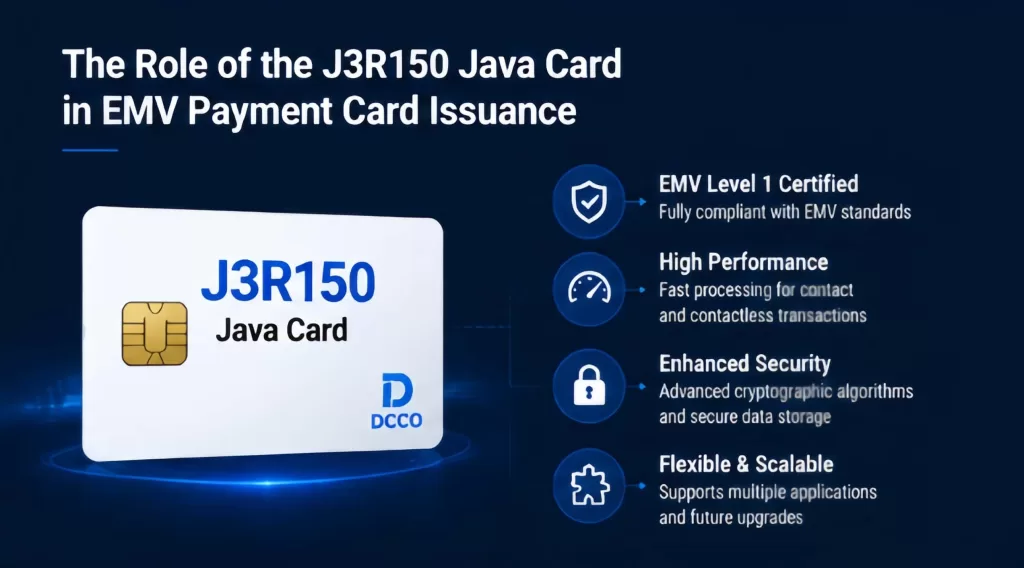
The J3R150 Card as a Secure Payment Platform
The primary role of the J3R150 card in an EMV environment is to provide a secure execution environment for payment applications. During payment transactions, the bank card must securely handle transaction authentication, cryptographic computations, application processing, and secure data storage.
The J3R150 Java smart card supports these operations by providing a dedicated hardware environment where sensitive payment functions can be executed securely. This separation of secure card operations from external systems reduces the risk of unauthorized access and helps protect critical financial information.
Supporting the Requirements of Modern EMV Card Projects
A successful EMV card project must consider the entire product lifecycle. The J3R150 Java Card supports this lifecycle in the following ways:
- Application Deployment:
Payment applications can be securely loaded into the Java Card environment. - Personalization:
Each card can be configured with unique customer information and cryptographic credentials. - Secure Operation:
The card protects sensitive data while processing transactions. - Lifecycle Management:
Card issuers can manage applications and security features throughout the card’s entire lifespan.
This lifecycle-oriented approach makes the J3R150 Java smart card ideal for financial institutions requiring reliable, long-term payment solutions.
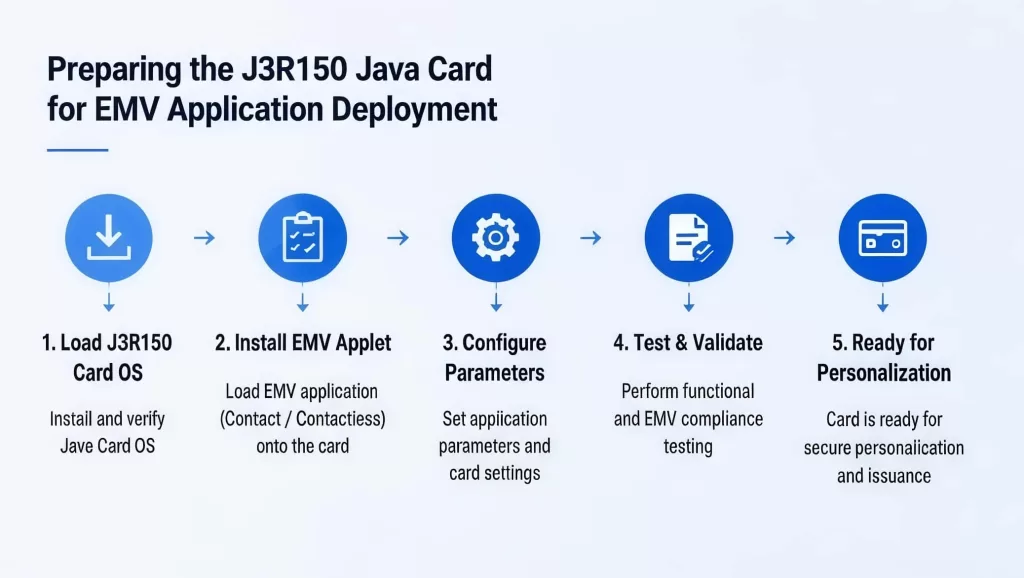
Preparing the J3R150 Java Card for EMV Application Deployment
Deploying Java cards for EMV payment issuance requires thorough preparation before production begins. Professional Java card manufacturers typically follow a structured process to ensure that the selected chip, application software, security configuration, and production environment work together correctly.
Defining EMV Payment Application Requirements
The first step is to understand the specific requirements of the payment project. Different card issuers may have varying needs depending on their payment ecosystems. Typical requirements include debit card issuance; credit card issuance; support for contact-based payments; support for contactless payments; dual-interface card development; and other secure applications.
These requirements determine how the J3R150 card is configured.
For example, a basic debit card project may require only a standard payment application, while an advanced bank card may require support for multiple applications, enhanced authentication, loyalty program integration, digital identity features, and other additional functionalities. Clarifying these requirements early on helps avoid unnecessary redesigns during later production stages.
Setting Up the Java Card Application Environment
The next step is to prepare the Java Card application environment. A typical EMV deployment process includes:
- Developing or integrating payment applets;
- Loading the application onto the Java Card platform;
- Configuring application parameters;
- Establishing secure communication channels;
- Testing application behavior.
The J3R150 Java Smart Card provides the necessary secure environment for these operations. The application loading process must follow strict security procedures to ensure that only authorized software is installed on the card.
Configuring Secure Application Management
Financial cards require strict control over the installation and management of applications. The Java Card architecture supports controlled management of the application lifecycle, including:
- Application installation;
- Application activation;
- Application updates;
- Secure deletion;
- Access control.
This capability is particularly valuable for large-scale banking projects, as payment products typically need to remain in operation for many years. Cards issued today may need to support future service enhancements without requiring a complete replacement. The J3R150 Java Card provides the foundation for this long-term application management strategy.
Secure Key Management and Personalization Processes
Once the Java Card application has been deployed, the next critical step is to prepare the J3R150 Java Card for actual financial transactions. Unlike ordinary identification documents, EMV debit and credit cards require a highly secure personalization process, as each card contains unique payment credentials and encrypted information.
From the perspective of a professional Java Card manufacturer, personalization is more than just printing cardholder information on the card’s surface. It is a highly controlled security process that transforms a blank J3R150 card into a valid payment credential.
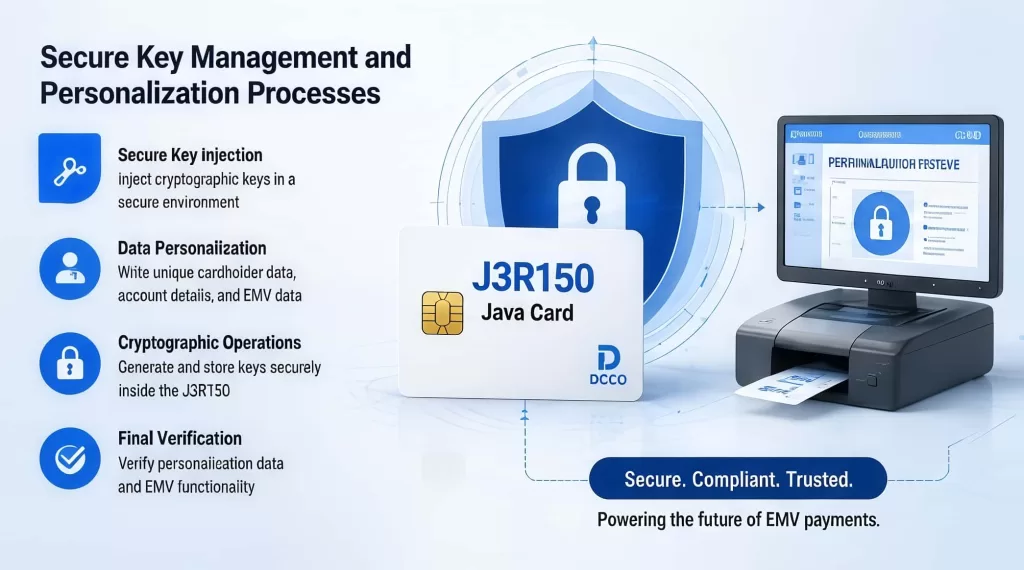
Secure Key Provisioning to Protect Payment Credentials
Encryption keys form the foundation of EMV transaction security. During the card issuance process, the J3R150 Java smart card must receive unique security credentials to authenticate transactions and communicate securely with payment networks. Key management typically involves:
- Generating secure encryption keys;
- Transmitting keys via secure channels;
- Injecting keys into the card;
- Verifying successful key installation;
- Enforcing strict access controls.
Professional manufacturers must ensure that sensitive components are not exposed during the production process. This requires securing the production environment; managing authorized personnel; implementing encrypted communication systems; and enforcing strict process monitoring. For financial projects, the security of the key injection process directly determines the reliability of the final payment card.
Personalizing J3R150 Cards for Individual Cardholders
Every EMV payment card must be personalized before it is delivered to the customer. The personalization process configures unique information for each J3R150 card, including cardholder information, account-related data, payment application parameters, issuer configuration, and security credentials. Although each card is produced using the same chip platform, personalization creates a unique payment identity for each card. This capability enables banks and financial institutions to issue millions of secure cards while maintaining individual control over each credential.
Secure Data Management During the Personalization Process
Professional Java Card manufacturers must carefully manage sensitive data throughout the personalization process. Key factors to consider include:
Data Protection:
Cardholder and payment data must be protected at all times during transmission and processing.
Production Traceability:
Each card should have a complete production record for quality management and security audits.
Access Control:
Only authorized systems and personnel may access sensitive information.
Verification:
Manufacturers must verify that every personalized card functions properly before shipment. This comprehensive approach ensures that every J3R150 Java Card delivered to customers meets strict financial security requirements.
A Comprehensive Approach to Deploying J3R150 Java Cards
Deploying J3R150 Java cards for EMV debit and credit card issuance requires a comprehensive approach that combines secure chip technology, application development, personalization, manufacturing expertise, and rigorous quality management. While the chip itself provides a secure foundation, the successful deployment of payment cards depends on the efficient management of the entire ecosystem.
As a professional Java card manufacturer, we carefully coordinate every stage of the process, including:
- Requirements analysis;
- Java Card application deployment;
- Secure key management;
- Card personalization;
- EMV testing;
- Manufacturing;
- Quality control;
- Mass delivery.
The J3R150 Java smart card provides financial institutions with a flexible and secure platform for developing modern payment cards.