
 English
  Español


Offline digital currency transactions place extremely high demands on the smart card itself. Unlike standard online payment processes, these transactions cannot rely on remote authorization servers during use. The card must make security decisions locally. It must protect the stored funds, verify transaction logic, enforce security rules, and resist cloning or tampering even when the network is unavailable. While traditional smart cards may support identity authentication or simple access functions, the Jcop4 J3R200 card is designed to provide a higher level of security.
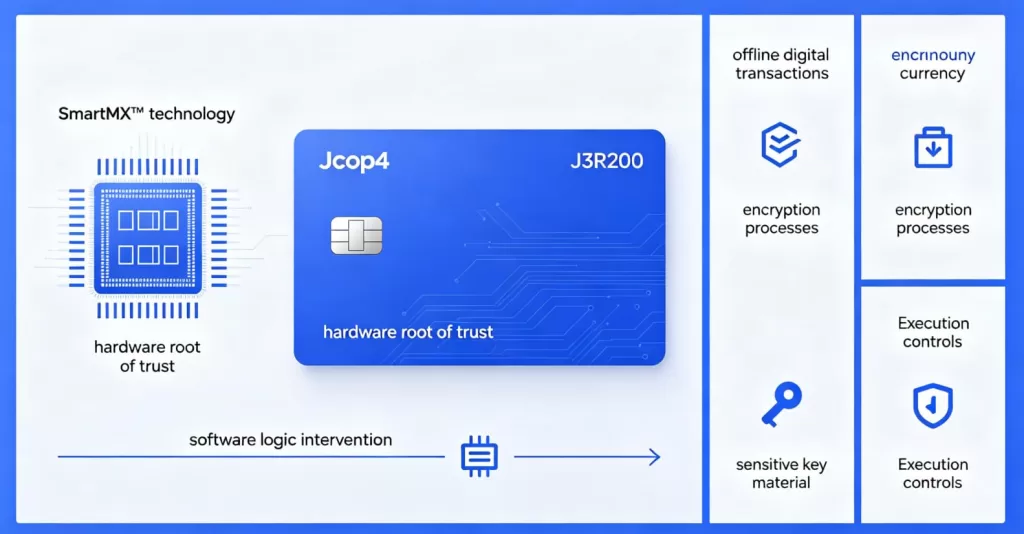
The Jcop4 J3R200 card is suitable for offline digital currency transactions due to its hardware root of trust. SmartMX™ technology enables secure operations at the chip level, meaning that encryption processes, sensitive key material, and execution controls are protected before software logic intervenes.
How does the Jcop4 J3R200 card differ from a standard Java card?
The difference lies in the platform implementation, authentication, and management methods. The Jcop4 J3R200 card is built on JavaCard 3.0.5 and GlobalPlatform 2.3, both of which support standardized applet management, secure lifecycle control, and application isolation required for high-value deployments.
JavaCard 3.0.5 provides developers with a mature environment for building secure applets that execute within the card without exposing sensitive logic to the outside. In offline digital currency scenarios, the Jcop4 J3R200 card can directly host application logic for value processing, balance verification, transaction counting, and security checks within its secure boundary. GlobalPlatform 2.3 adds another layer of operational control by defining how organizations load, update, personalize, and manage applications throughout the card’s entire lifecycle.
Dual-Interface Design Enables Practical Payments
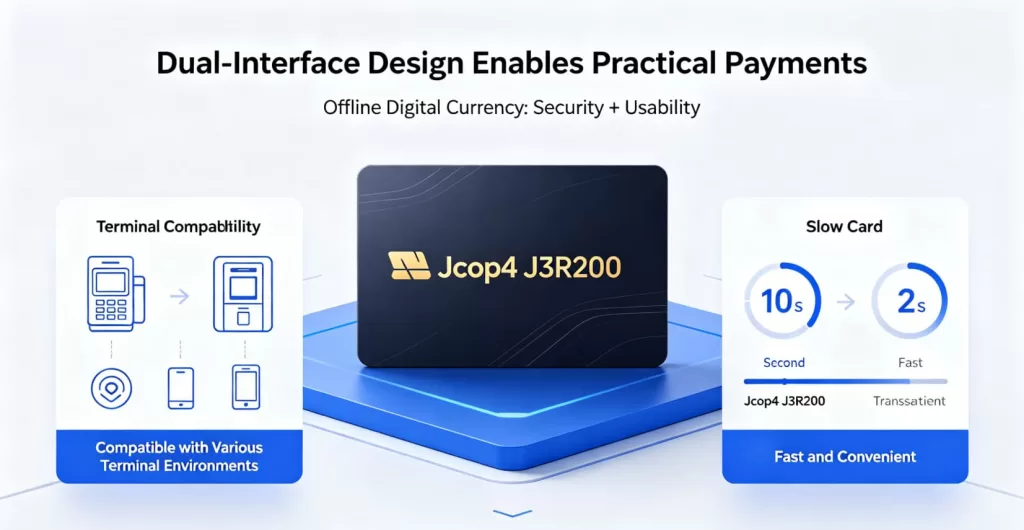
Offline digital currency is not only about security but also about usability. Even if a card is secure, it cannot gain a foothold in the market if it is slow, inconvenient to use, or incompatible with various terminal environments. The Jcop4 J3R200 card solves this problem through dual-interface communication.
It supports both contact-based communication compliant with the ISO/IEC 7816 standard and contactless communication compliant with the ISO/IEC 14443 Type A/B standard, enabling flexible deployment across various payment and identity infrastructure environments.
For offline digital currency transactions, contactless operation is particularly important. Users expect to complete transactions instantly with a single tap. Therefore, the J3R200 card supports high-efficiency contactless communication speeds of up to 848 kbit/s and up to 3.2 Mbit/s in VHBR mode. This directly enhances the user experience in high-throughput environments, such as public transportation systems, crowded retail locations, or integrated campus payment networks.
Support for Offline Transaction Mode
Many people believe that digital currencies are only useful when connected to the internet. In reality, however, some of the most practical applications are precisely those that can function normally even when the network is unavailable, unstable, or intentionally limited. This is the core logic behind offline digital currency transactions. They require the ability to securely store value on a card, verify transactions locally, and maintain integrity until subsequent synchronization or settlement.
The Jcop4 J3R200 card supports this operating model because its designers built it from the ground up to manage trust-related functions directly on the device. Offline value transfer requires the simultaneous fulfillment of multiple conditions: secure value storage, transaction authentication, anti-rollback logic, replay protection, and strict balance update rules. If any one of these links is weak, the entire model becomes vulnerable. Therefore, the J3R200 Java smart card, designed specifically for offline currency transactions, not only protects data but also safeguards the sequence and logic of every transaction.
Secure Storage and Local Decision-Making
In offline scenarios, the card typically serves as the direct source of information. This means the system must protect stored values from unauthorized access, reading, or modification. The J3R200 card’s secure controller architecture helps ensure that sensitive data remains protected while transaction logic runs in a secure environment. This enables the card to function as a trusted repository of value, rather than a passive record.
Risk Control Without Real-Time Network Verification
Offline transactions also rely on intelligent risk control. Because the system doesn’t require online authorization during use, the card and terminal must actively enforce rules such as transaction limits, balance thresholds, and usage counters. This is where the stability of the Jcop4 J3R200 card comes into play. A well-structured security platform can consistently enforce local rules, reducing the risk of fraud while providing convenience for users. This is the fundamental reason why the card supports offline digital currency transactions.
The Jcop4 J3R200 Card Brings Security to Offline Digital Currency Transactions
The Jcop4 J3R200 card supports offline digital currency transactions because its architecture is specifically designed to satisfy the trust requirements that these transactions demand. It combines the SmartMX™ security controller architecture, JavaCard 3.0.5, and GlobalPlatform 2.3, thereby providing the hardware protection, application control, and lifecycle management required for high-security use cases. Its dual-interface design makes it highly practical for real-world applications. It supports both contact-based payments compliant with the ISO/IEC 7816 standard and contactless payments compliant with the ISO/IEC 14443 Type A/B standard, enabling compatibility with both traditional and modern infrastructure.