
 English
  Español


In large-scale citizen ID card projects involving hundreds of thousands of cards, the cards’ functionality goes far beyond verifying a single citizen’s identity. Each card must have consistent security features, interact with a wide range of card readers, protect keys and identity data throughout a service life spanning several years, support controlled personalization, and remain flexible enough to adapt to future public service needs. For this reason, the most critical Java Card features for large-scale citizen ID projects are not merely processor speed or storage capacity. Rather, the following elements are essential:
Hardware-level security;
Robust cryptographic capabilities;
Applet isolation mechanisms;
Secure lifecycle management;
Adequate application storage space;
Contact and contactless interoperability;
Long-term platform stability.
Beyond meeting these requirements, selecting the right Java Card for citizen identification must be based on a comprehensive ID system architecture, not simply on the card with the largest storage capacity.
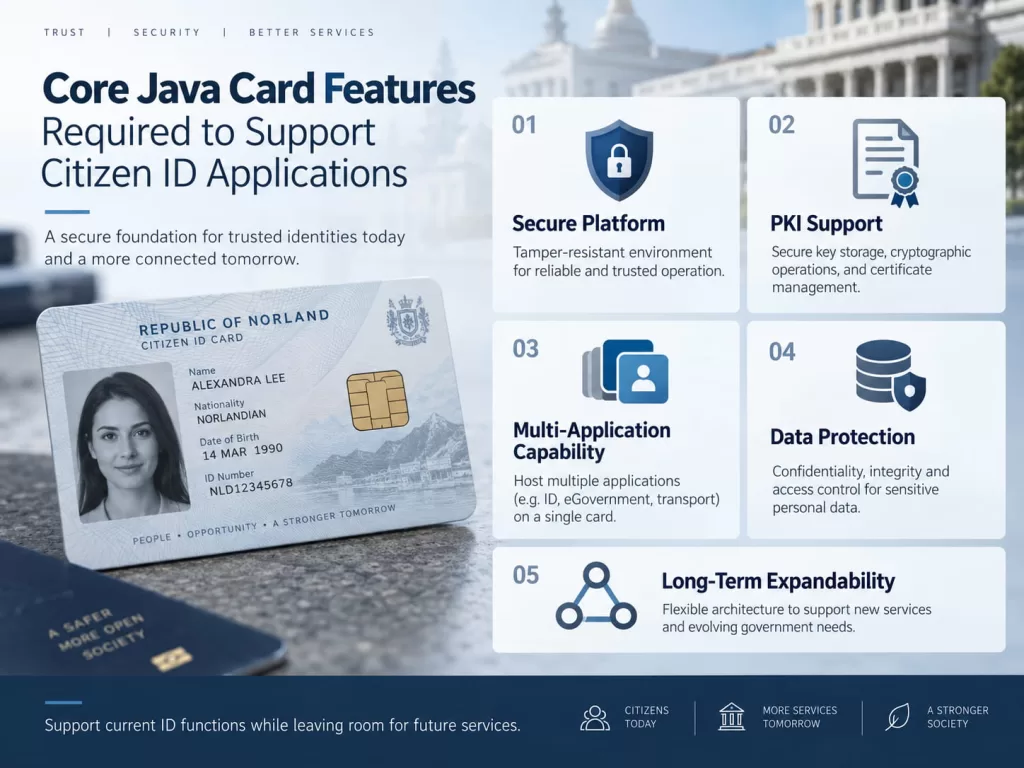
Core Java Card Features Required to Support Citizen ID Applications
Large-scale citizen ID projects require more than just a secure chip with ample storage space. The selected Java Card platform must protect sensitive ID information, support a variety of government applications, be easy to manage over a long service lifecycle, and operate reliably in various card reader environments. Therefore, when evaluating whether a Java Card can support the deployment of a national-level citizen identity authentication system, the following five Java Card features are most important.
Java Card Features: Hardware Security and Strong Encryption Protection
Citizen credentials may contain or utilize the following:
Private authentication keys;
PKI certificates;
Citizen identifiers;
Digital signature certificates;
Application keys;
Government service credentials.
As a result, Java smart cards must protect sensitive key material within a tamper-resistant secure element and perform critical cryptographic operations internally. Depending on the specific project requirements, the card may need to support RSA, ECC, AES, and SHA-2 family algorithms, generate secure random numbers, and provide hardware-level protection against physical attacks.
For example, in a PKI-based ID card, the private key should be retained on the card, with the secure element performing the required signing or authentication operations. Compared to storing cryptographic credentials in standard readable memory, this approach establishes a stronger trust boundary. For national-level projects, security certification is also critical. Government agencies and system integrators may require security platforms that have undergone independent evaluation, rather than relying solely on vendor claims.
Java Card Features: Applet Isolation and Multi-Application Capabilities
Modern citizen credentials may ultimately support far more than just national identity verification. A single Java card can contain independent applications for the following purposes:
National electronic ID (e-ID);
PKI authentication;
Digital signatures;
Healthcare;
Other public services.
Java cards’ applet-isolation architecture is particularly important in this context. Its runtime firewall isolates application contexts, preventing unauthorized cross-application access. For large-scale citizen service initiatives, this isolation mechanism lets governments expand service offerings without building all functionality into a single, monolithic application.
GlobalPlatform Lifecycle Management
National-level identification documents are often valid for several years. During this period, government agencies may need to install new applications, update existing services, and replace management keys.
This makes secure lifecycle management a core functionality rather than an optional add-on.
GlobalPlatform provides standardized mechanisms for card content and application management. Its specifications support dynamic “post-issuance management,” including adding and modifying applications after a card has been issued. For large-scale citizen ID projects, this means the ID platform can evolve continuously without replacing every physical card whenever new services are introduced.
Storage Capacity to Meet Current Application and Future Expansion Needs
Storage capacity requirements should be calculated based on the complete certificate architecture:
Applet code + certificates + keys + identity data + administrative overhead + space reserved for future use
Simple eID and PKI applications can typically fit easily on a Java smart card with a capacity of around 150 KB.
However, if the ID card integrates the following functions:
Electronic Identity (e-ID) + Digital Signatures + Healthcare + Other Public Service Applications
it may require significantly more storage capacity.
Contact and Contactless Interoperability
Large-scale citizen ID card projects typically involve a variety of different terminal environments. Contact-based communication is suitable for the following scenarios:
Government service counters;
Administrative office terminals;
Desktop PKI operations.
Contactless communication is suitable for:
Rapid citizen identity verification;
Transportation or public services;
Interactions with mobile devices or self-service kiosks;
Identity verification.
Therefore, compared to cards that support only contact-based communication, dual-interface Java smart cards offer greater deployment flexibility.
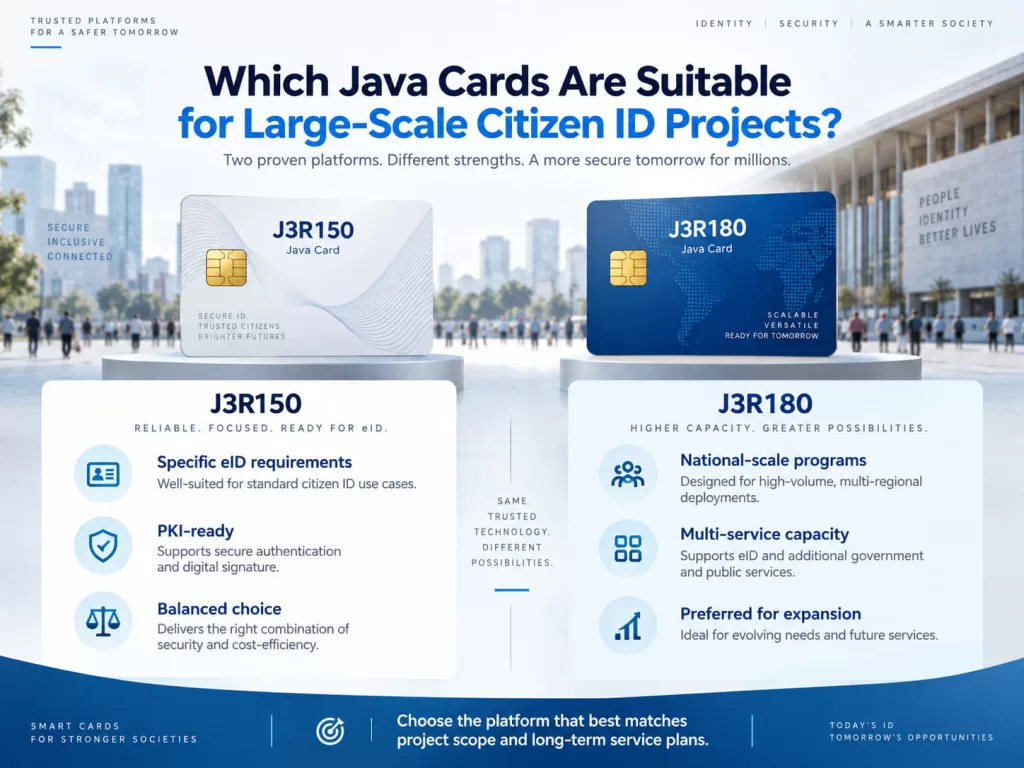
Which Java Cards Are Suitable for Large-Scale Citizen ID Projects?
Once you have defined the required security level, application capacity, lifecycle management, and interface architecture, the next step is to match these requirements with the appropriate Java Card. Different citizen ID projects have varying requirements for storage capacity, encryption performance, multi-application support, and future scalability. Therefore, we recommend selecting a card based on the ID project’s actual scale, rather than unthinkingly choosing the model with the largest capacity.
For projects focused on eID and PKI, the J3R150 may meet requirements; however, more complex national ID projects and multi-service application solutions may require the J3R180 or the higher-capacity J3R452.
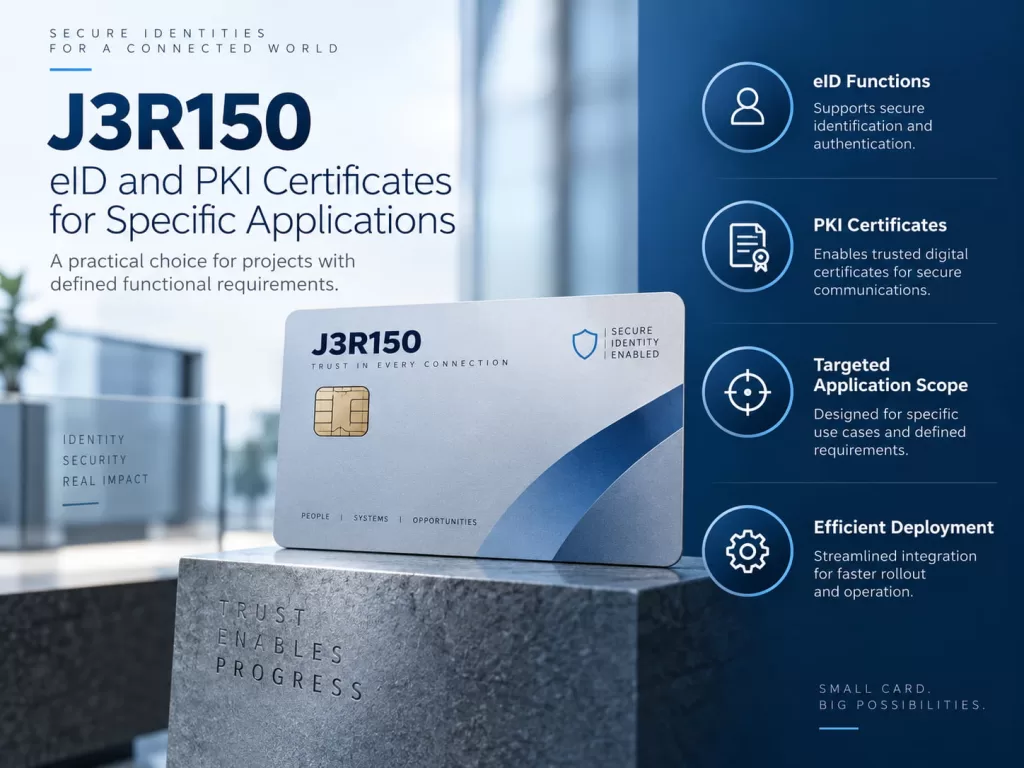
J3R150 — eID and PKI Certificates for Specific Applications
The J3R150 supports the Java Card 3.0.5 and GlobalPlatform 2.3 standards, provides about 150 KB of user storage, supports RSA/ECC/AES encryption algorithms, and offers contact or dual-interface configuration options. Application scenarios include e-passports, citizen cards, health cards, ePKI, and digital signature applications. If the certificate architecture is already defined and 150 KB of storage is sufficient for future expansion, the J3R150 Java smart card is a suitable choice.
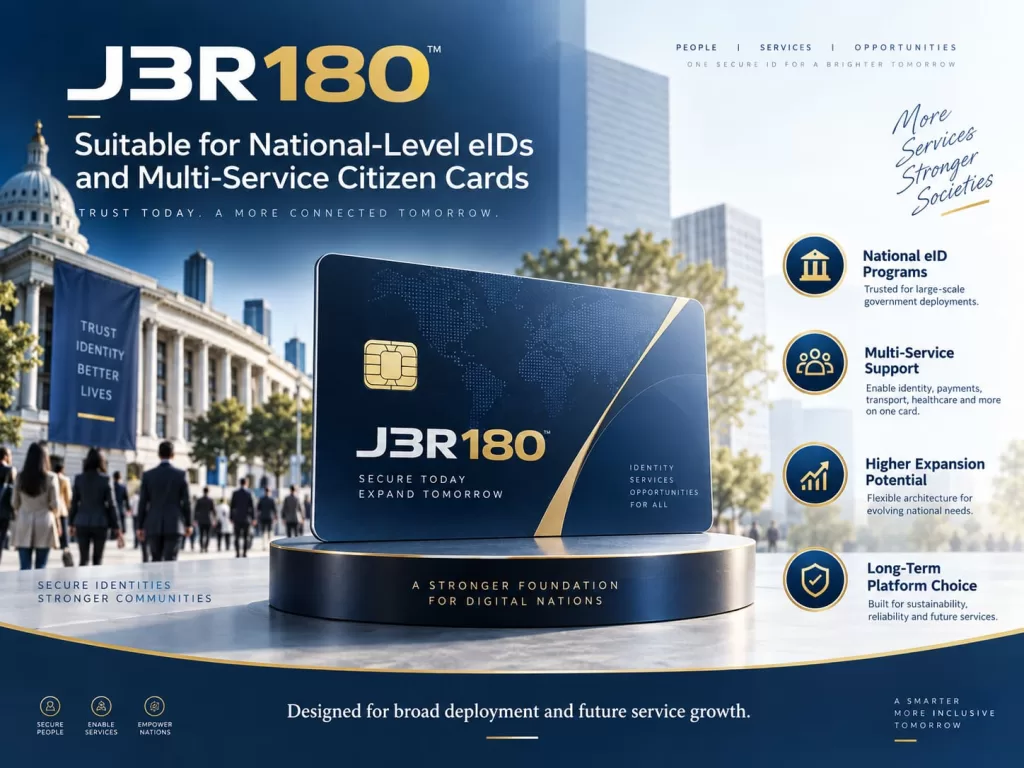
J3R180 — Suitable for National-Level eIDs and Multi-Service Citizen Cards
The J3R180 increases user storage to about 180 KB and integrates Java Card 3.0.5, GlobalPlatform 2.3, dual-interface communication, robust RSA/ECC/AES encryption, and higher-level security features. It is primarily used for national-level eIDs, electronic passports, electronic driver’s licenses, health and social welfare cards, ePKI, and digital signature applications.
For typical large-scale government identity projects, the J3R180 Java smart card achieves an excellent balance between security, application capacity, and multi-service flexibility.
J3R452 — Suitable for Large-Scale Next-Generation Multi-Application Credentials
Consider the J3R452 Java smart card when citizen credentials are expected to evolve into a broader, secure government platform. It integrates JCOP 4.5, Java Card 3.0.5 Classic, GlobalPlatform 2.3.1, about 450 KB of application capacity, advanced cryptography, dual-interface communication, and PUF-based security features. It is designed for high-security e-government and identity verification applications.
Therefore, the final selection process can be simplified as follows:
| Project Type | Recommended Direction |
| Focused citizen ID + PKI | J3R150 |
| National eID + several citizen services | J3R180 |
| Large multi-application government credential | J3R452 |
Java Card Features Suitable for Citizen ID Programs
For large-scale citizen ID programs, Java Card features include: security, cryptographic capabilities, applet isolation, lifecycle management, interoperability, and sufficient capacity to support long-term expansion.
Consequently, the most suitable Java Card for citizen identification (Citizen ID) does not necessarily have to be the newest or highest-capacity model. Rather, it should securely support the current identification architecture while reserving sufficient, controllable flexibility for new services that the government plans to add over the card’s lifecycle.
Below are several Java Cards we recommend for large-scale citizen ID projects:
The J3R150 is suitable for identity projects with specific requirements;
The J3R180 is a strong first choice for national-level multifunctional eID cards;
The J3R452 is better suited for next-generation citizen ID platforms with complex architectures and high requirements for future scalability.