
 English
  Español


How Does the THD89 Chip in RFID Credit Cards Prevent Contactless Skimming?
The convenience of contactless payments should not come at the expense of security. The TMC THD89 Java card is a dual-interface security element designed to effectively prevent contactless fraudulent transactions of RFID credit cards through multiple layers of protection, including hardware protection, modern encryption technology, secure transaction protocols, and issuer controls. It supports both contact (ISO/IEC 7816) and contactless (ISO/IEC 14443 Type A) communication and integrates a wide range of encryption suites—DES/3DES, AES, RSA, and Chinese SM1/SM3/SM4 algorithms—allowing issuers to implement security measures compliant with EMV standards and domestic standards.
RFID Credit Card Security Technology Based on the TMC THD89 Java Card
RFID credit cards communicate wirelessly via NFC technology, meaning data transmission requires no physical contact. While this improves speed and ease of use, it also introduces a theoretical risk of data leakage. The TMC THD89 Java card effectively addresses this issue as a dual-interface security element that supports both contact and contactless communication and integrates multiple layers of security controls. The THD89 does not rely on a single defense mechanism, but combines standards compliance, hardware encryption, secure key storage, and transaction-level authentication.
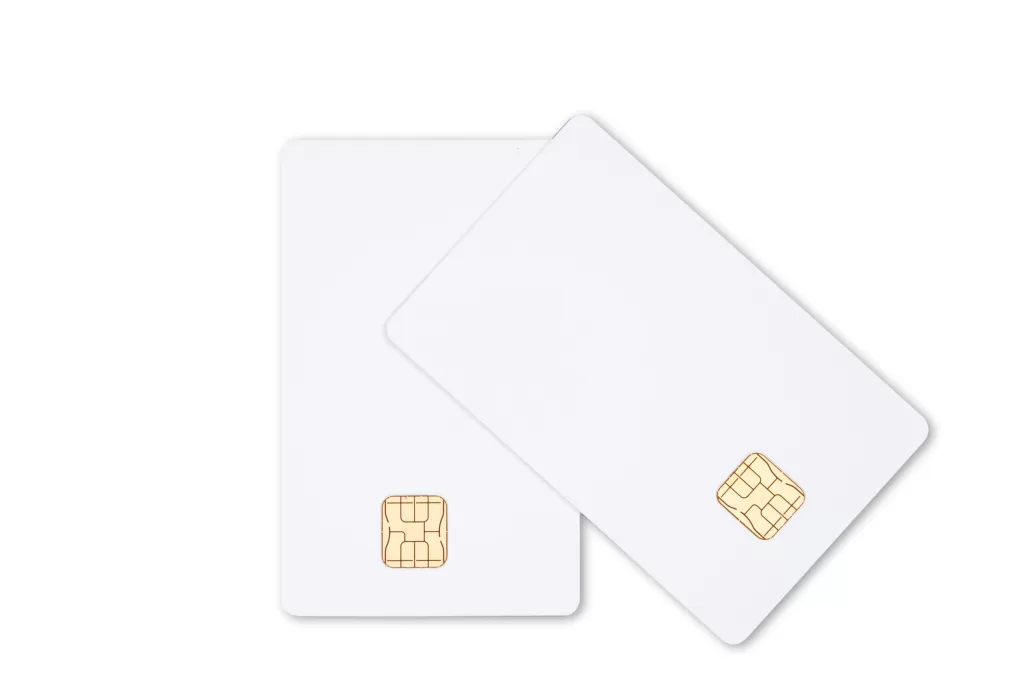
Standards Compliance is the First Layer of Protection for RFID Credit Cards
The THD89 chip fully complies with ISO/IEC 7816 (contact interface) and ISO/IEC 14443 Type A (contactless interface) standards. This compliance ensures seamless interoperability with global payment terminals, government identification systems, and secure RFID infrastructure.
More importantly, standards compliance enforces a structured authentication process. Before any sensitive data exchange, the RFID credit card and terminal perform a pre-defined handshake process. This includes application selection, mutual authentication, and session parameter negotiation. Furthermore, the dual-interface functionality of the TMC THD89 Java card supports secure personalization via contact communication in a controlled environment. This ensures that encryption keys are injected under high-security conditions before the card is used for contactless payments.

Encryption Architecture of the TMC THD89 Java Card in RFID Credit Cards
Encryption technology is the core mechanism for preventing contactless fraud. THD89 integrates a comprehensive suite of internationally recognized encryption algorithms, including:
- DES / 3DES
- AES
- RSA
- SM1 / SM3 / SM4
This multi-algorithm architecture enables RFID credit cards to comply with both international financial standards and domestic regulatory frameworks. In practice, when a transaction occurs, THD89 generates a dynamic ciphertext based on keys securely stored within the chip. These keys are non-derivative and protected by tamper-proof hardware boundaries. Even if an attacker intercepts the transmitted radio frequency signals, they cannot reconstruct or replay valid transaction data.
Transaction-Level and Lifecycle Security for THD89-Based RFID Credit Cards
Contactless fraud often targets data at rest. THD89 eliminates this vulnerability by implementing a dynamic authentication mechanism.
Each transaction involves:
- Mutual authentication between the card and the terminal
- Generation of a unique application password
- Use of unpredictable numbers (random numbers)
- Transaction counter (ATC)
- Dynamic CVV or equivalent authentication value
Because each transaction has a unique cryptographic feature, replaying captured data will fail authorization checks. Issuing banks use a secure backend system to verify encrypted information, ensuring its authenticity before approving payments. This dynamic approach transforms contactless communication from a static broadcast into a safe, encrypted dialogue. In effect, THD89 converts potentially passive radio frequency radiation into an active, encrypted session, rendering it unusable by eavesdropping devices.

Tokenization and Data Minimization in Design
Modern RFID credit cards equipped with TMC THD89 Java cards typically employ a tokenization framework. Instead of transmitting the actual PAN, the system sends a token that is invalid outside the authorized network. If a thief intercepts this token, it cannot be used independently, as it requires verification through the issuer’s secure system. Combined with encrypted verification of each transaction, tokenization further reduces the risk of fraud.
Furthermore, THD89 supports the principle of data minimization. Only necessary transaction data is exposed during communication; sensitive keys or authentication seeds are securely stored internally within the chip. This principle significantly reduces the attack surface exploitable by unauthorized readers.
Issuer Lifecycle Management and Operational Control
Chip-level security is only effective when combined with rigorous operational procedures. The THD89 supports secure key injection via a Hardware Security Module (HSM), personalized secure channels compliant with GlobalPlatform specifications, and key rotation policies.
Issuers can implement:
- Security domain isolation
- Real-time revocation mechanism
- Transaction anomaly monitoring
- Firmware authentication updates
By combining secure hardware, dynamic encryption, and lifecycle management, RFID credit cards built on the THD89 platform achieve financial-grade security, suitable for payment networks and government identification systems.
Preventing contactless fraud with a multi-layered defense strategy
The THD89 chip employs a multi-layered defense strategy, effectively preventing contactless fraud of RFID credit cards by integrating standards compliance, strong encryption algorithms, secure key storage, hardware tamper-proofing, two-way authentication protocols, and lifecycle control at the issuer level. The chip ensures that each transaction generates dynamic, non-replayable authentication data, thus preventing intercepted contactless signals from being used for fraud.