
 English
  Español


When procuring smart cards, chip selection is not merely a technical choice; it also impacts security, user experience, reader compatibility, cost, and long-term stability. Therefore, we help customers select the appropriate chip, matching the card’s functionality to the actual deployment environment, rather than simply relying on specifications. The widespread use of 13.56MHz RFID card stems from their practical balance. They support fast touch interaction, broad NFC compatibility, and offer greater application potential than basic 125kHz RFID cards. However, this doesn’t mean that all 13.56 MHz chips are interchangeable. MIFARE, NTAG, DESfire, and FM11RF08 each have their strengths. Some options suit simple identification better, while others are designed for secure prepaid transactions, transportation systems, or high-trust access control.
Application Scenarios for Effective Chip Selection for 13.56MHz RFID Card
When selecting a 13.56 MHz RFID card, the decision should always be based on its intended use, not solely on its technical specifications. Whether users apply the card for access control, commercial prepaid systems, or NFC interaction, each application scenario imposes different requirements for memory, security, and compatibility. In practical deployments, choosing the wrong chip often leads to unnecessary cost increases or functional limitations. For example, choosing a high-security chip for a simple identification system may increase costs without providing any practical value.
Conversely, choosing the wrong chip for a transaction-based system may introduce security risks. Therefore, in 13.56 MHz card applications, aligning the chip’s functionality with business objectives is crucial for achieving efficiency and reliability. In practical deployments, 13.56 MHz RFID cards offer greater flexibility than 125kHz RFID cards, especially in applications that require data storage or mobile interaction.

Application and Advantages of MIFARE Chips in 13.56MHz RFID Card
MIFARE chips are among the most widely used solutions in the 13.56 MHz RFID card market. Their strong ecosystem compatibility ensures seamless integration with existing readers and systems, reducing deployment complexity. This widespread adoption also means that technical support, development resources, and integration tools are readily available. For businesses, this translates to faster implementation and lower risk. Furthermore, system integrators’ familiarity with MIFARE technology further improves deployment efficiency and reduces training needs. Organizations widely use MIFARE-based 13.56 MHz cards in access control, transportation, and prepaid systems. Their performance and cost advantages make them a reliable choice for mainstream applications. In addition, MIFARE chips support flexible memory configurations, customizable to application needs. Whether used for employee identification, transportation tickets, or stored-value cards, they deliver stable, reliable performance.
NTAG for NFC and Lightweight Applications
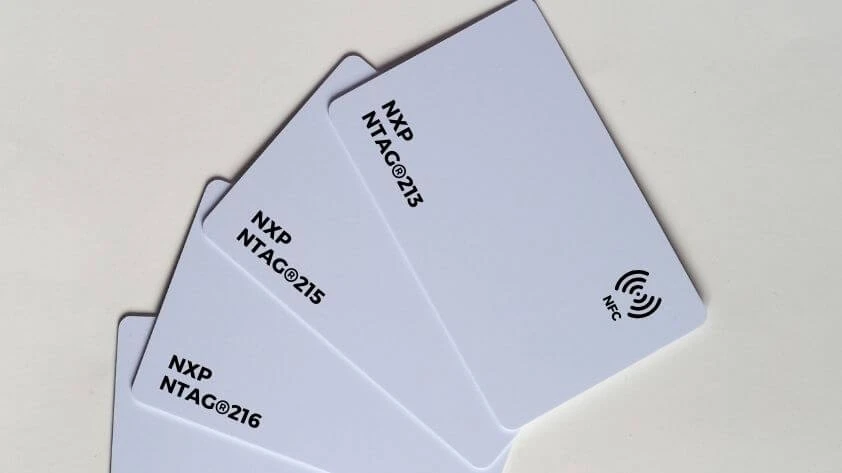
Engineers optimize NTAG chips for NFC-enabled devices, making them ideal for applications that require smartphone interaction. Manufacturers commonly use 13.56 MHz RFID cards equipped with NTAG for marketing, digital access, and simple data sharing. Furthermore, NTAG chips can seamlessly integrate with mobile applications, enabling users to access information or services instantly. This functionality enhances user engagement and creates new opportunities for digital interaction.
Generally, NTAG is best suited for low-security, high-convenience environments. It offers fast communication and ease of deployment, but is not suitable for high-security transaction systems. Enterprises commonly use NTAG chips for applications such as event tickets, product authentication, and promotional activities. Their simplicity reduces implementation difficulty while maintaining reliable performance.
DESfire for High-Security Environments
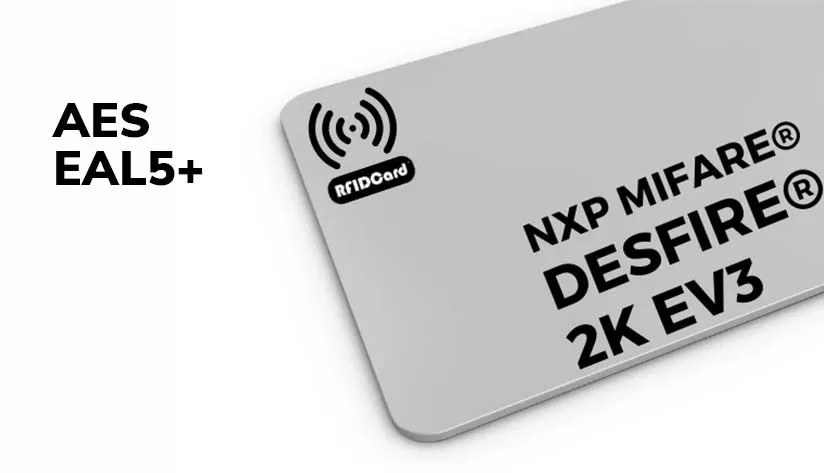
DESfire chips are designed specifically for high-security applications. They support encrypted communication and secure authentication, making them ideal for sensitive systems. Furthermore, DESfire technology provides advanced key management and a secure file structure, effectively preventing unauthorized access. This level of security is crucial for applications such as financial transactions and secure identity verification systems. By deploying DESfire, enterprises can significantly reduce the risk of data breaches. 13.56 MHz RFID cards with DESfire chips can support multiple applications simultaneously, such as access control, payment, and authentication, making them suitable for enterprise-level deployments. This versatility allows enterprises to consolidate multiple credentials onto a single card, improving efficiency and reducing operating costs.
The Cost-Effective FM11RF08 Chip
The FM11RF08 achieves a good balance between cost and functionality. Users widely use it in applications that require stable performance without advanced security features. For large-scale deployments, cost-effectiveness is paramount. The FM11RF08 helps businesses deploy reliable 13.56MHz cards while controlling budgets. This makes it particularly suitable for projects with high card volume requirements. The chip has good compatibility with common systems, making it a good choice for projects prioritizing price and ease of integration. Furthermore, integrators can integrate the FM11RF08 into existing infrastructure with minimal modifications, reducing implementation time and costs. Its flexibility makes it ideal for organizations seeking efficient and scalable solutions.
How to Choose the Right 13.56MHz RFID Card Chip for Your Project?
We evaluate each project through five practical questions: What is the purpose of the card? What are the security requirements? Which readers are already installed? What is the expected transaction volume? And how much lifecycle flexibility is needed?
If the project focuses on simple NFC interaction, touch-based information retrieval, or lightweight identification, NTAG may be the best choice. If the goal is to build a user-friendly and widely supported access or prepaid environment, MIFARE is the most suitable option. If a project requires enhanced security and better control over data and authentication, DESfire is undoubtedly the first choice. If a project needs a deployment solution that balances cost-effectiveness and practicality, FM11RF08 is usually a good option.