
 English
  Español


When implementing eID, issuing authorities must strike a balance between the highest standards of cryptographic security and long-term operational flexibility. Modern eID cards typically require integrating multiple public and private-sector use cases into a single secure hardware carrier. They must simultaneously support ICAO-compliant e-passport applications, national healthcare registration credentials, digital signature tools for legal contracts, and contactless transportation functions. Built on the advanced JCOP 4 SecID platform, the JCOP J3R180 Java Card serves as a model for high-security public sector deployments. It provides a scalable, secure, and fully auditable execution platform, offering a robust security architecture for governments to deploy a resilient national eID infrastructure.
The Security Foundation of the JCOP J3R180 Java Card
The architecture of sovereign electronic identity requires a clear separation between hardware control and application logic. The JCOP J3R180 Java Card achieves this separation by implementing open platform standards based on Java Card 3.0.5 Classic and the GlobalPlatform Card Specification 2.3. Together, these standards establish a multi-layered runtime environment that transforms a single chip into a multi-application secure element.
The Role of Java Card 3.0.5 Classic Compliance
At the core of the JCOP J3R180 card is a compliant execution engine that processes Java bytecode via an on-chip Java Card Virtual Machine (JCVM). This architecture isolates application applets from the underlying hardware, offering two significant advantages to government card-issuing authorities:
1. Hardware Independence:
Government development teams can use standard Java APIs to write identity applications, ensuring that software development remains decoupled from the lifecycle of specific hardware.
2. Application Portability:
Code written for the JCOP platform can be deployed on devices of various form factors—including dual-interface smart cards, eSE, or e-passports—without requiring a complete rewrite of the security logic.
GlobalPlatform 2.3 and Multi-Application Isolation
A key challenge for national e-ID programs is securely integrating multiple public services into a single credential. A citizen’s national ID card typically serves as a travel document, national health insurance card, and driver’s license all at once. The JCOP J3R180 Java card addresses this complexity by strictly enforcing the GlobalPlatform 2.3 firewall architecture.
This firewall prevents unauthorized object sharing between applications. Unless a secure sharing interface is explicitly defined, an application managing a citizen’s medical records cannot access the private keys or biometric templates associated with the national ID application. Furthermore, the platform supports dynamic application loading after card issuance. Updates or entirely new public sector applications can be deployed wirelessly (OTA) or via citizen self-service kiosks without compromising the security of existing applications.

Multi-Application Isolation and Dynamic Applet Lifecycle Management
One of the key requirements for a modern national e-ID is integration. For example, when using an ID card at a hospital registration desk, it must be ensured that the medical registration application cannot access the private key used for legally binding digital signatures, nor can it read biometric passport data stored in the ICAO file structure. The Java Card architecture natively implements an absolute logical barrier, the Applet Firewall.
The Applet Firewall isolates the runtime contexts of different applets deployed on JCOP J3R180 Java cards. This ensures that even if a secondary application contains vulnerabilities, it cannot logically bypass the firewall and compromise core national identity records, thereby meeting the stringent security requirements of the financial and government sectors.
Compliant with Common Criteria EAL6+ and eIDAS Regulations
When a government entity issues digital identity credentials, it bears full responsibility for preventing systematic abuse by state-sponsored actors and sophisticated criminal groups. Therefore, national procurement frameworks require independent and rigorous security certification. The JCOP J3R180 Card meets these requirements through its high-level security certification.
Common Criteria EAL6+
The JCOP J3R180 platform holds a Common Criteria (CC) Evaluation Assurance Level 6 Enhanced (EAL6+) certificate. This level of certification indicates that the chip’s security architecture has undergone semi-formal verification, rigorous testing, and mathematical analysis by an accredited independent laboratory. EAL6+ certification demonstrates that the card can effectively withstand a variety of advanced attack methods, including:
1. Differential Power Analysis (DPA) and Simple Power Analysis (SPA)
2. Fault Injection Attacks (FIA)
3. Physical micro-probing and reverse engineering

Compliance with eIDAS and EU Regulation 2019/1157
For countries seeking to integrate into international cross-border frameworks, compliance with EU standards is a common benchmark. The JCOP J3R180 card is designed to comply with EU Regulation 2019/1157, which sets forth stringent security requirements for identity documents issued to EU citizens. This compliance makes the card ideally suited for use as a QSCD under the eIDAS Regulation, enabling governments to issue electronic ID cards.
The JCOP J3R180 Java Card with Advanced Encryption Capabilities
Cryptographic algorithms provide a computational security boundary for electronic authentication. As computing power increases and quantum computing becomes more widespread, government-issued ID cards must adopt advanced cryptographic primitives. The JCOP J3R180 Java Card meets this need with a dedicated hardware cryptographic coprocessor that accelerates both symmetric and asymmetric encryption algorithms.
Long-Term Security Through High-Bit Asymmetric Cryptography
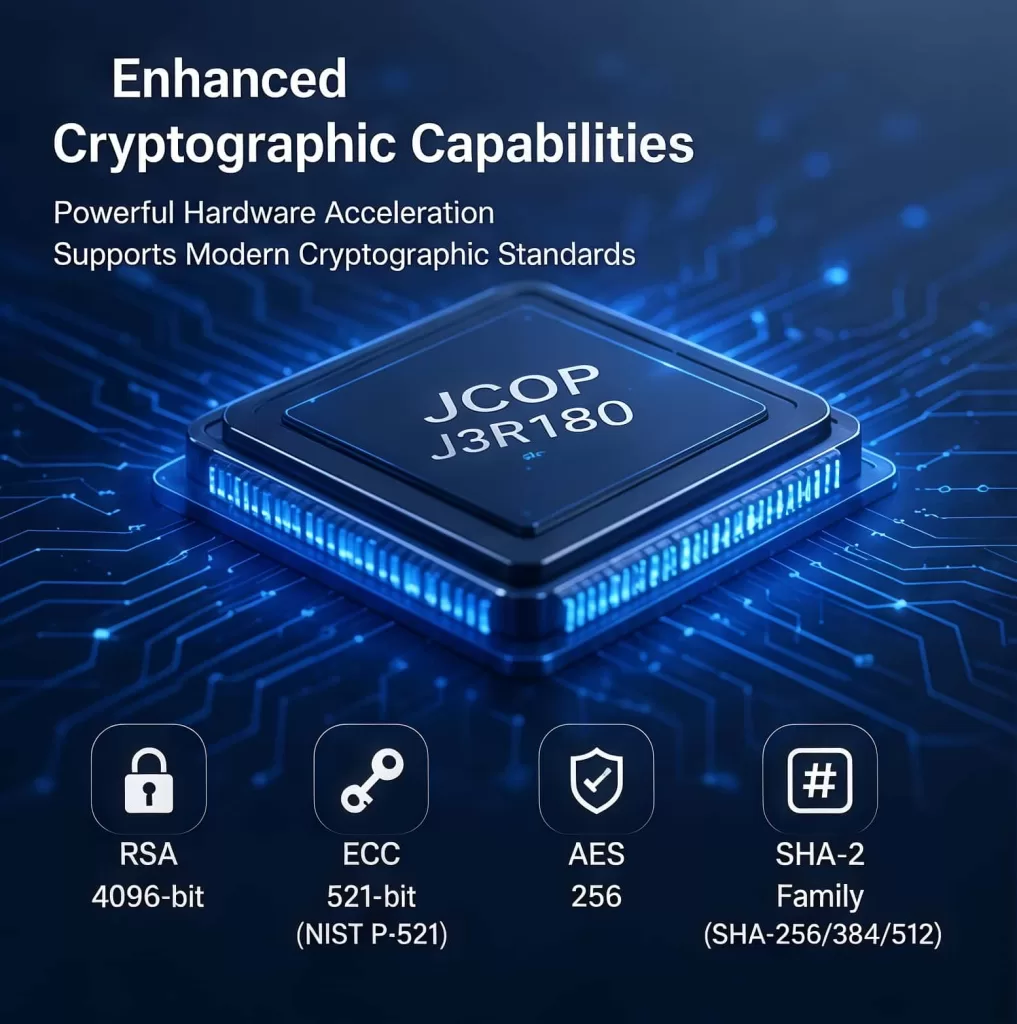
Although 2048-bit RSA keys remain common, global security agencies recommend transitioning to longer key lengths or elliptic curve frameworks to protect data over a longer lifecycle. The JCOP platform provides native hardware acceleration for the following:
- RSA 4096-bit encryption and key generation: Enables secure digital signature execution and key exchange, capable of withstanding brute-force attacks.
- ECC supports up to 521 bits: Supports high-security curves, including NIST P-521 and Brainpool variants. ECC provides security equivalent to or better than RSA at shorter key lengths, thereby reducing communication payloads and accelerating contactless processing speeds.
JCOP J3R180 Java Card Supporting National Electronic ID Cards
Establishing a national electronic identity system is a complex undertaking that requires balancing regulatory compliance, technical flexibility, and long-term security. The underlying smart card platform must serve as a reliable foundation capable of protecting citizen data from evolving security threats over many years of operation.
The JCOP J3R180 card meets these requirements by integrating the following three core technical capabilities:
- Open, flexible architecture: Compliant with Java Card 3.0.5 Classic and GlobalPlatform 2.3 standards.
- Advanced security guarantees: Common Criteria EAL6+ certification and physical PUF anti-cloning controls effectively prevent hardware-level and side-channel tampering.
- Advanced encryption capabilities: Hardware-accelerated high-bit asymmetric cryptographic primitives, including 4096-bit RSA and 521-bit ECC, ensure compliance with modern security requirements.
By using the JCOP J3R180 card, government agencies can deploy secure electronic identity systems that comply with stringent international standards.