
 English
  Español


Whether smart cards are used for public transportation, employee access control, banking, healthcare, or government identity verification, users expect every interaction to be fast, reliable, and error-free. If smart cards repeatedly fail to communicate with readers, it not only reduces operational efficiency and frustrates users but also increases maintenance costs. This is one of the main reasons RFID smart card is widely used across various industries. Unlike traditional contact IC cards, RFID smart card communicate via radio frequency technology. Since there are no exposed metal contacts, the risk of physical wear, contamination, and mechanical failure is significantly reduced, providing a more stable user experience throughout the card’s lifespan and minimizing contact failure issues.
Causes of Contact Failure in Contact IC Cards
Contact IC cards contain an integrated circuit connected to a series of exposed metal contacts on the card’s surface. When the card is inserted into a compatible reader, these metal contacts align with corresponding terminals inside the reader, enabling the exchange of power and data. This method of communication has been successfully used for decades in banking, telecommunications, government identification, and security authentication systems because it provides a stable and highly controllable communication channel.
However, because every transaction relies on direct physical contact, the quality of that contact is critical. Even minor interference can prevent successful communication between the card and the reader.
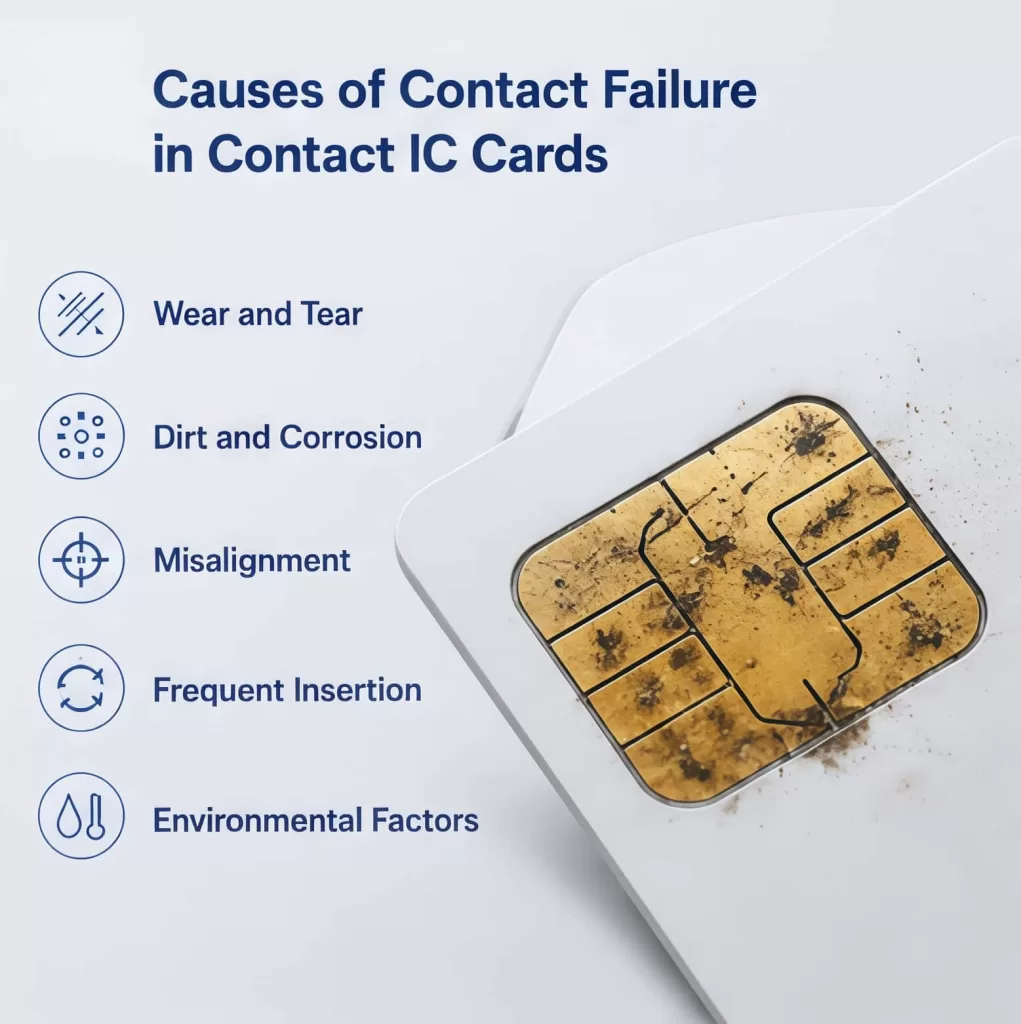
The Most Common Causes of Contact Failure
As a smart card manufacturer, we frequently receive inquiries from customers regarding intermittent reading issues. In most cases, the problem lies not with the chip itself, but with the physical communication interface.
The most common causes include:
Surface Wear:
Each insertion and removal creates slight friction between the card and the reader. After thousands of insertion cycles, the metal contacts gradually wear down, reducing conductivity.
Dirt and Contamination:
Dust, fingerprints, oil, moisture, or other contaminants can accumulate on the contact surfaces. Even a thin layer of contaminants can disrupt electrical communication.
Mechanical misalignment:
If the card is inserted at an incorrect angle or the reader’s contact pins are worn, proper electrical contact may not be established.
Environmental factors:
Humidity, oxidation, and temperature fluctuations can gradually affect the condition of the exposed contact surfaces, especially in harsh industrial environments.
Why Are High-Frequency Applications More Vulnerable to Attacks?
Contact IC cards perform well in low-usage environments. However, when transaction volumes increase sharply, mechanical wear accelerates.
Common applications include:
| Application | Daily Usage Frequency |
|---|---|
| Public Transportation | Very High |
| Office Access Control | High |
| Student Campus Cards | High |
| Hospital Identity Cards | High |
| Financial Payment Cards | Medium to High |
In such situations, businesses often find that the costs of replacing cards and maintaining card readers gradually become a significant operational expense. This is precisely where RFID smart cards demonstrate their advantages.
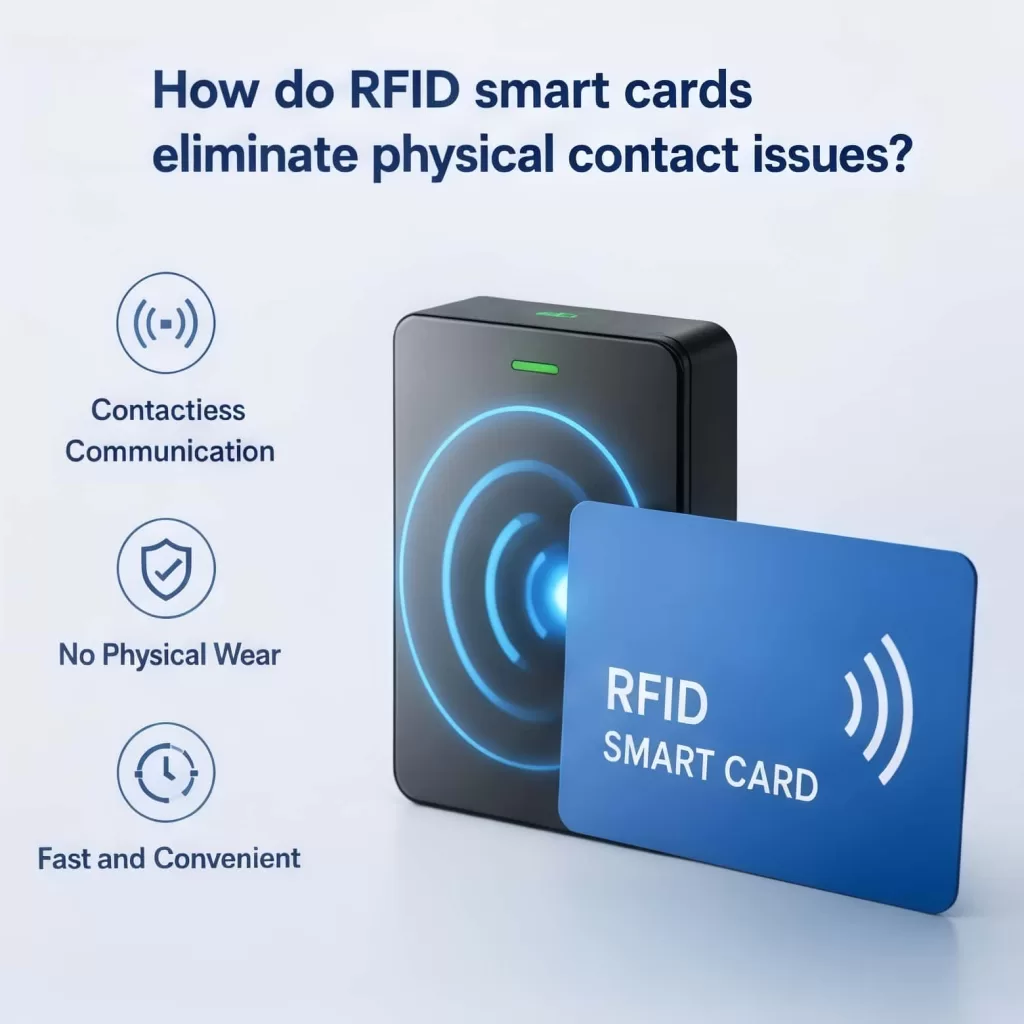
How Do RFID Smart Cards Eliminate Physical Contact Issues?
The most fundamental difference between RFID smart cards and contact IC cards lies in their communication methods. RFID cards do not rely on exposed electrical contacts; instead, they feature a built-in antenna connected to a security chip. When the card enters the electromagnetic field generated by a compatible reader, energy is transmitted wirelessly, enabling secure communication without any physical contact. Since no metal-to-metal contact is required, several traditional failure mechanisms are eliminated. This simple architectural difference has a significant impact on long-term reliability.
One of the greatest advantages of RFID smart cards is the complete elimination of exposed contact pads. The absence of exposed metal surfaces ensures that no friction occurs during normal use and that repeated insertions do not cause scratches. That conductive surfaces do not wear out over time, meaning daily operations have a much smaller impact on reading performance.
As a result, RFID cards typically maintain stable communication performance throughout their expected service life. For organizations managing tens of thousands of cards, this increased durability directly translates to lower replacement rates and reduced maintenance costs.
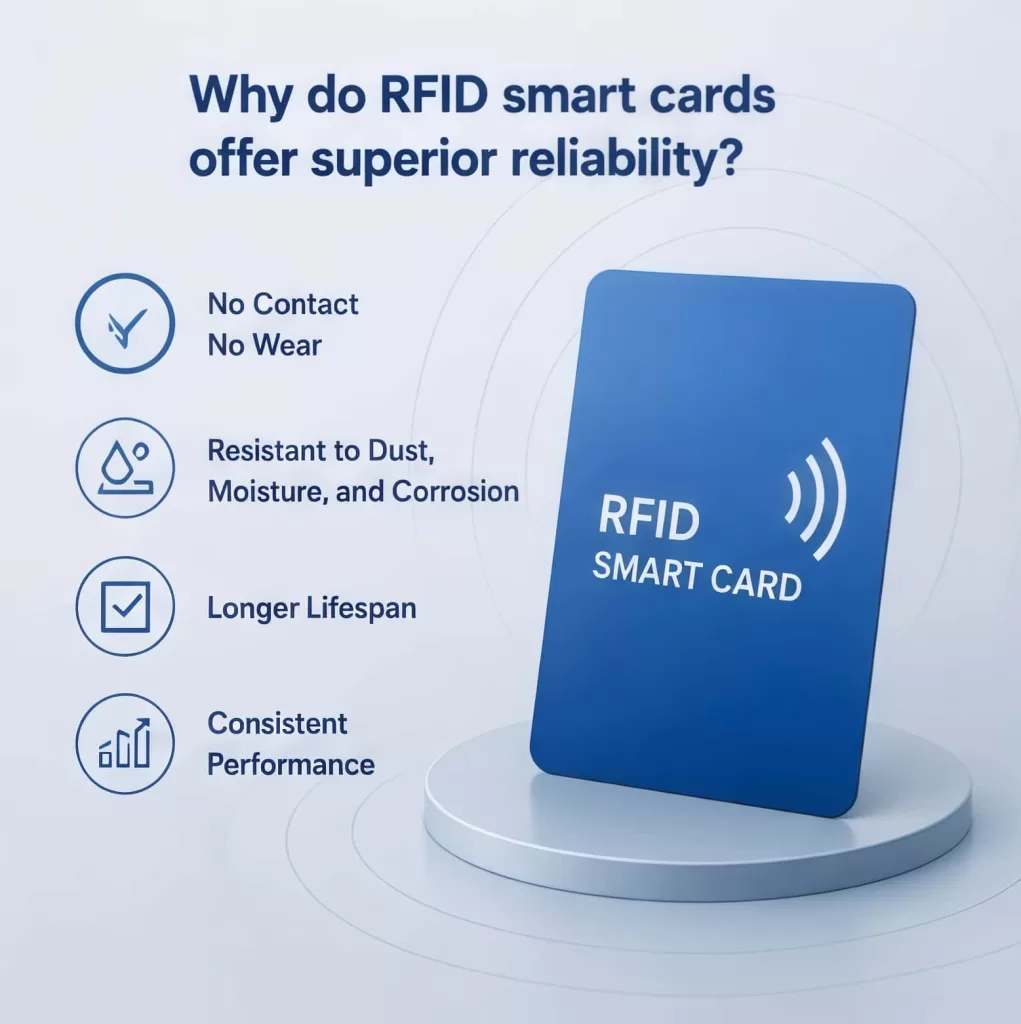
Why Do RFID Smart Cards Offer Higher Reliability?
Reducing contact failures is not merely a matter of removing metal contacts from the card. The true advantage of RFID smart cards lies in their ability to maintain stable performance across a wide range of operating environments. From an RFID card manufacturer’s perspective, reliability depends not only on whether the card functions properly on day one, but also on whether its performance remains stable over thousands or even millions of authentication cycles. By eliminating physical contact between the card and the reader, RFID technology minimizes many of the factors that traditionally cause communication failures.
Stability of RFID Smart Cards Under High-Frequency Use
Some cards are used very infrequently, while others are swiped dozens of times a day. Public transportation cards, employee access cards, student IDs, and hospital ID cards are all typical examples of high-frequency use. In such cases, contact-based IC cards are subject to continuous mechanical interaction with the card reader. Over time, repeated insertion and removal gradually wear down the card’s contacts and the reader’s terminals.
RFID cards completely eliminate this problem, as users need to hold the card near the reader. There is no need for insertion, no friction, and no repetitive mechanical stress. This helps organizations maintain stable system performance even as transaction volumes continue to grow.
Reliability is not merely a technical metric; it directly influences users’ perception of the system.
The difference between these two technologies:
| Contact IC Card | RFID Smart Card |
|---|---|
| Insert card correctly | Simply tap or present the card |
| Reader alignment required | Flexible reading position |
| Slower interaction | Faster authentication |
| More susceptible to wear | Minimal physical wear |
| Higher chance of read failure | More consistent communication |
Security Advantages Beyond Contact Reliability
Modern RFID smart cards also offer robust security features. Reliability and security go hand in hand—the former ensures stable operation, while the latter protects sensitive information. From the perspective of a professional RFID card manufacturer, an ideal RFID solution should combine both.
Many people mistakenly believe that RFID technology is merely a wireless version of traditional cards. In reality, RFID smart cards contain a secure integrated circuit capable of:
Cryptographic computations
Secure key storage
Mutual authentication
Digital signature support
Secure application execution
The wireless interface changes the method of communication, not the security model. Depending on the chip platform, the card may support advanced encryption algorithms that meet the security requirements of financial institutions, government agencies, and enterprise systems.
Delivering a Faster, More Reliable User Experience
RFID smart cards eliminate the risk of contact failure by completely removing the physical contact interface. Through wireless communication, the card minimizes mechanical wear, reduces the impact of environmental pollution, and provides more stable performance throughout its lifespan. Ultimately, for organizations managing large-scale card deployments, this results in a faster, more reliable user experience and a lower total cost of ownership. The benefits of RFID technology extend far beyond contactless communication. Modern RFID smart cards integrate secure hardware, advanced encryption capabilities, a flexible Java Card platform, and support for multiple applications, enabling them to meet the needs of industries such as government agencies and financial institutions.