
 English
 Español



A cryptocurrency wallet’s security depends entirely on the private key used to authorize transactions. If malware or an attacker gains access to this private key, they may transfer the associated assets without the owner’s permission. Crypto Java Card mitigates this risk by storing cryptographic keys in a Secure Element and performing signature operations on the card itself; during this process, the private key never leaves the card. The host application sends transaction data to the card to obtain the corresponding digital signature. Hardware protection alone isn’t enough: the card must also support the required blockchain algorithms, secure key management, and a robust transaction authorization process.
Effective protection depends not only on keeping private keys within secure boundaries at all times, but also on ensuring every signature request strictly adheres to the wallet’s security rules.
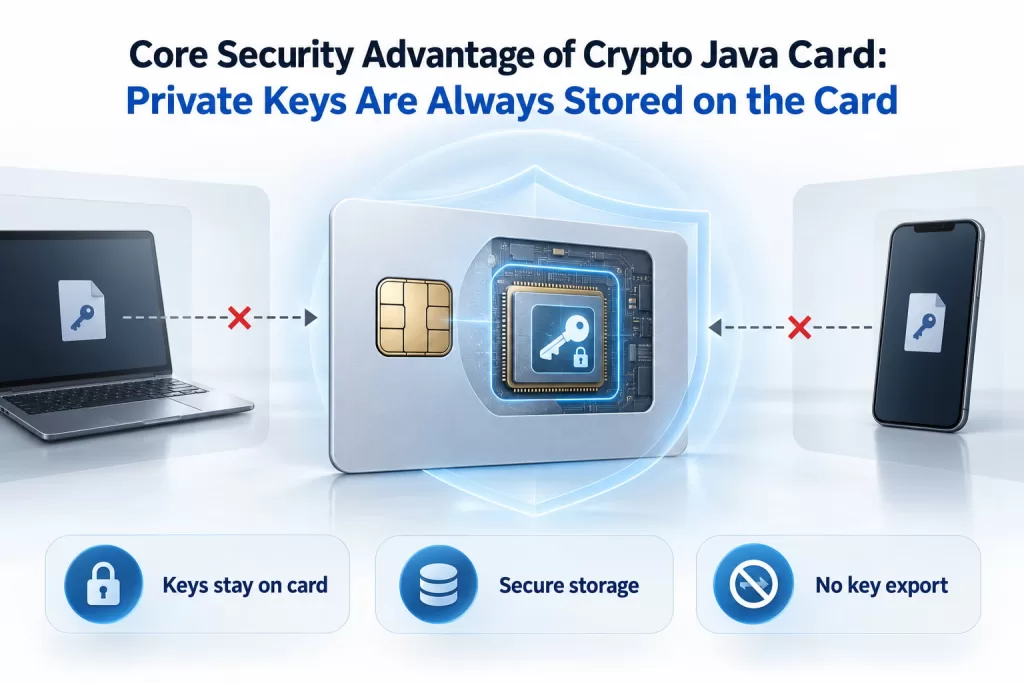
Core Security Advantage of Crypto Java Card: Private Keys Are Always Stored on the Card
The fundamental advantage of Java Card in cryptocurrency applications is that it separates sensitive cryptographic operations from the general-purpose devices running the wallet software. Computers or smartphones prepare transactions and communicate with the blockchain, while the secure element handles private-key operations.
This separation mechanism changes what attackers can access after compromising the host device. Attackers can no longer find private keys in ordinary application files or memory; instead, they must contend with the card’s own access controls, applet implementations, and hardware security mechanisms. This protection works best when the system securely generates or imports private keys, stores them as non-exportable objects, and uses them only for authorized cryptographic operations.
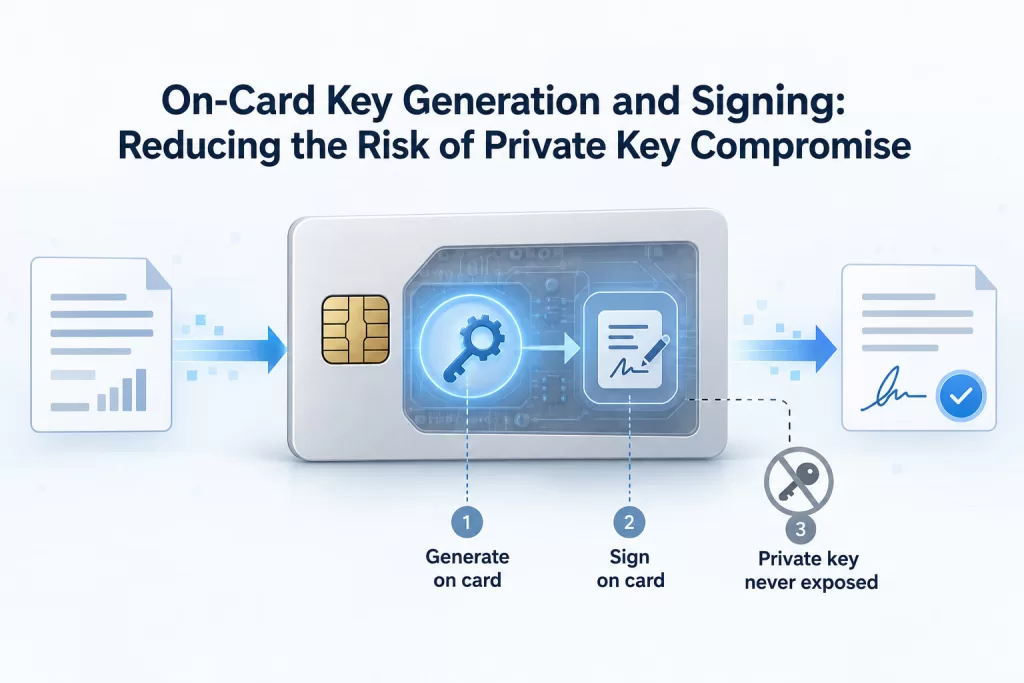
On-Card Key Generation and Signing: Reducing the Risk of Private Key Compromise
In a Java Card-compliant secure card, the private key remains inside the secure element during routine wallet operations. When the platform and wallet applet support on-card generation, the card generates the key internally; alternatively, the card can import the key through a strictly controlled configuration process. The applet then uses this key to sign authorized data without ever exporting the private key itself.
The signing process can be summarized in the following simplified steps:
Transaction preparation → Initiate signature request → Perform cryptographic operations on the card → Return the signature to the wallet.
This design complies with the National Institute of Standards and Technology (NIST) guidelines on “non-exportable cryptographic key storage.” These guidelines state that when keys are strictly prohibited from being exported to the host processor, the secure element serves as an effective protective environment. (Source: NIST SP 800-63C-4)
Signatures can leave the card, but private keys must never leave it. This mechanism reduces the risk of key theft by preventing attackers from extracting private keys through compromised host software, application memory leaks, or accidental exposure of key material.
Applet Isolation and Access Control Help Protect Wallet Keys
Java Card can isolate wallet applications from other applications on the same Secure Element. Java Card’s Runtime Firewall isolates applet contexts and restricts access to objects. Applets cannot access objects across contexts unless they use an explicitly supported sharing mechanism.
For Crypto Java Card, wallet applets should expose only the operations necessary for wallet functionality, such as retrieving public keys, performing address-related functions, and signing transactions.
Smart cards must also validate incoming instructions, enforce the corresponding access-control conditions, and reject requests that violate applet rules. In specific deployment scenarios, authenticated secure communication mechanisms can provide additional protection for interactions between the smart card and the host.
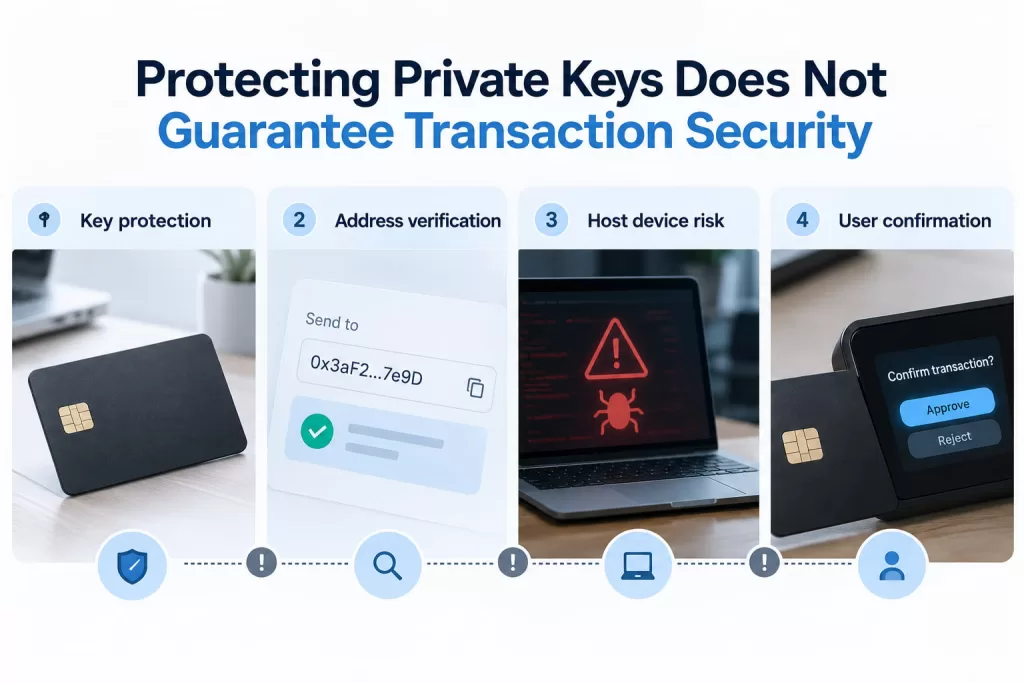
Protecting Private Keys Does Not Guarantee Transaction Security
Security elements can significantly increase the difficulty of extracting private keys, but they cannot automatically determine whether each transaction truly reflects the user’s actual intent. If an attacker compromises a computer, they may change the transaction’s destination address before sending the request to the card. As long as the request follows the applet’s rules, the card will still generate a valid signature.
This highlights an important distinction: protecting private keys defends against one type of attack, while controlling how private keys are used addresses another.
Authentication, Signature Authorization, and Transaction Control for Crypto Java Card
A well-designed wallet system should clearly define which signature requests the card accepts and how users authorize these requests. Depending on the specific use case, security measures may include: transaction verification, spending limits, account restrictions, or confirmation via a trusted display or standalone device. If the card lacks a trusted display, it cannot independently present each transaction’s details to the user. Therefore, the accompanying wallet system must ensure that users can verify the transaction information before signing.
Verifying Chip Security and Key Management
Card security depends on multiple factors, including the secure element, the operating system, the implementation of cryptographic algorithms, and key management processes. Before deployment, project teams should verify the algorithms used, supported key-generation capabilities, relevant security certifications, and restrictions on private-key export. Additionally, establish a key recovery plan. If you cannot export private keys and you lose or damage the card, you’ll need an appropriate backup or recovery strategy to regain access, because you can’t copy the private keys directly from the card.
Before Deployment, Ensure the Encryption on the Java Card Matches the Blockchain
Secure chips do not automatically support all cryptocurrencies. Wallet mini-programs must implement the signature algorithms and key management functions required by the target blockchain. Therefore, the selection process should be based on the wallet’s technical requirements and ultimately verified on the actual card.
Select a Java Card with the Necessary Cryptographic Support
Bitcoin and Ethereum typically use ECDSA on the secp256k1 curve, while other blockchain ecosystems may require Ed25519. Wallets using hierarchical deterministic (HD) accounts may also need to support the BIP32 or BIP44 standards.
We have listed the following platforms suitable for cryptocurrency applications:
| Platform | Published Capabilities | Typical Application Direction |
|---|---|---|
| J3R180 | 180 KB EEPROM, secp256k1/secp256r1, BIP32/BIP44, FIDO/FIDO2 | Developer wallets and consumer crypto cards |
| J3R452 | Approximately 452 KB EEPROM, broader cryptographic support including Ed25519, BIP32/BIP44/BIP39 | Institutional wallets and more complex multi-application projects |
These specifications are for reference only. The selected card must support the specific algorithms, key derivation methods, and signature formats required by the target wallet.
Verify Key Protection and Signature Functionality Before Production
Before moving to large-scale production, we recommend testing the full signature process on the target card. Confirm that the card can generate or configure keys correctly, that independent software can verify the generated signatures, and that it can reject unauthorized commands.
The following three checks are critical:
- Key Protection: Private keys cannot be exported via standard application programming interfaces (APIs).
- Blockchain Compatibility: The card can generate valid signatures using the required algorithms.
- Operational Readiness: The signing, authorization, and recovery processes all function as expected.
This validation confirms that the card can store private keys and reliably protect and use them within the intended wallet architecture.
Protecting Cryptocurrency Wallet Private Keys
Cryptographic Java cards protect private keys by storing them within a secure element and executing signing operations within that protected environment. The wallet receives a signature instead of the private key, reducing the risk of theft if a computer or mobile device is compromised.
Effective protection also requires applet isolation, appropriate cryptographic support, transaction authorization, and a clear recovery strategy.