
 English
  Español


As cryptocurrencies transition from niche investments to mainstream financial instruments, the need for robust and tamper-proof private key storage solutions has become increasingly urgent. While software wallets are convenient and easy to use, they remain vulnerable to malware and cyberattacks. Hardware wallets have achieved significant security improvements, with Java cards for cryptocurrency offering the best protection. These miniature, highly secure Java cards, such as the J3R180 and J3R452 models, are transforming how individuals and institutions protect their digital assets. Please rewrite this passage, converting the passive voice into the active voice while preserving the original meaning, and incorporate more natural, conversational phrasing.
Hardware Security Module for Java Cards for Cryptocurrency
Traditional paper wallets, while offline, are susceptible to physical damage and loss. USB-based hardware wallets strike a good balance between security and convenience. However, they can still be at risk if attackers compromise their firmware or if users connect them to an infected computer. Java cards address this shortcoming by effectively functioning as dedicated HSMs to protect digital assets.
An HSM is a physical computing device used to protect and manage digital keys, perform encryption and decryption functions, and provide cryptographic services. In the cryptocurrency field, Java cards embed a complete and highly secure operating system into a tamper-proof chip.
Unlike general-purpose computing environments, Java Cards for cryptocurrencies are purpose-built for security-critical applications. They provide a closed execution environment that completely isolates cryptographic operations from the outside world. This inherent design philosophy makes Java cards for cryptocurrencies the most sensitive component for protecting any digital asset.
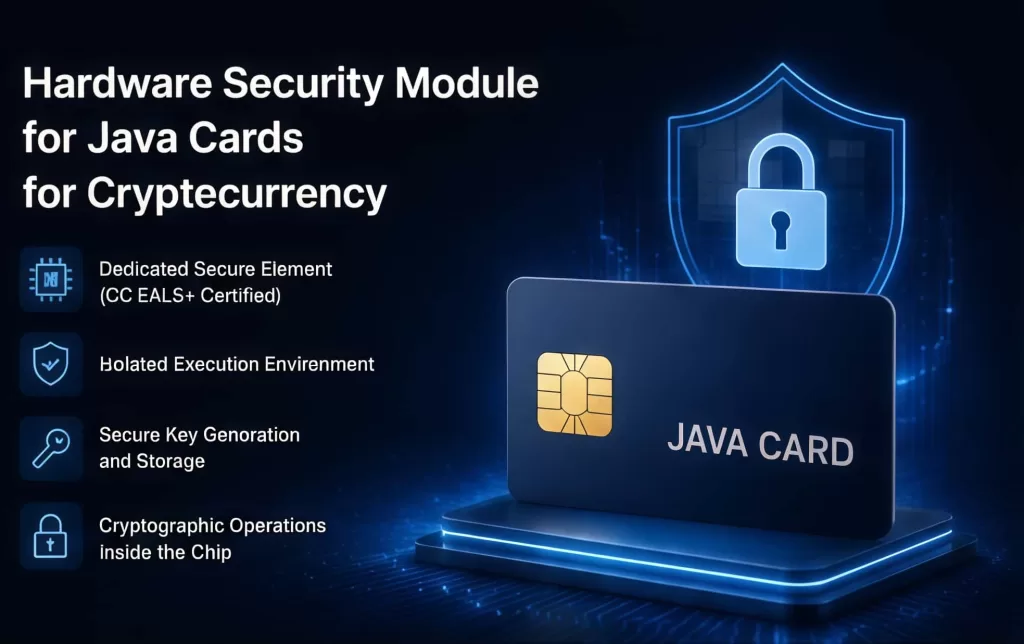
Private Key Isolation and Closed Execution
The core of cryptocurrency security lies in the private key—a string of encrypted data that grants the holder ownership and control over digital assets. Private key leakage means financial loss. Therefore, the primary goal of any secure storage solution is to ensure the absolute privacy of the private key, inaccessible to unauthorized entities. Java cards for cryptocurrencies achieve this goal through a carefully designed architecture that enforces strict private key isolation and a closed execution environment.
In a Java card, the private key is generated and stored internally within a secure element. This means that even during transaction signing, the key never leaves the chip. When a user initiates a transaction, unsigned transaction data is sent to the Java card. The card’s secure operating system runs a dedicated cryptocurrency applet that signs the transaction using an internally stored private key. Only the signed transaction, not the private key itself, is released from the card. This ensures that transaction data remains confidential and tamper-proof throughout its journey to and from the card.
Furthermore, the closed execution environment of the cryptocurrency Java card provides robust protection against various forms of attacks, including side-channel attacks (SCA), such as Simple Power Analysis (SPA) and Differential Power Analysis (DPA), as well as fault injection attacks.
Internal Structure of the J3R180 and J3R452 Java Cards
To better understand the practical application of these security principles, it is essential to examine the architectures of leading cryptocurrency Java cards, such as the J3R180 and J3R452. These NXP chip-based cards represent the cutting edge of secure element technology, with unique advantages that meet the stringent requirements of digital asset protection.
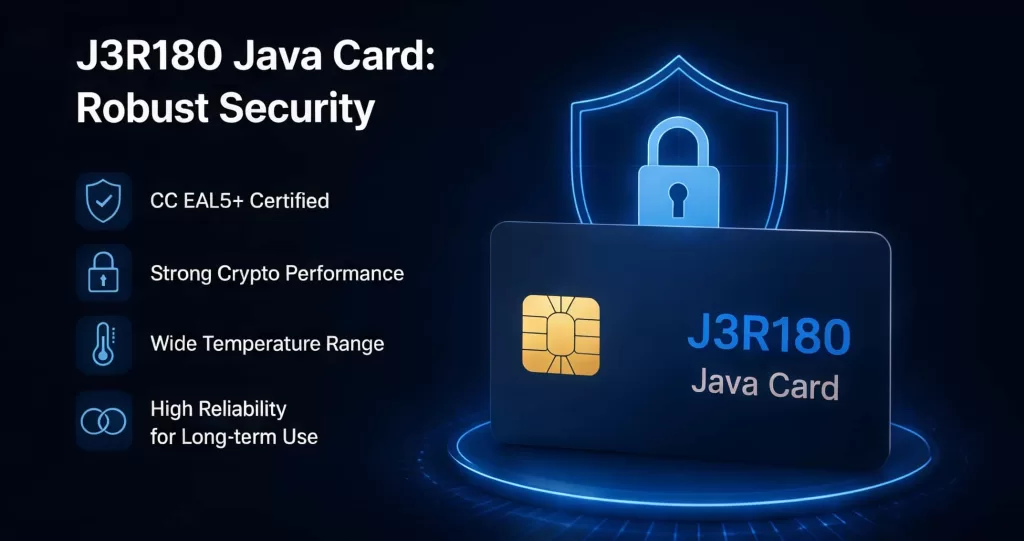
J3R180 Java Card: Robust Security
The J3R180 is a highly secure Java Card platform, typically running Java Card 3.0.5 Classic.It offers strong encryption and ample memory, giving developers enough space to run dedicated cryptocurrency applets. Key technical specifications include:
- Memory: Typically provides approximately 180KB of non-volatile memory (NVM), providing sufficient space for the Java Card operating system, GlobalPlatform components, and multiple cryptocurrency applets. Advanced security features protect this memory to prevent unauthorized reading or modification.
- Encryption Algorithms: Supports a variety of modern encryption algorithms required for blockchain interaction. This includes ECC with key lengths up to 521 bits, crucial for Bitcoin, Ethereum, and many other cryptocurrencies. It also supports RSA encryption up to 4096 bits, as well as various SHA family hash algorithms for transaction integrity and digital signatures.
- Certifications: The J3R180 Java Card has received advanced security certifications, such as the general guideline EAL6+, indicating that it has passed rigorous evaluation against sophisticated attack methods.
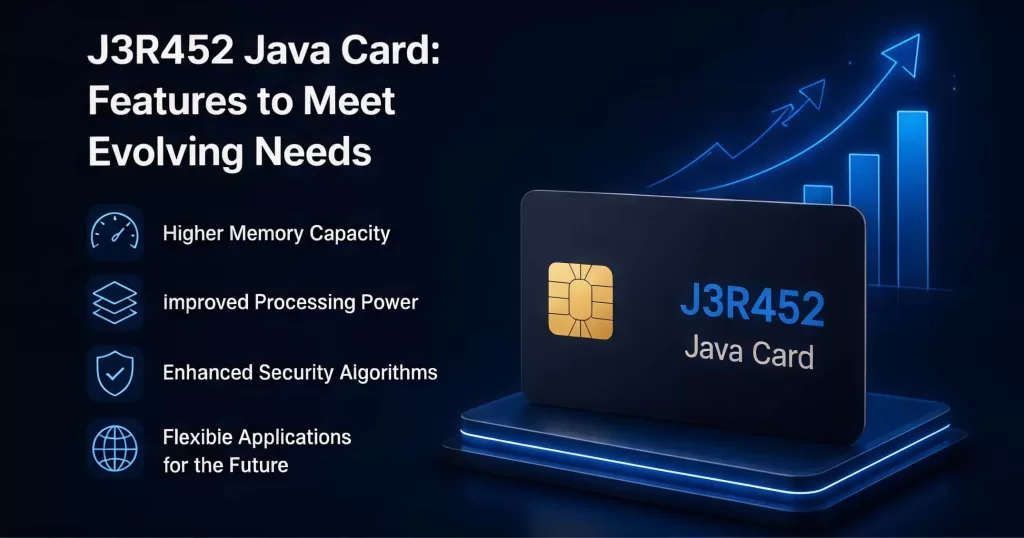
J3R452 Java Card: Features to Meet Evolving Needs
The J3R452 represents a revolution in cryptocurrency Java card technology, providing more powerful features for demanding applications. Building on the strengths of its predecessors, the J3R452 Java Card offers the following features:
- Larger Memory Capacity: The J3R452 Java Card boasts a larger NVM capacity (typically exceeding 450KB), allowing it to host more complex cryptocurrency apps and manage richer transaction histories or multi-signature schemes. The larger memory capacity also facilitates storing larger cryptographic parameters or multiple key pairs used for various blockchain interactions.
- Advanced Encryption Support: In addition to standard ECC and RSA algorithms, the J3R452 typically supports advanced elliptic curve algorithms such as Brainpool to meet specific blockchain requirements or future encryption standards.
- High-Speed Interface: The J3R452 Java Card boasts impressive transaction speeds, reaching up to 848Kbps on its contactless interface. This high throughput is crucial for enabling seamless, fast payment experiences in physical retail environments or for rapid interaction with decentralized applications (dApps).
Both the J3R180 and J3R452 operate within the GlobalPlatform framework, which provides a standardized infrastructure for managing applications on the card. This ensures interoperability and supports secure post-issuance management, which is critical for the dynamic cryptocurrency environment.
Java Cards for Cryptocurrency Enable Dynamic Loading and OTA Updates
The cryptocurrency space is characterized by rapid innovation and continuous development. New blockchain protocols, cryptographic algorithms, and security standards emerge constantly. This dynamic environment presents a challenge for hardware-based security solutions: how to maintain relevance and security without frequent hardware replacements? Java Cards for Cryptocurrency address this challenge by supporting dynamic application loading and over-the-air (OTA) updates.
The architecture of the Java Card platform allows for the secure loading of new applications after the card is issued to the user. This means that if a new cryptocurrency becomes popular, or if a user wants to add support for a specific token not initially included, they can securely download the new application and install it on their Java Card.
Furthermore, OTA (Over-The-Air) updates are a key feature for maintaining security and functionality. As cryptocurrency security practices evolve or developers discover minor vulnerabilities, organizations can securely update the Java Card operating system and existing applets remotely. The card issuer or applet developer typically signs these updates to ensure their authenticity and integrity before installation.
Better Protection for Your Digital Assets
Java Cards for cryptocurrencies offer unparalleled protection for private keys thanks to their robust Hardware Security Module (HSM) capabilities, ensuring they are generated, stored, and used in a closed, tamper-proof environment. This fundamental isolation, coupled with advanced defenses against side-channel and fault-injection attacks, creates an impenetrable barrier to unauthorized access and cryptographic vulnerabilities. The Java Card platform’s multi-application architecture provides users with flexible multi-currency management, allowing a single card to securely host applets for multiple cryptocurrencies, including Bitcoin and Ethereum. This single-card, multi-chain approach simplifies asset management while maintaining stringent security standards.