
 Español
  English


A custom Java Card is more than just a plastic card with an embedded chip. It is a secure execution platform that runs multiple applications on a single tamper-resistant device. Given the diverse customization requirements, Java Cards have become the preferred choice for products in payment, identity verification, transportation, access control, and security authentication. For custom Java Card projects, we offer three chip series:
- NXP JCOP Series
- Infineon SECORA/SLE Series
- China Financial Chip
Each of these three chip series meets the security levels, certification paths, memory configurations, application ecosystems, and localization requirements of different target markets.
NXP JCOP Series: The Most Widely Used Chip Choice for Custom Java Card
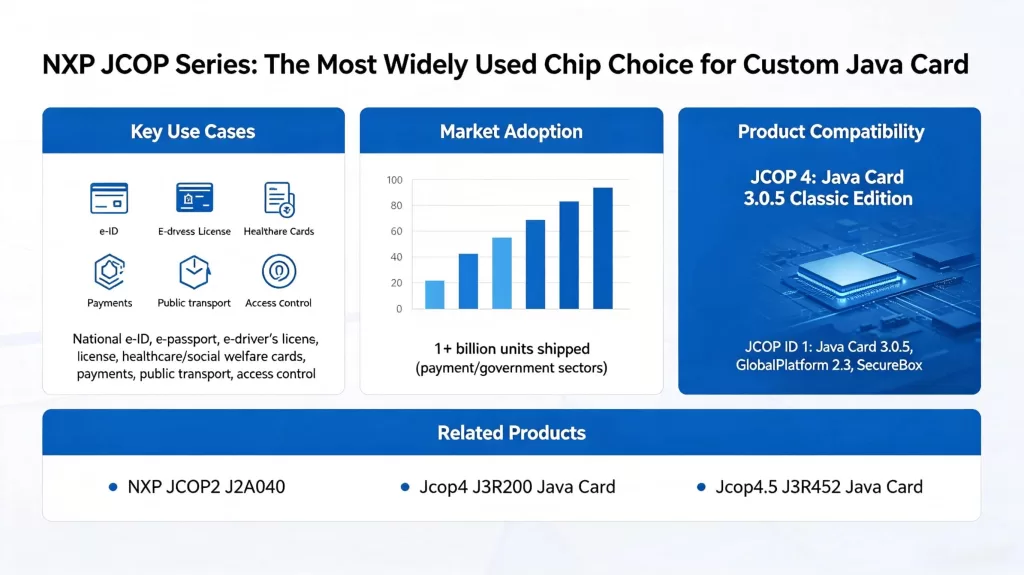
Within the commercial Java Card ecosystem, the NXP JCOP series stands out as one of the most widely adopted and well-established platforms on the market. NXP positions JCOP as a trusted Java Card operating system platform for secure integrated circuits, highlighting its use cases in national e-ID cards, e-passports, e-driver’s licenses, healthcare and social welfare cards, payments, public transportation, and logical or physical access control. NXP’s earlier but still relevant public documentation also notes that organizations have deployed the JCOP platform on a massive scale, with more than 1 billion units shipped across the payment and government sectors.
For custom Java Card production, JCOP is the most flexible solution if a project requires a stable Java Card ecosystem, broad application coverage, and a clear migration path across generations. Specifically, JCOP 4 is compatible with Java Card 3.0.5 Classic Edition. At the same time, JCOP ID 1 is compatible with Java Card 3.0.5 and GlobalPlatform 2.3, and supports SecureBox, enabling secure deployment of customer IP.
Where is JCOP Best Suited?
JCOP works particularly well for payment cards, government ID cards, transit cards, and other projects that need large-scale deployment and the flexibility to support multiple applications on a single card. JCOP ID 1 supports e-passports, driver’s licenses, national ID cards, health cards, and optional MIFARE payment applications. At the same time, JCOP 4 is positioned as a platform for secure document and transaction scenarios.
Related products include:
- NXP JCOP2 J2A040
- Jcop4 J3R200 Java Card
- Jcop4.5 J3R452 Java Card
Infineon SECORA and SLE Series: High-Security Solution Chips for Identity and Payment
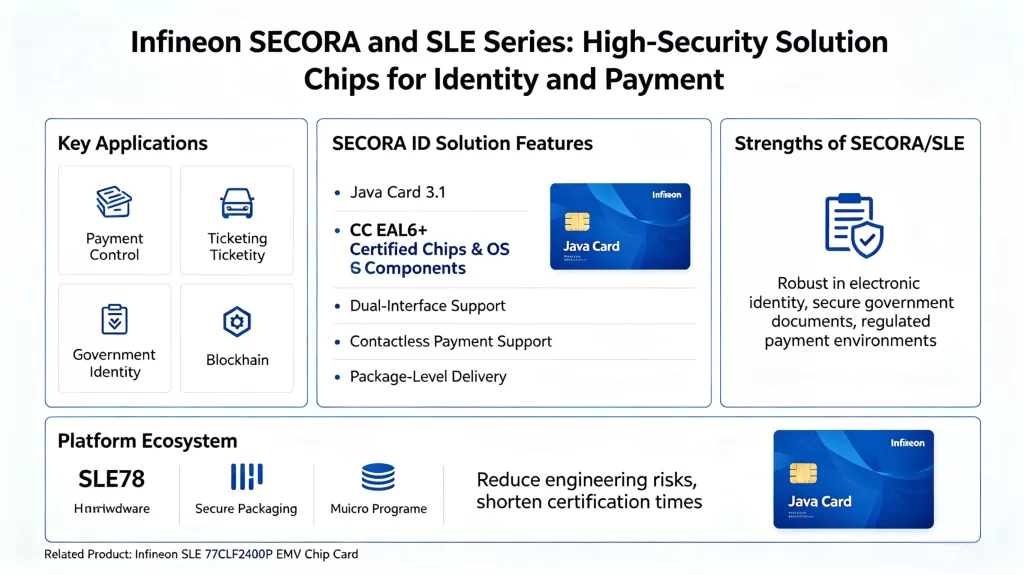
When projects prioritize high security, strict authentication, and strong compatibility with identity or payment issuance, Infineon’s SECORA series is the ideal choice. Infineon’s SECORA is suitable for payment, access control, ticketing, government identity, and blockchain applications. Infineon specifically developed the SECORA ID solution as a ready-to-use Java Card security platform for electronic identity applications.
Infineon’s SECORA ID page lists its key advantages, including Java Card 3.1, CC EAL6+ certified chips and operating system components, dual-interface support, contactless payment support, and package-level delivery. This makes SECORA particularly attractive when card issuers require a turnkey identity platform rather than bare chips paired with standalone software stacks.
The Strengths of SECORA/SLE
SECORA and SLE are particularly robust in electronic identity, secure government documents, and regulated payment environments, where authentication and lifecycle trust are just as critical as core functionality. Infineon’s materials showcase a platform ecosystem encompassing SLE78 hardware, secure packaging, ready-to-use microprograms, and middleware support. This architecture is highly valuable for customers seeking to reduce engineering risks and shorten certification times.
Related products include:
Infineon SLE 77CLF2400P EMV chip card
China Financial Chip Series: Policy-Driven Custom Java Card Projects
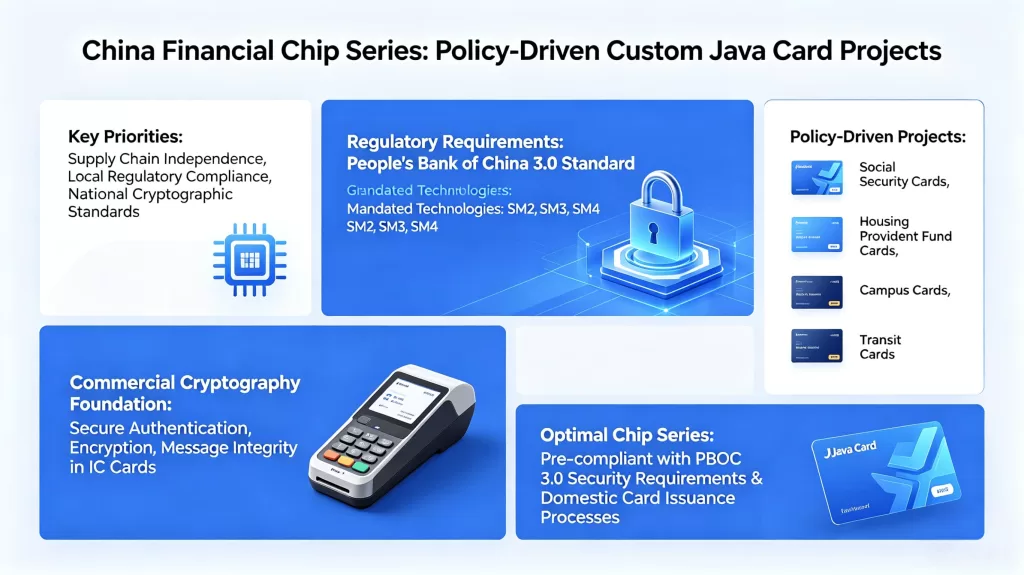
When a project prioritizes supply chain independence, local regulatory compliance, and national cryptographic standards, the China Financial Chip Series often becomes the preferred choice. The State Cryptography Administration of China has clarified that the “People’s Bank of China 3.0” standard establishes specific security enhancement requirements for debit and credit card applications and explicitly mandates the use of SM2, SM3, and SM4 technologies within the financial IC card ecosystem. The agency also notes that commercial cryptography provides the technological foundation for secure authentication, encryption, and message integrity in IC cards.
This is critical for social security cards, housing provident fund cards, campus cards, transit cards, and other policy-driven projects where domestic procurement is a strategic requirement. In this context, the optimal chip series for custom Java Card applications consists of chips that already comply with the People’s Bank of China 3.0 security requirements and domestic card issuance processes.
Fudan Micro FM1280: A Practical Chinese Java Card Platform
The FM1280 is a dual-interface chip featuring 80K of data space, GP standard compliance, support for Java Card applications, and UnionPay chip card security certification at the EAL4+ level. Therefore, when a project requires a financial IC architecture compatible with Java Card and supporting dual-interface capabilities, the FM1280 is the ideal choice for domestic custom Java Card production. Fudan Microelectronics has also released a series of smart card chips, with applications spanning public transportation, retail, bank cards, social security cards, medical insurance cards, access control, and identity recognition.
How to Match Chip Series with Custom Java Card Types
The best approach to selecting a chip series is to start with the business scenario rather than the chip catalog.
- If the Java Card is intended for EMV payments, JCOP and SECORA Pay are the natural choices, as both ecosystems are built specifically for financial security and card issuers.
- If the card is used for electronic ID cards or passport issuance, JCOP ID and SECORA ID are more suitable.
- If the card is used for domestic public service projects, domestically produced financial chips that support Java Card and comply with the People’s Bank of China 3.0 standard are a safer bet.
When a project requires the broadest global compatibility and the most streamlined Java Card ecosystem, use JCOP. When authentication depth and identity-level security are primary considerations, use SECORA/SLE, and when policy, sovereignty, or local encryption compliance is more important than international standardization, use Chinese financial chips.
Selecting the Most Appropriate Java Card Chip
We can generally divide the chip series used for custom Java cards into three major categories. NXP JCOP is the most balanced and globally recognized choice for payment, identity, transportation, and multi-application cards. Infineon SECORA/SLE is the most reliable choice for electronic identity, e-passports, and regulated payment projects. When prioritizing alignment with the People’s Bank of China 3.0 standard, adopting domestic encryption technology, and ensuring supply chain autonomy, you can choose Chinese-manufactured financial chips such as Fudan Microelectronics’ FM1280 and the Huada Smart Card series.