
 English
 Español



Yes. The TMC THD89 Java Card, through its single-chip, dual-application architecture, can simultaneously support both China’s PBOC and international EMV payment applications on a single bank card. Banks do not need to issue separate cards for domestic and international transactions; instead, they can load both payment applications onto the secure chip of the same card. Each application has its own Application Identifier (AID), payment data, encryption keys, and personalized configuration, enabling compatible terminals to select the appropriate payment application for a transaction.
The THD89 Java Card supports the Java Card 3.0.4 and GlobalPlatform 2.2.2 standards, as well as a variety of encryption algorithms, including RSA, ECC, SM2, SM3, and SM4. However, installing the two applications is just the beginning. Banks must also properly configure the application selection mechanism, payment credentials, terminal compatibility, and transaction routing.
How does a single TMC THD89 Java Card support both domestic and international payment applications simultaneously?
The key lies in distinguishing between the “physical chip” and the “payment applications running on the chip.” A bank card typically contains a single secure chip, but that chip can host multiple payment applications. Each application follows its own payment rules while sharing the underlying hardware infrastructure and secure execution environment.
For THD89-based dual-application cards, the PBOC application and the international EMV application can coexist without requiring two separate chips. This not only reduces the need for cardholders to carry multiple cards for different payment scenarios but also allows issuing banks to manage each application’s configuration independently.
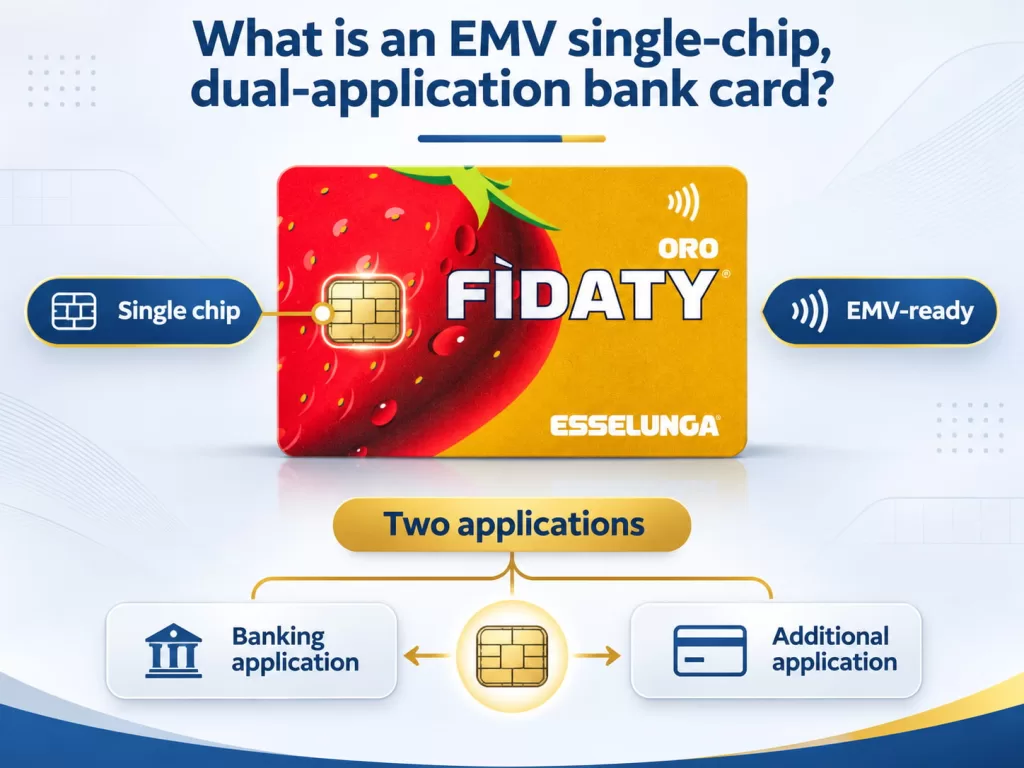
What is an EMV single-chip, dual-application bank card?
An EMV single-chip, dual-application bank card refers to a card that contains two payment applications within a single physical security chip:
Domestic PBOC application: Processes transactions through compatible domestic payment infrastructure.
International EMV application: Processes transactions through relevant international payment organizations (payment schemes) and their compatible terminals.
Although these two applications share the same chip, they are logically independent. Each application has its own AID and payment configuration, which enables the terminal to identify which application should process the current transaction. The THD89 chip provides the required underlying Java Card environment and cryptographic capabilities for this architecture.
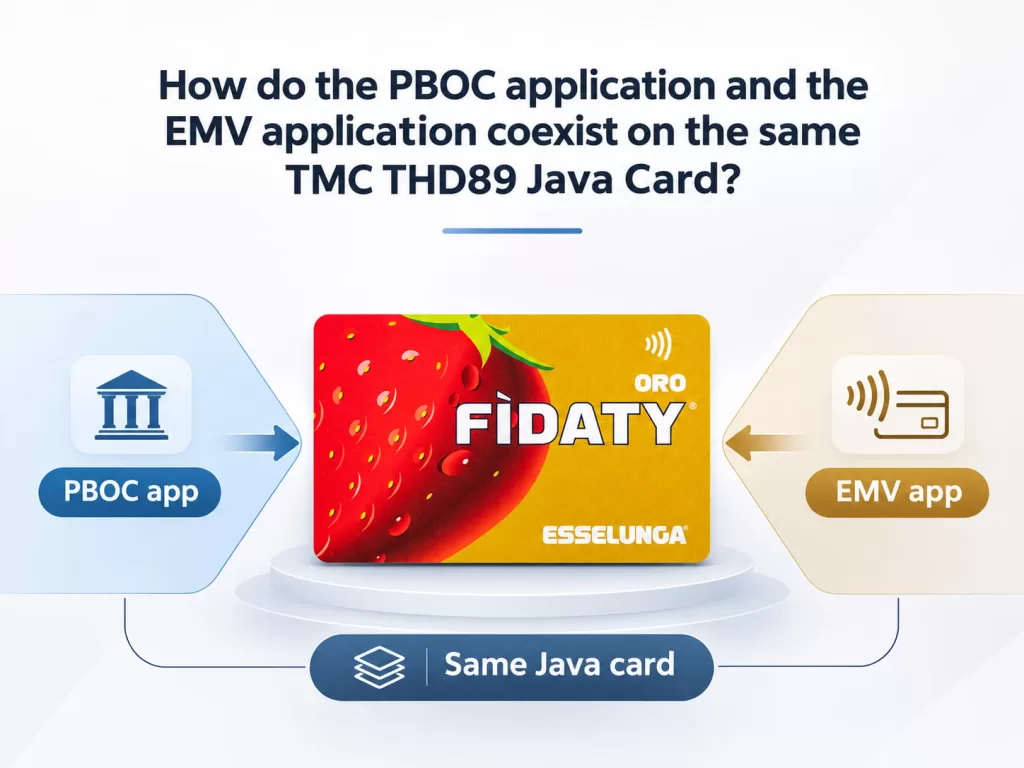
How do the PBOC application and the EMV application coexist on the same TMC THD89 Java Card?
These two applications are installed and personalized separately within the same chip. Each application requires its own independent configuration, including:
- Application Identifier (AID);
- Payment account and application data;
- Encryption keys and authentication parameters;
- Transaction rules and risk management settings.
The THD89’s Java Card environment supports loading multiple applications, and its cryptographic capabilities meet the security requirements of various payment environments.
How does a payment terminal identify the correct application?
A payment terminal does not automatically determine whether a card belongs to a domestic or international application simply by identifying the chip model; instead, it identifies the application by comparing the AIDs supported by the card with those supported by the terminal.
The typical processing flow is as follows:
Present card → Application discovery → AID matching → Application selection → Payment processing
For contact transactions, EMV terminals use an application selection process, such as the mandatory “AID list” method. In contactless transactions, the terminal can obtain available payment applications through the “Proximity Payment System Environment” (PPSE).
When both the card and the terminal support multiple applications, the terminal can determine which application to use based on its configuration, application priority, or the cardholder’s selection. (See the “Visa EMV Application Selection Guide.”) Therefore, domestic terminals may select the PBOC application, while compatible international terminals may select the corresponding EMV application.
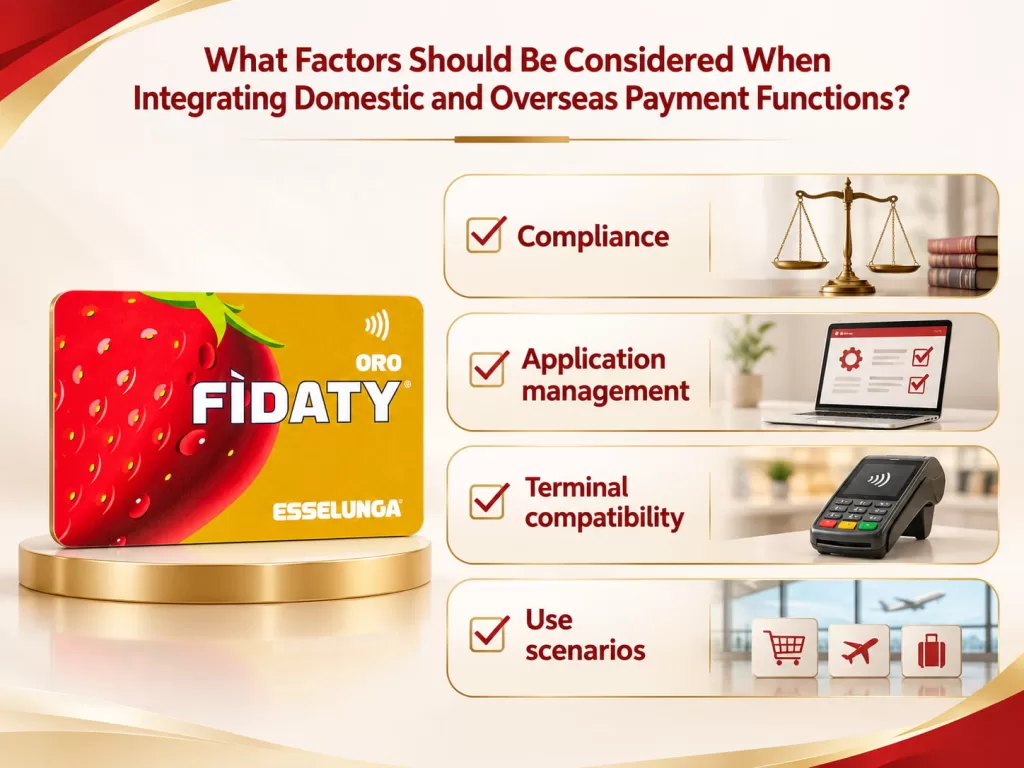
What Factors Should Be Considered When Integrating Domestic and Overseas Payment Functions?
Although both payment applications can coexist on the same THD89 Java Card, the issuing bank must coordinate their configuration. It is not sufficient to install these two applications independently without considering how they interact with the bank’s personalization system, payment terminals, and transaction processing infrastructure.
The most critical considerations include: application identifiers, card reader compatibility, and the secure management of payment data. These factors determine whether the final card will operate reliably in both domestic and international payment environments.
Are separate AIDs and personalization configurations required?
Yes. Each payment application must have its own unique AID and corresponding personalization configuration.
Banks must define application labels, account information, keys, transaction parameters, and application priorities. Additionally, banks must specify whether these two applications are linked to the same underlying bank account or represent distinct payment products. For security reasons, application-specific keys should be managed independently through the issuing bank’s secure key management infrastructure. This prevents the automatic sharing of the same credentials across domestic and international payment environments.
Do existing POS terminals and ATM systems support this new card?
Support is not automatic. Existing terminals must recognize the corresponding applications and meet their payment processing requirements.
For example:
- Domestic POS terminals must support the PBOC (People’s Bank of China) application and its transaction specifications.
- Overseas POS terminals must support the corresponding EMV payment applications.
- ATMs must support the corresponding contact-based interfaces, applications, and transaction functions.
Banks should also verify their acquiring networks, transaction routing, and host processing configurations. For incompatible terminals or payment networks, transactions cannot be forced through even if the card supports dual applications.
How should security, encryption algorithms, and payment data be managed?
These two applications should maintain their own payment credentials, authentication data, and encryption key configurations separately.
The THD89 chip supports RSA, ECC, SM2, SM3, SM4, and other encryption capabilities listed in the DCCO product specifications. These capabilities lay the foundation for meeting the relevant requirements of domestic and international payment applications. However, banks must ensure that each mini-program uses the correct algorithms, keys, and security parameters corresponding to its payment profile. Furthermore, personalized configuration and key injection should be performed within a controlled and authorized production process.
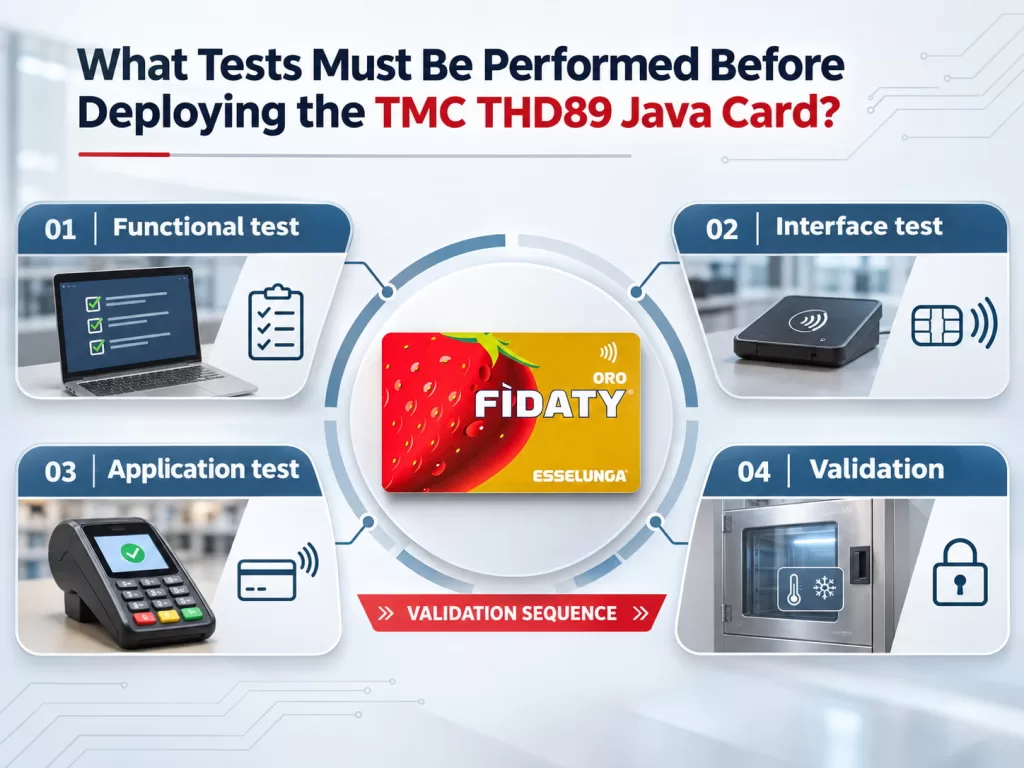
What Tests Must Be Performed Before Deploying the TMC THD89 Java Card?
A successful dual-application design must be validated to ensure it functions properly as a complete payment card. Before issuing the card, banks and card manufacturers should verify the application selection, transaction processing, encryption operations, the accuracy of personalized data, and compatibility with the intended POS and ATM infrastructure.
This is particularly important because even if two applications are successfully loaded onto the card, issues may still arise during actual payment transactions.
How should the two payment applications be tested on different terminals?
Testing should cover the payment environments and various interfaces required by the project.
Key test items include:
- Application Selection: Confirm that both domestic and international terminals can select the correct Application Identifier (AID).
- Transaction Processing: Test typical retail transactions and other necessary payment operations.
- Interface Compatibility: Verify contact and contactless transactions (as applicable).
- Security: Check authentication, encryption operations, and transaction data.
Back-End Integration: Confirm that transactions are accurately transmitted to the corresponding issuing institution and payment processing systems.
The TMC THD89 Java Card has also been used in specific dual-interface Visa payment card configurations. For example, the official Visa list of certified cards includes the THD89-F350A configuration, which utilizes the VSDC 2.9.2 payment application. This indicates that cards based on the THD89 platform have passed international payment certification; however, it should be noted that this certification applies only to specific product configurations, not all THD89 cards.
Can a single TMC THD89 Java Card support both domestic and international payments?
Yes. The TMC THD89 card employs a “single-chip, dual-application” EMV architecture, enabling it to support both domestic PBOC payment applications and international EMV payment applications on the same secure chip.
To achieve this functionality, the following four key conditions must be met:
- Application Configuration: Two payment applications must be installed, each configured with its own Application Identifier (AID) and personalization data.
- Security Management: Encryption keys and payment credentials must be properly isolated and managed.
- Terminal Compatibility: Both domestic and international card readers must recognize and support the corresponding payment applications.
- Production Validation: Before card issuance, both transaction environments must be tested separately.
The THD89 Java Card provides a secure Java Card platform for such banking projects. The goal is to enable a single physical bank card to support two payment environments while ensuring the security and independence of each application and the reliability of transaction processing.