
 English
  Español

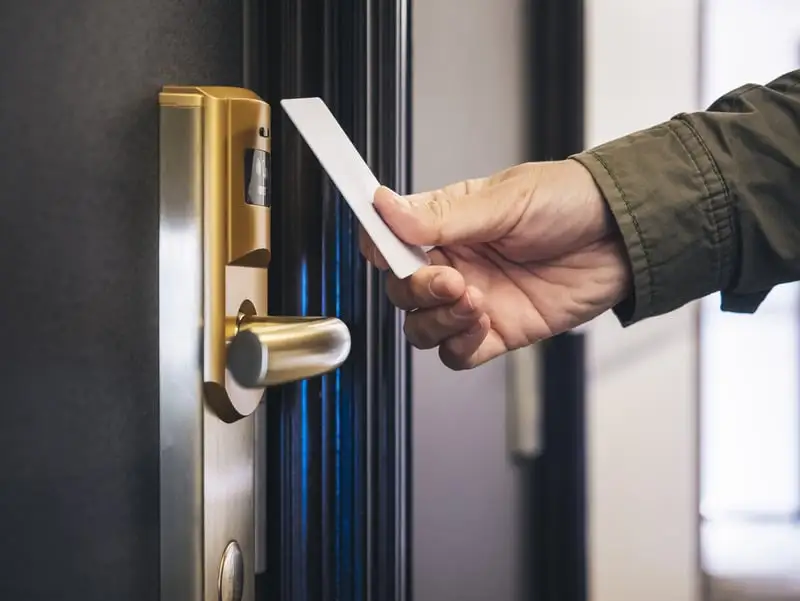
Antenna geometry, chip tuning, reader hardware, installation environment, card structure and wear, and system configuration all interact to determine whether a hotel key card can be reliably read at 1 cm or fails to read at nearly 7 cm. Based on these factors, we have compiled several key influences on the reading range to help you better understand hotel room cards based on the NXP MIFARE Ultralight EV1 chip.
Core Factors Affecting Hotel Key Card Reading Range
The reading range of hotel key cards based on the NXP MIFARE Ultralight EV1 is 0-10 cm, primarily due to its 13.56 MHz near-field magnetic coupling. Unlike long-range RFID systems, this technology relies on inductive coupling between the reader coil and the card antenna. Because the system operates in the near-field of a magnetic field, signal strength decreases rapidly with increasing distance. Even a 1-2 cm change in distance can significantly impact performance. The Ultralight EV1 chip requires a certain induced voltage to power the chip and enable ISO14443 Type A communication. If electromagnetic coupling cannot provide sufficient energy, a transaction will fail even if the card is within the theoretical 10cm effective range.
Impact of Hotel Key Card Antenna Design and Card Structure
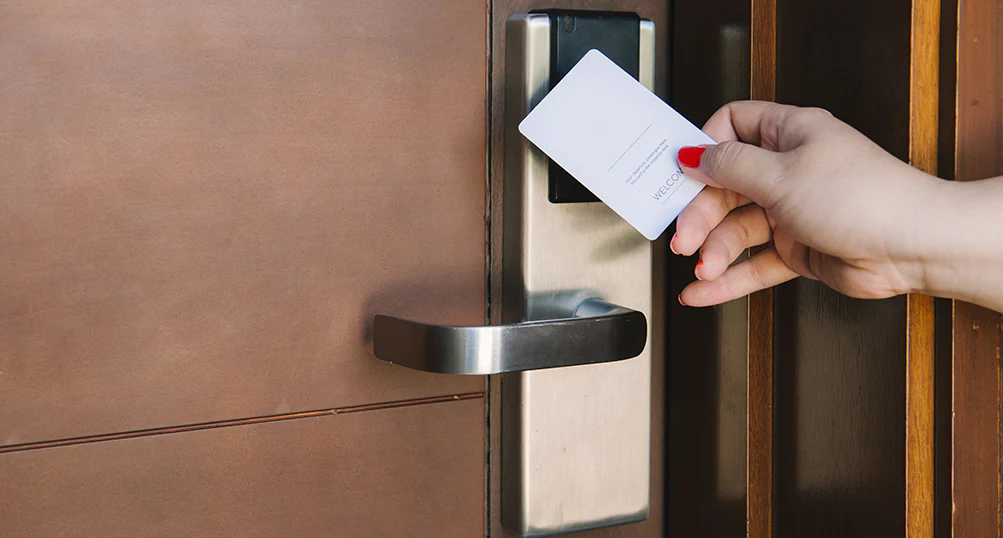
The antenna embedded within the hotel key card is one of the most critical factors affecting readability.
Antenna Geometry and Loop Design
- A larger antenna loop area increases magnetic flux coupling.
- Optimized trace width reduces resistive losses.
- Appropriate coil turns balance inductance and quality factor.
- Full-card CR80 loop designs generally offer stronger performance.
However, while an excessively high Q value can improve peak range, it reduces tolerance to detuning. Therefore, specialized antenna optimization aims to balance sensitivity and environmental adaptability.
Card Coating and Stacking Effects
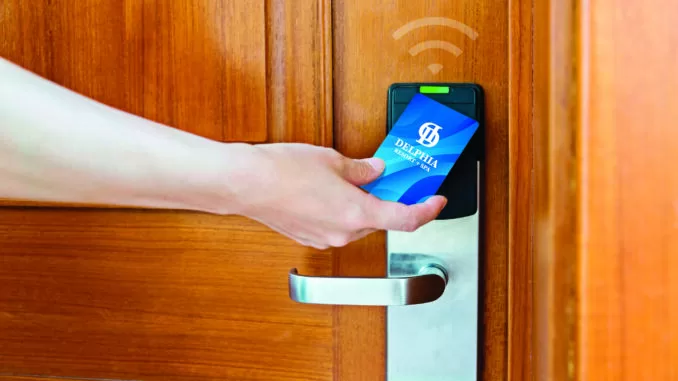
The physical structure of a hotel key card includes PVC/PET coatings, adhesives, and printing layers, all of which affect the resonant frequency. Improper design can lead to high-dielectric-constant adhesives or metallic security features that reduce readability. Furthermore, inlay placement accuracy is crucial. Even a slight misalignment of the antenna can shift the optimal reading area, leading to an inconsistent user experience with hotel door locks. Therefore, consistently stable antenna manufacturing and rigorous quality control are crucial for maintaining reliable performance over the 0-10 cm reading range.
Hotel Key Card Reader Hardware and Magnetic Field Strength
Contactless systems are always a two-way balancing act. Even the best hotel key cards cannot perform optimally without a well-designed reader. Reader coil size, transmit power, receiver sensitivity, and firmware configuration collectively determine the achievable reading distance. Larger reader coils generate stronger, more uniform magnetic fields. High-sensitivity analog front-end (AFE) circuits can detect weak return signals from the card. However, increasing magnetic field strength is not always the best solution. Regulatory compliance and electromagnetic compatibility (EMC) requirements limit maximum output power. Therefore, system-level tuning between the reader and the hotel room card is essential.
Environmental and Manufacturing Factors Affecting Hotel Key Card Reading Stability
Metal door frames, lock bodies, and mounting screws can cause a loss of the reader antenna frequency. Even a minute amount of metallic contact can absorb magnetic energy, reducing the effective communication range. Ferrite shielding and non-metallic pads are typically required to maintain stable performance. Human interaction is also crucial. Guests may present their room cards at an angle, in their wallets, or stacked with other cards. Wallet materials increase the distance between the room card and other cards, introducing dielectric load and reducing coupling efficiency. Variations in temperature and humidity alter dielectric properties and antenna resonant frequencies. While the NXP MIFARE Ultralight EV1 chip is stable and reliable, its performance under extreme conditions should still be verified during system testing.
Manufacturing Tolerances and Card Aging Effects
Differences in antenna position, copper wire thickness, solder quality, and tuning capacitor values can all lead to measurable range deviations between batches. Therefore, rigorous RF quality inspection is essential during circuit board manufacturing. Custom processes can also affect performance. Hot stamping, metallic inks, holographic foil, or UV coatings near the antenna, if not thoroughly tested, can cause circuit detuning. Over time, card wear poses an additional risk. Repeated bending, moisture, and mechanical stress can all degrade antenna integrity. High-quality lamination processes and durable inlay bonding technologies minimize performance degradation.
Ensuring Precise Reading Range
The 0-10 cm reading range of hotel key cards, which is affected by the NXP MIFARE Ultralight EV1 chip, is not solely determined by the chip itself, but rather by the combined effects of numerous factors, including antenna design, card structure, reader hardware, installation environment, manufacturing quality, and firmware configuration.
Optimizing a single factor rarely guarantees success. Instead, reliable performance requires system-level validation, from RF simulation and antenna tuning to field testing and batch quality control. By combining rigorous manufacturing processes with professional reader calibration, hotel key cards can ensure a secure, fast, and consistent access experience for guests within the expected 0-10 cm operating range.