
 English
  Español


The true value of DESFire technology lies in its ability to transform 13.56MHz RFID cards into a secure, standards-compliant platform suitable for access control, public transportation, smart city services, mobile credentials, and other high-trust applications. NXP positions the MIFARE DESFire EV3 as a high-security IC for contactless smart city services. The chip complies with ISO/IEC 14443 A 1-4 and ISO/IEC 7816-4 standards, is Common Criteria EAL5+ certified, and supports a variety of open cryptographic algorithms. It integrates encryption, authentication, privacy controls, and transaction integrity into a mature platform.
Why is DESFire a powerful security foundation for 13.56MHz RFID cards?
DESFire is specifically designed for scenarios where 13.56MHz RFID cards are required not only to identify users but also to perform additional functions. NXP’s DESFire series is built around multi-application support, secure communication, and compatibility with existing contactless infrastructure. The EV3 products support multiple applications within their storage capacity limits, with each application capable of containing up to 32 files and transferring up to 848 kbit/s, while retaining security features such as mutual authentication, RF channel encryption, and application-level access control. This combination of features makes it better suited to professional card-application projects than basic proximity cards.
From a deployment perspective, its architectural design is equally critical. NXP states that the series complies with ISO/IEC 14443-1 to -4 and ISO/IEC 7816-4, and that the EV3 platform is also compatible with the NFC Forum Type 4 specification. In practical applications, this means that 13.56 MHz cards based on DESFire technology can operate within existing contactless ecosystems while providing enhanced security.
DESFire’s security is a multi-layered system
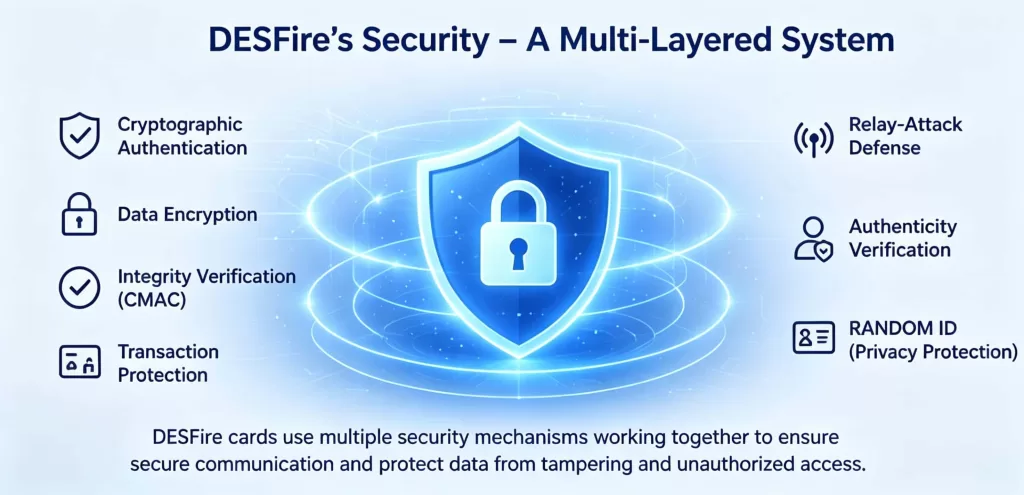
DESFire cards offer superior security compared to many traditional contactless cards because they do not rely on a single protection mechanism. NXP’s EV3 feature set integrates multiple security features, including cryptographic authentication, data encryption, CMAC-based integrity verification, transaction protection, relay-attack defence, authenticity verification, and privacy-focused identification options such as RANDOM ID. In other words, the card does more than prove its own identity it also verifies the authenticity of communications and ensures that no one has tampered with the transaction data.
This layered design is precisely what users expect from 13.56MHz cards. While campus cards, access control cards, and smart transit cards may not always need bank-level security, organizations need to raise their security standards when they store value, manage identity data, or link user entitlements to mobile devices. DESFire provides issuers with this upgrade path without requiring a future redesign of the platform.
How does DESFire protect data at the interface?
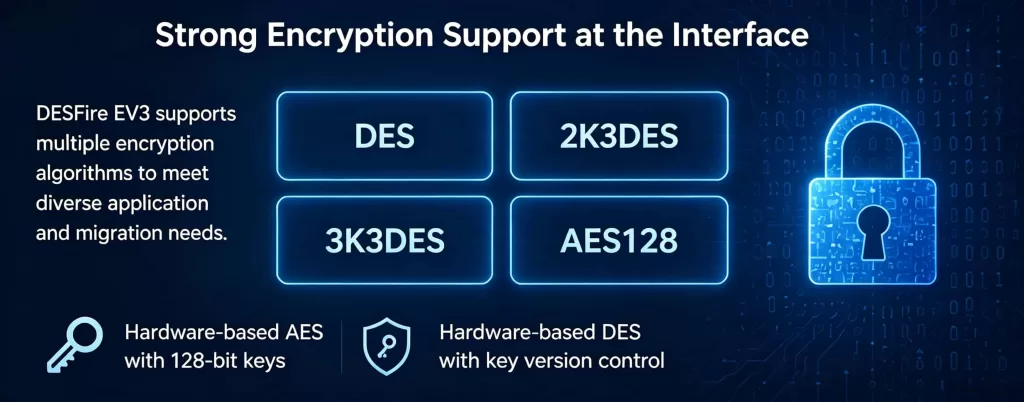
One of DESFire’s most significant cryptographic advantages is its support for multiple encryption algorithms. NXP lists the algorithms supported by the EV3 series, including:
- DES
- 2K3DES
- 3K3DES
- AES128
This provides card issuers with flexibility, allowing them to adapt seamlessly, whether they are migrating from legacy systems or building new systems from the ground up with stronger encryption technologies. The platform also supports hardware-based AES with 128-bit keys and hardware-based DES with key version control, making key lifecycle management in practical applications much easier.
Some card issuers need to maintain backward compatibility with existing legacy infrastructure, while others prefer to adopt the AES standard directly. DESFire-based 13.56MHz cards enable card issuers to select the appropriate encryption configuration without changing platforms.
Bringing Two-Way Authentication to 13.56MHz RFID Cards
A key security advantage of the 13.56 MHz RFID card based on DESFire technology is two-way authentication. NXP lists two-way three-step authentication and ISO/IEC 7816-4-compliant two-way authentication as EV3 security features. This means that both parties to the transaction participate in verifying the card’s legitimacy, rather than the card simply responding to any reader’s request.
This is critical for anti-cloning strategies. If a system only checks static identifiers, cloning becomes much easier. Two-way authentication forces attackers to contend with real-time encrypted challenge-response behavior, which is far more difficult than replicating printed numbers or simple serial numbers.
What applications can DESFire security enable for 13.56MHz RFID cards?
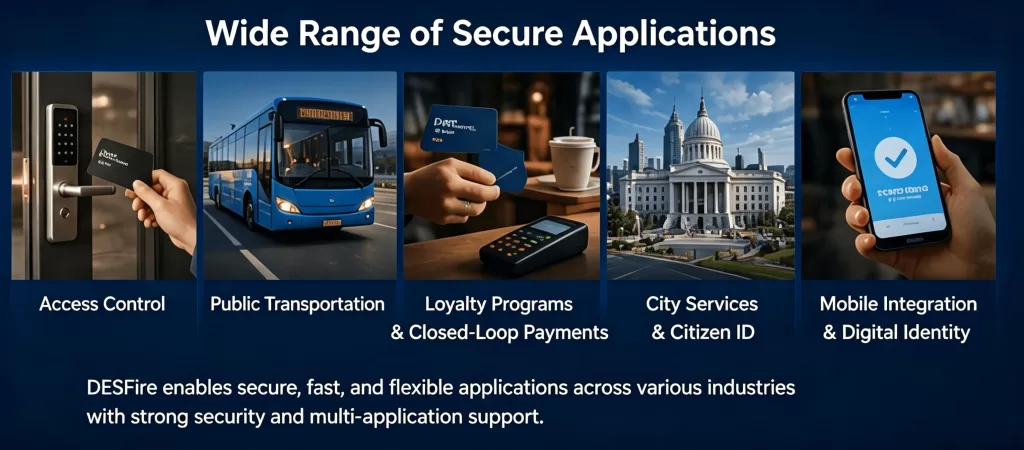
For scenarios such as access control, 13.56MHz RFID cards based on DESFire technology enable systems to verify credentials beyond static credentials. When a 13.56 MHz RFID card is used to open doors, control lockers, or unlock secure areas, two-way authentication, encryption, integrity checks, and relay protection all play a critical role.
Public Transportation, Loyalty Programs, and City Services
13.56 MHz RFID cards based on DESFire technology are also well-suited for smart city and transportation environments because they can support multiple applications, enable fast transactions, and protect executed transactions through transaction MACs and transaction timers. Examples include public transportation, ride-sharing, attraction tickets, citizen services, closed-loop payments, and loyalty programs, all on a single card. This is where the advantages of the 13.56 MHz card size truly shine. It is fast enough to handle short, repetitive interactions, while DESFire provides sufficient encryption depth to ensure its reliability.
Security Authentication and Digital Identity Scenarios
For secure authentication, DESFire enables secure identity verification and complies with mainstream contactless standards. This makes 13.56MHz RFID cards based on DESFire technology suitable not only for transportation or access control systems but also for identity recognition scenarios that require both secure authentication and a convenient user experience. More broadly, DESFire technology works well across a wide range of applications because its security model is not tied to just one business context. Whether card issuers need access control, identity verification, transportation, loyalty programs, or mobile interactions, they can adapt the same 13.56 MHz RFID card architecture to fit their needs without weakening its cryptographic core.
Delivering Multi-Layered Security for 13.56MHz RFID Cards
The cryptographic and security advantages of DESFire-based 13.56MHz RFID cards stem from their multi-layered protection, rather than a single isolated feature. DESFire integrates a variety of powerful algorithm options for 13.56 MHz RFID cards, such as AES and 3DES, and combines encrypted RF communication, mutual authentication, CMAC-based authentication, integrity checks, protection against relay attacks, transaction MAC, transaction timing control, privacy-focused ID options, and standards-based interoperability.