
 English
  Español


Choosing the appropriate thickness for a proximity card is a seemingly simple yet crucial design decision. Thickness affects the card’s fit in a wallet, durability, personalization, and compatibility with readers and holders. A comparison is made between common thin cards (approximately 0.8–0.9 mm, similar to ISO CR80) and thicker cards (approximately 1.8 mm). This section explains how thickness affects portability, manufacturing processes, antenna/insertion selection, reader compatibility, and long-term durability, especially for systems using chips such as the TK4100 125kHz RFID proximity card.
Proximity Card Thickness and Its Impact on Layers
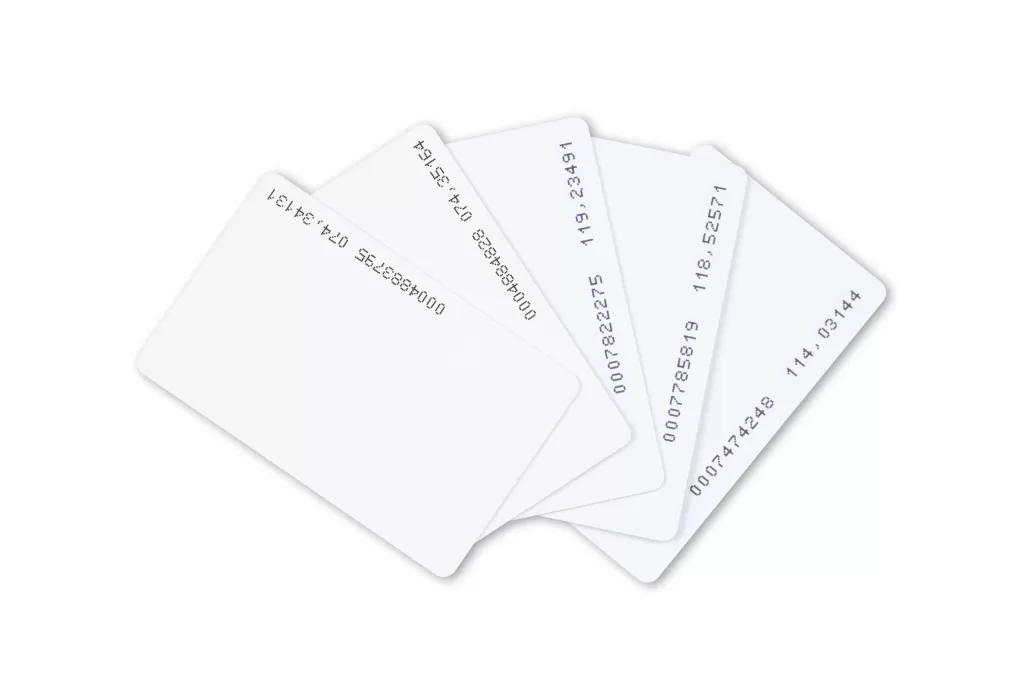
Choosing the appropriate proximity card thickness begins with understanding how users typically use cards. A 0.8–0.9 mm card thickness, very close to the standard CR80 card mount thickness, is lightweight, flexible, and easy to carry, fitting easily into wallets, card holders, or multi-card packs. This card size is widely accepted in business environments such as office buildings, hotels, and membership cards, where convenience and portability are paramount.
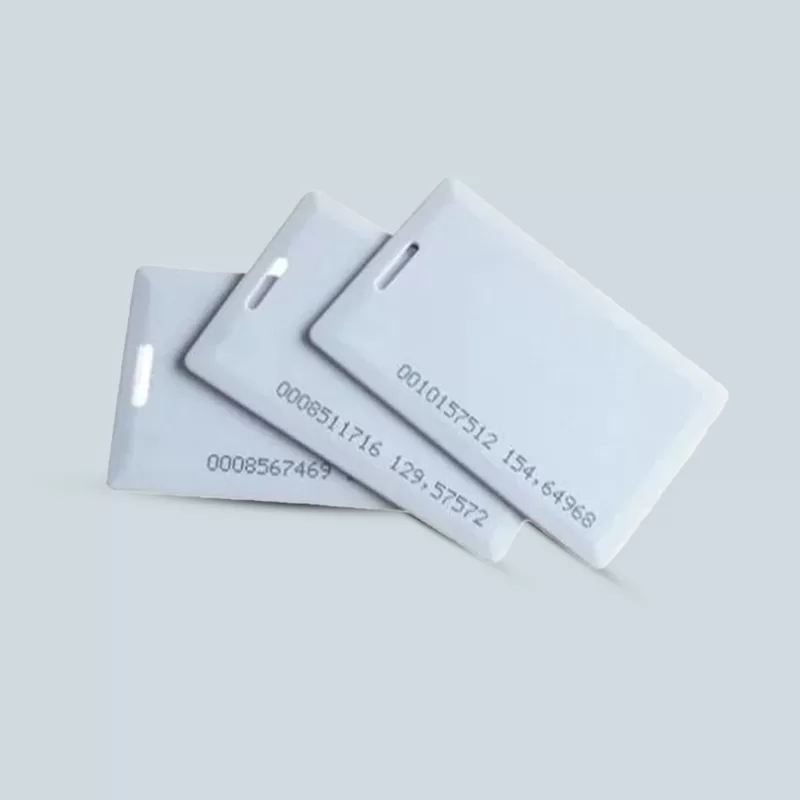
In comparison, 1.8 mm thick proximity cards are more rigid. The increased thickness improves tactile feedback when lightly touching a wall reader and reduces the likelihood of card bending or fatigue of internal components. However, thicker cards are less convenient to carry in a wallet and may not fit into thinner card slots. From a user perspective, thinner cards improve portability, while thicker cards improve structural durability and perceived robustness.

Proximity Card RF Structure and TK4100 125kHz RFID Proximity Card Performance
From an engineering perspective, RF performance depends primarily on antenna geometry, coil turns, trace resistance, and reader field strength, not just thickness. The TK4100 125kHz RFID proximity card operates at a low frequency (125 kHz) and uses inductive coupling between the card’s antenna loop and the reader coil.
Cards with a thickness of 0.8–0.9 mm typically place the antenna slightly closer to the reader surface, which can slightly improve the inductive voltage under some poor mounting conditions. A 1.8 mm thick card will slightly increase the physical distance, but in a properly tuned system, this difference rarely causes functional problems. Proper antenna tuning during manufacturing ensures consistent read performance regardless of card thickness. Therefore, RF compatibility should always be verified using final production materials rather than relying on theoretical assumptions.
Short-Range Reader Compatibility and Mechanical Limitations
Reader compatibility must be evaluated from both electromagnetic and mechanical perspectives. Electromagnetically, most 125 kHz readers can detect 0.8–0.9 mm and 1.8 mm proximity cards if the antenna design and tuning are correct. However, mechanical compatibility often becomes a limiting factor.
Slot-Type Readers and Insertion Devices
If your system uses a slot-type reader or card feeder, the card thickness must strictly adhere to the CR80 standard. A 1.8 mm thick card may jam or fail to align properly in the slot.
Wall-Mounted and Surface Readers
Wall-mounted proximity card readers are generally compatible with both card thicknesses, but thicker cards may require slightly more force to insert. In high-traffic areas, this slight force can actually improve user click consistency.
Thickness, Durability, and Manufacturing Process
Durability is one of the strongest arguments for choosing 1.8 mm proximity cards. The thicker construction improves its resistance to impacts: bending fatigue, edge cracking, delamination, lanyard hole tearing, and industrial handling stress. In warehouses, manufacturing plants, or outdoor environments, thicker cards typically have a longer lifespan and lower replacement frequency.
Conversely, 0.8-0.9 mm thick cards are ideal for controlled indoor environments with minimal physical damage. Modern lamination techniques using reinforced PVC or PET significantly improve card durability, but their mechanical strength still cannot fully match that of thicker cards.
Manufacturing and Personalization Considerations
The manufacturing processes for thin and thick proximity cards differ significantly.
Cards with a thickness of 0.8–0.9 mm:
- Consistent with standard CR80 production lines
- Compatible with most desktop and industrial card printers
- Enables efficient dye sublimation and thermal transfer printing
- Enables a simplified lamination workflow
Cards with a thickness of 1.8 mm:
- May require multi-layer core stacking or cavity milling
- Lamination temperature and pressure control adjusted as needed
- Requires customization with industrial-grade printers
- May increase tooling and setup costs.
Furthermore, in thicker cards, inlay integration must be strictly controlled to prevent stress concentration points. Proper bonding technology is crucial for maintaining RF consistency and mechanical integrity.
Proximity Card Decision Matrix – 0.8–0.9 mm vs 1.8 mm
When choosing 0.8–0.9 mm proximity cards, portability and wallet comfort are primary considerations, followed by reader systems including slot-type devices, the need for large-scale issuance, frequent certificate replacements, and cost-effectiveness.
Choosing a 1.8 mm proximity card should be based on long-term durability, anticipated industrial or outdoor deployments, card attachment to lanyards or badge reels, minimizing replacement costs, and reader mechanical clearance. For systems based on the TK4100 125kHz RFID near-field card, RF performance remains stable for both thickness categories when antenna tuning and quality control standards are correctly applied. Ultimately, thickness selection is not merely an aesthetic consideration but an engineering decision that impacts availability, lifecycle costs, customized workflows, and system reliability.
Final Recommendation
The choice between 0.8-0.9 mm and 1.8 mm proximity cards should be determined based on factors such as the operating environment, reader infrastructure, manufacturing capabilities, and total cost of ownership. Thinner cards offer superior portability and broad compatibility with standard equipment. Thicker cards provide greater durability and structural strength in harsh environments. For the TK4100 125kHz system, the difference in RF performance is negligible as long as proper antenna design and verification procedures are followed. As manufacturers, we recommend conducting reader compatibility testing, mechanical clearance verification, and lifecycle simulation before determining thickness specifications.