
 English
  Español


Unlike traditional storage-based ID cards, Java Card is a “secure computing platform” that integrates embedded security hardware with programmable application capabilities. It enables government agencies and identity solution providers to deploy highly secure applications while ensuring that personal data and cryptographic credentials are strictly protected. The J3R452 Java Card is a next-generation secure smart card solution designed specifically for demanding identity authentication scenarios. Based on the advanced P71D600 platform, this card integrates an enhanced security architecture with high-performance cryptographic capabilities to meet the demands of modern identity applications.
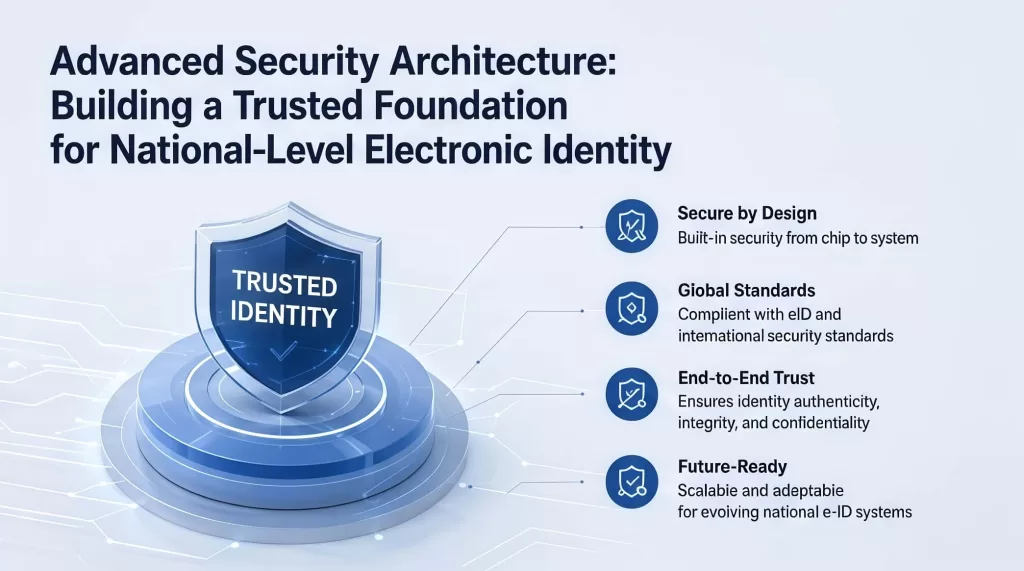
Advanced Security Architecture: Building a Trusted Foundation for National-Level Electronic Identity
National-level electronic identity systems involve citizens’ most sensitive information and therefore require extremely high security standards. Electronic identity (e-ID) credentials may contain personal identification information, biometric reference data, authentication keys, and digital signature certificates.
If these assets are compromised or tampered with, it not only jeopardizes personal privacy but may also threaten the security of the nation’s digital infrastructure. Therefore, when designing smart cards for identity authentication, professional Java Card manufacturers build a multi-layered protection system that seamlessly integrates secure hardware, cryptographic mechanisms, and application-level security controls.
The J3R452 Java smart card achieves this goal through an advanced security architecture specifically designed for high-security identity applications.
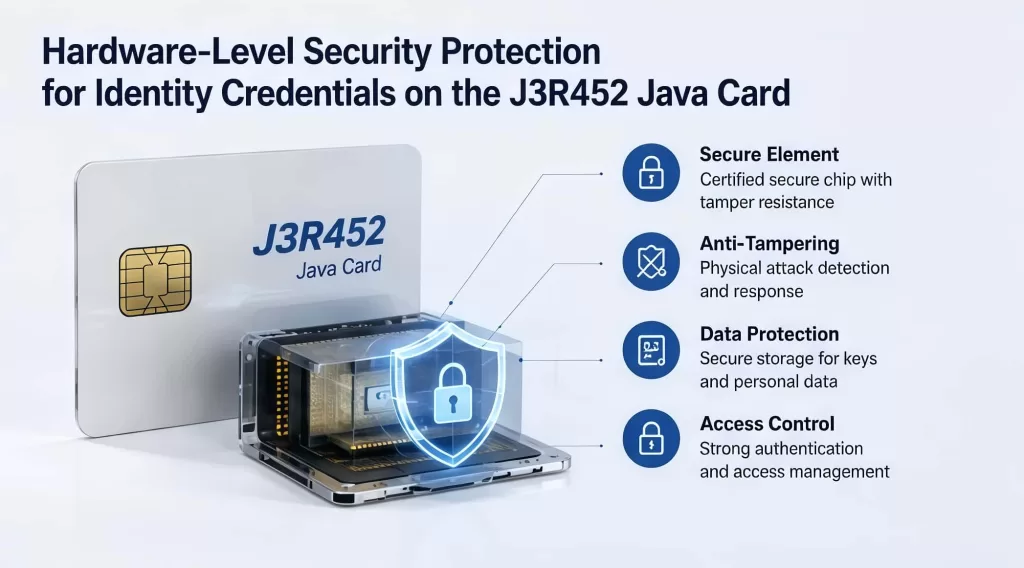
Hardware-Level Security Protection for Identity Credentials on the J3R452 Java Card
The cornerstone of the J3R452 Java Card’s security lies in its secure hardware environment. Unlike purely software-based identity solutions, a hardware-based secure element provides a dedicated security boundary for storing and processing sensitive information.
The J3R452 Java smart card protects critical assets, including private keys, digital certificates, authentication credentials, and encryption parameters. These sensitive elements are always retained within the secure chip environment, thereby reducing the risk of unauthorized extraction. For national-level electronic identity systems, this hardware protection is crucial, as identity credentials must maintain their trustworthiness even when the card is at risk of physical contact attacks.
PUF Technology: Building a Unique Hardware Identity
A key security advantage of the J3R452 Java smart card lies in its integration of Physical Unclonable Function (PUF) technology. PUF technology leverages the inherent physical properties of semiconductors to generate a unique hardware fingerprint. Each chip possesses a unique identity that cannot be easily replicated. This offers multiple security benefits:
1. Hardware Identity Binding:
PUF technology establishes a secure binding between the chip’s identity and cryptographic credentials. This effectively prevents attackers from transferring sensitive information to unauthorized devices.
2. Anti-Cloning Protection:
Since each chip possesses unique physical characteristics, creating an exact duplicate becomes extremely difficult. This significantly enhances resistance to hardware cloning attacks.
3. Enhanced Key Protection:
PUF-based mechanisms strengthen the key generation and storage processes. For national identity authentication systems, this capability provides an additional layer of security beyond traditional encryption methods.
Defense Against Side-Channel Attacks
Government identity authentication applications face complex security threats, including side-channel attacks. Such attacks attempt to steal sensitive information by analyzing physical characteristics. The J3R452 Java Card employs hardware-level security mechanisms designed to mitigate the risk of such attacks. This capability is particularly important for electronic identity (e-ID) applications, as encryption keys and authentication credentials must be properly protected throughout the card’s entire lifecycle.
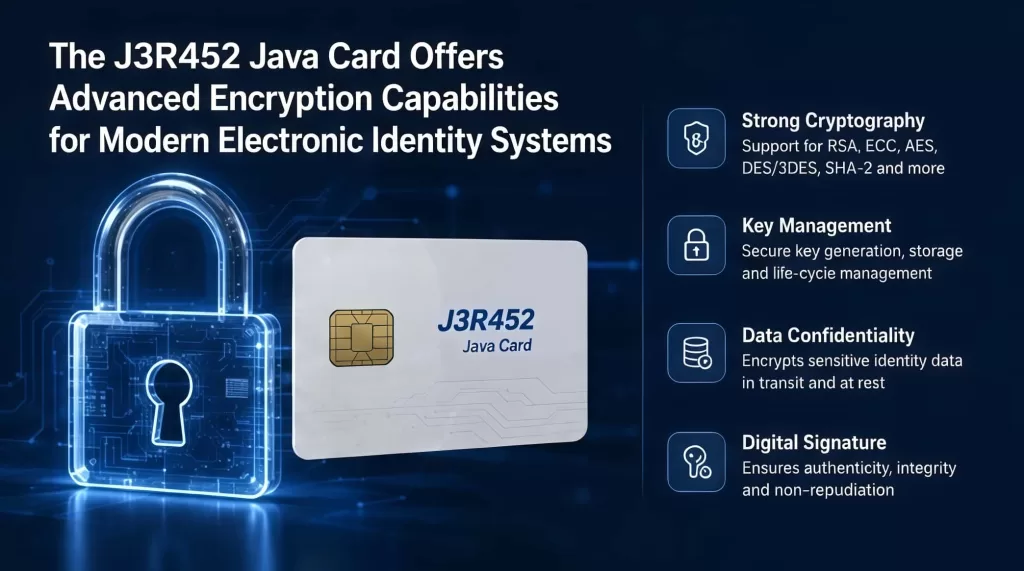
The J3R452 Java Card Offers Advanced Encryption Capabilities for Modern Electronic Identity Systems
Encryption technology is at the core of all types of secure electronic identity (e-ID) systems. Government identity platforms rely on encryption algorithms to enable the following functions:
- Authentication;
- Digital signatures;
- Secure communications;
- Credential verification.
As identity systems become increasingly digitized and interconnected, they require encryption solutions that offer both robust security and high performance. The J3R452 Java Card supports advanced encryption capabilities to meet these evolving needs.
Support for the EdDSA (Ed25519) Algorithm to Enable Efficient Digital Signatures
A major enhancement of the J3R452 Java Card is its support for the EdDSA (Ed25519) algorithm. Ed25519 is designed to provide digital signature operations that combine strong security features with high performance. For identity authentication scenarios, this offers numerous advantages:
- Faster signature generation;
- Lower computational resource requirements;
- Efficient authentication processes;
- Improved user experience.
In national-level electronic identity systems, millions of authentication requests may be generated daily. Therefore, efficient cryptographic performance directly impacts the system’s scalability. Support for Ed25519 enables the J3R452 Java smart card to more effectively meet modern authentication demands.
Support for Secure Digital Authentication
Digital identity systems require reliable methods to verify the authenticity of specific credentials. The J3R452 Java card achieves secure authentication by combining elements such as protected key storage, advanced cryptographic operations, and a secure application execution environment. This enables governments and service providers to build trusted authentication processes. For example, citizens can use electronic identity credentials for online government services, digital signatures, secure access authentication, and electronic document verification.
The J3R452 Java Card Enables a Secure and Scalable National Digital Identity System
Developing a national electronic identity system requires secure, reliable, and future-proof technology. As governments transition from traditional paper-based documents to digital credentials, the functionality of smart cards should not be limited to information storage. They must become trusted security platforms capable of protecting citizens’ identities, supporting advanced authentication, and adapting to future digital services.
The J3R452 Java Card provides a robust foundation for these requirements by combining an advanced security architecture, cryptographic capabilities, and programmable Java Card technology. Its key advantages include:
- Hardware-level identity protection via PUF technology, which creates a unique device identifier and enhances resistance to cloning and physical attacks;
- Support for advanced cryptographic technologies, including EdDSA (Ed25519), enabling efficient digital signatures and modern authentication applications;
- Support for government identity applications, including electronic ID cards, electronic health insurance cards, and electronic driver’s licenses;
- Compatibility with international identity standards, including security protocols for electronic passports such as BAC, EACv2, and SAC;
The J3R452 Java smart card provides government and identity solution providers with a reliable secure element platform for building a trusted digital identity infrastructure.