
 English
  Español


Selecting a chip for a Java Card solution is far more than simply comparing storage capacity, processor performance, or unit price. In real-world projects, the chip serves as the cornerstone of the entire Java Card architecture. It influences application development, security certification, personalization, production processes, and the product lifecycle—and even determines whether the system can add new services years after deployment. This is particularly important when developing customized Java Card solutions for banking, government identity management, telecommunications, transportation, healthcare, or enterprise applications. The most suitable solution must strike a balance between security, operating system platform, storage capacity, cryptographic capabilities, interface requirements, certification status, supply stability, and long-term scalability.
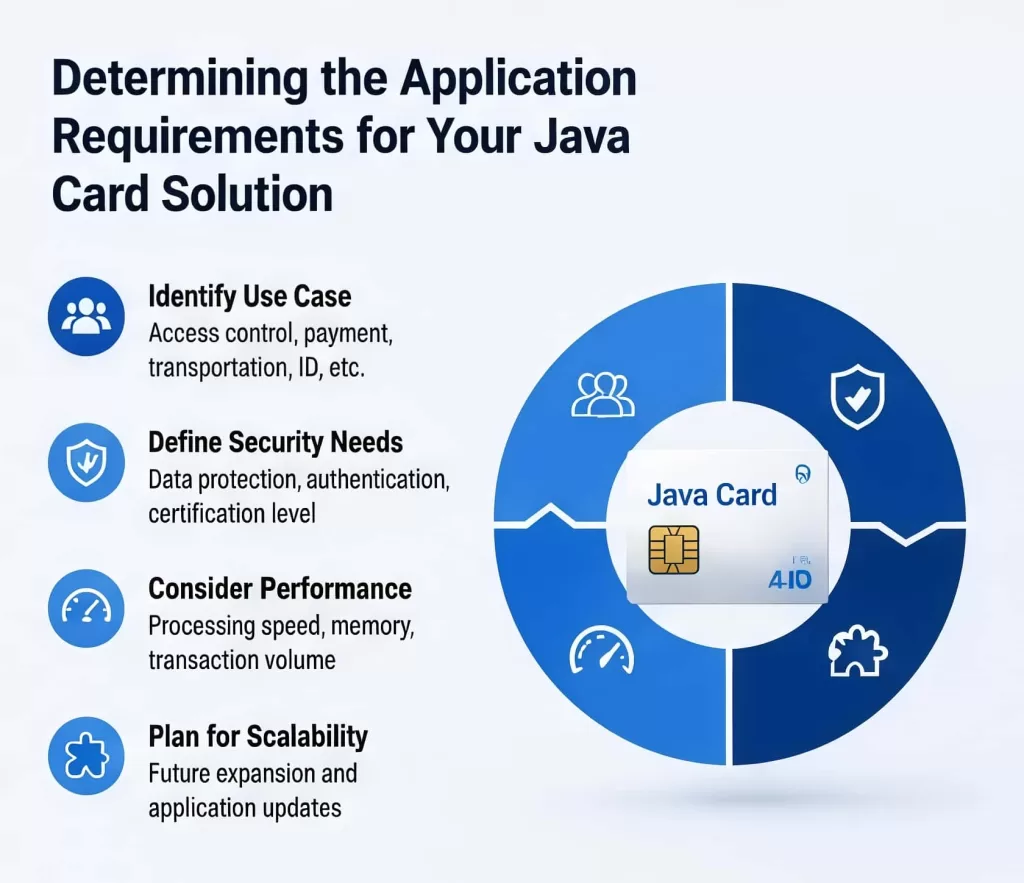
Determining the Application Requirements for Your Java Card Solution
The first mistake many project teams make is selecting a chip before defining the actual application requirements. A Java Card chip should support the intended product architecture, rather than forcing the project to adapt to the limitations of the selected hardware. Therefore, professional Java Card manufacturers typically begin with a detailed application analysis.
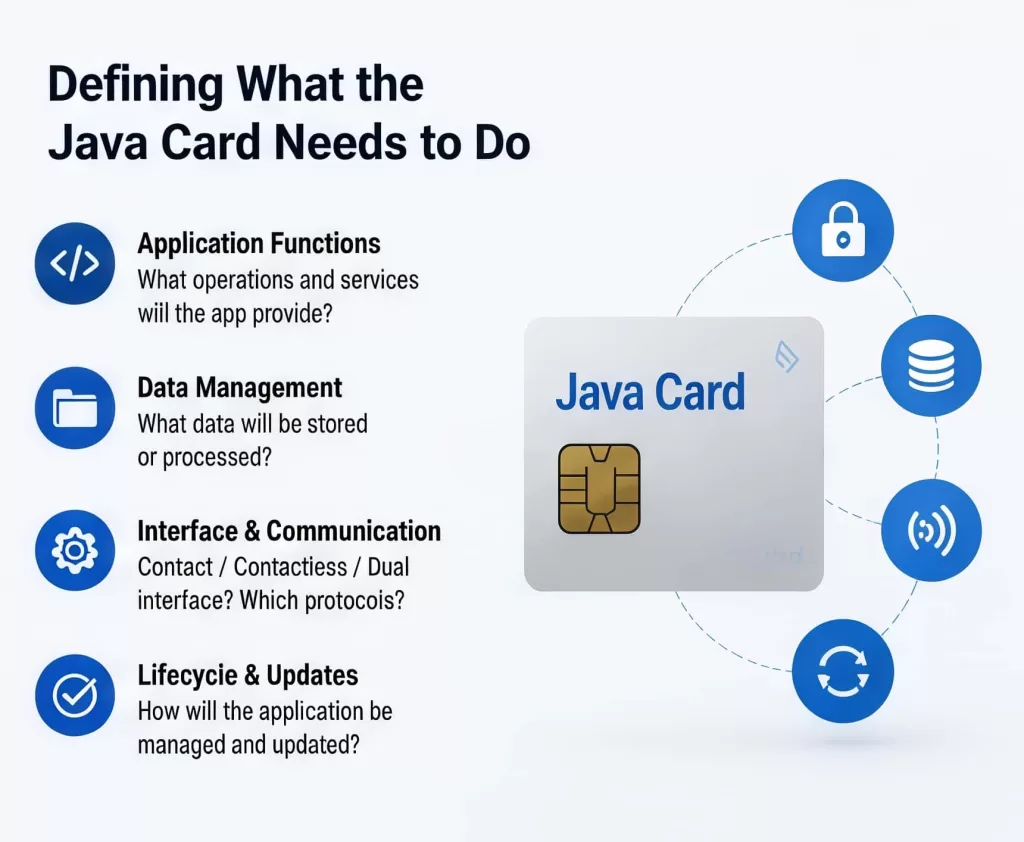
Defining What the Java Card Needs to Do
Different Java Card applications have varying technical requirements.
Financial Java Cards may need to support secure payment applications, cryptographic key management, EMV-related features, multiple payment applications and secure over-the-air updates.
Government-issued ID cards may prioritize digital identity verification, biometric data protection, digital certificates, national cryptographic algorithms, and advanced security authentication.
Transportation cards may prioritize fast transaction processing, contactless communication, low-cost deployment, and high-volume production.
Determining Whether a Java Card Solution Requires a Single-Application or Multi-Application Architecture
A key consideration is whether the card will host a single application or multiple independent applications. Simple applications may require only limited memory and a straightforward security architecture. In contrast, multi-application Java Card solutions may need to support multiple security services simultaneously. For example, a single Java Card could combine the following scenarios: authentication, payments, transportation, healthcare, and membership services.
In such cases, the selected chip must provide sufficient memory and a secure environment to prevent applications from interfering with one another. The chip should also support appropriate application lifecycle management to enable the installation, updating, or removal of applications under controlled conditions.
For custom Java Card projects, this requirement should be confirmed before development begins. Changing the chip after application development has started may result in significant redesign costs.
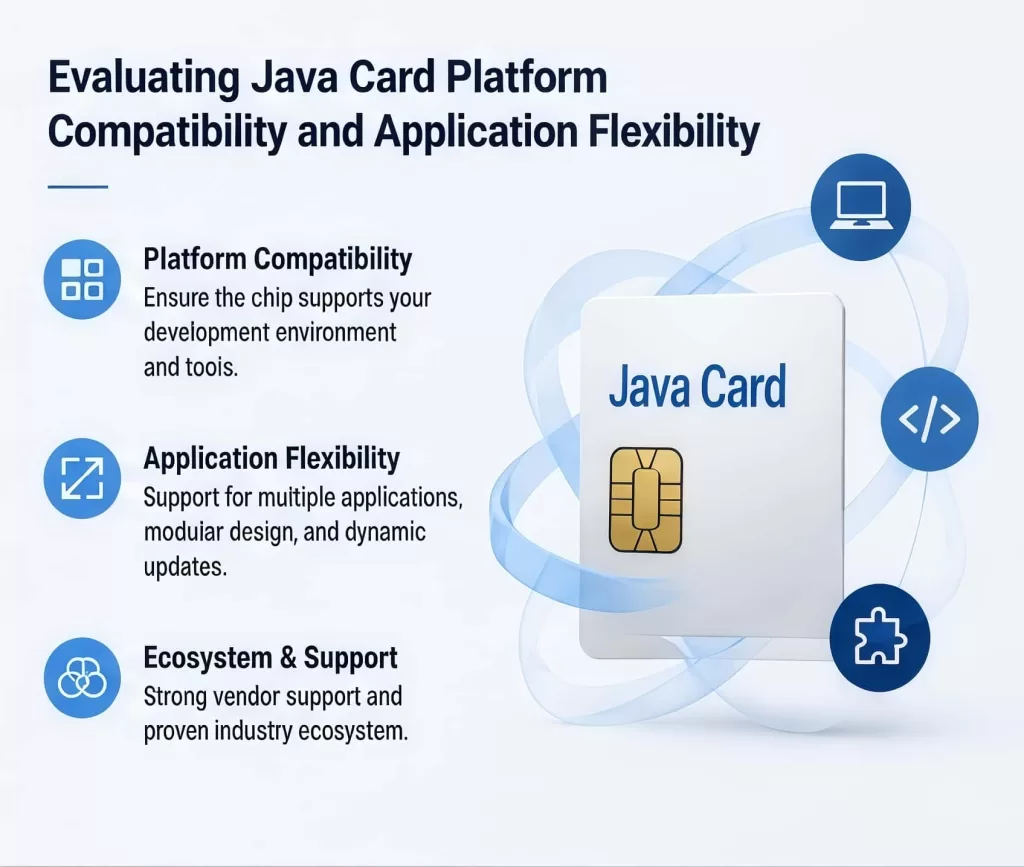
Evaluating Java Card Platform Compatibility and Application Flexibility
Once application requirements have been defined, the next step is to evaluate the Java Card platform itself. Not all secure chips provide the same Java Card environment. Differences in supported Java Card versions, GlobalPlatform features, memory architecture, and application management directly impact project development.
A professional Java Card manufacturer should verify whether the selected chip supports the required Java Card and GlobalPlatform specifications. These standards influence how applications are developed, loaded, managed, and updated.
For example, a Java Card solution project may require Java Card application development, secure applet loading, multiple security domains, application lifecycle management, and secure post-deployment updates. If the chip platform does not support the required features, developers may need to redesign the architecture or introduce additional software layers. Therefore, chip selection should always consider compatibility with the entire development and deployment environment.
Considering Application Portability
One of the key advantages of Java Card technology is its potential for application portability. A well-designed Java Card application can reduce dependence on a single hardware platform. However, actual portability still depends on the supported Java Card environment, available APIs, cryptographic capabilities, and platform-specific features. Therefore, project teams should evaluate whether the selected chip provides a stable foundation for future migration. This is particularly important for long-term projects. Choosing a flexible platform from the outset gives the project greater freedom to adapt to future requirements.
Matching Chip Security to the Risk Level of Java Card Solution Projects
Security must never be viewed as a one-size-fits-all standard. The appropriate security level depends on what the card is designed to protect and the threats it must withstand. Payment cards, government ID cards, and corporate access cards may all use Java Card technology, but their security requirements can vary significantly.
Evaluating Security Certification Requirements
For high-security projects, certification can serve as a fundamental selection criterion. Depending on the specific application, projects may need to comply with relevant standards or certification frameworks, including the Common Criteria, EMVCo, Global Platform, ISO/IEC standards, and national cybersecurity requirements. Similarly, government projects may require specific security certifications or national cryptographic capabilities. Therefore, professional Java Card manufacturers should identify certification requirements early in the project.
Examining Hardware-Level Security Features
Chip security depends on more than just certification labels. A comprehensive evaluation should consider the chip’s ability to protect sensitive information from compromise. The most critical question is whether the chip can safeguard sensitive assets throughout the entire application lifecycle. For custom Java Cards, these assets may include private keys, authentication credentials, digital certificates, payment data, and biometric information. The selected chip should provide an appropriate hardware security architecture that matches the value and sensitivity of the data being protected.
DCCO Technology’s Project Approach to Java Card Solutions
As a professional Java Card manufacturer, DCCO approaches chip selection from a full application lifecycle perspective. We do not recommend chips based solely on technical specifications; instead, we evaluate customer needs from multiple dimensions.
These include:
- Application type
- Security requirements
- Java Card platform
- Memory requirements
- Cryptographic capabilities
- Interface architecture
- Certification requirements
For customers developing custom Java Cards, this approach helps ensure that the selected chip is not only compatible with the current application but also aligns with the product’s long-term development strategy. The goal is to establish a stable connection between chip selection, application development, personalization, manufacturing, and deployment.
Selecting the Right Chip for Java Card Solutions
Selecting the right chip is one of the most critical decisions in developing a successful Java Card solution. The chip influences virtually every aspect of the project, from application development and security certification to manufacturing, personalization, lifecycle management, and future upgrades.
Therefore, the team should first clarify the card’s intended functionality and determine whether the solution needs to support a single application or multiple applications. Next, they should evaluate Java Card and GlobalPlatform compatibility, security certification, cryptographic capabilities, memory capacity, interface requirements, and physical architecture. At the same time, long-term factors such as chip availability, supply stability, manufacturing compatibility, and total cost of ownership should be given equal consideration. Therefore, the best approach is straightforward: first define the application, then evaluate the entire technology stack, and only select a chip after fully understanding the project’s long-term requirements.