
 English
 Español



The level of data protection provided by contact cards depends on the chip embedded within them. Basic contact-based memory cards may store information only in EEPROM, while password-protected cards can restrict specific write operations. More advanced secure memory cards—such as those using Microchip’s AT88SC CryptoMemory chip—offer configurable access permissions, mutual authentication, and encrypted communication capabilities. However, having a contact interface does not necessarily mean that the card supports data encryption, nor does it guarantee protection against unauthorized reading.
For enterprises selecting contact smart cards, the key is to clarify exactly what the chip protects. It may safeguard against read or write operations, protect data confidentiality, or ensure communication integrity. Understanding these differences helps determine whether a basic contact chip card meets requirements or requires a more advanced security solution.
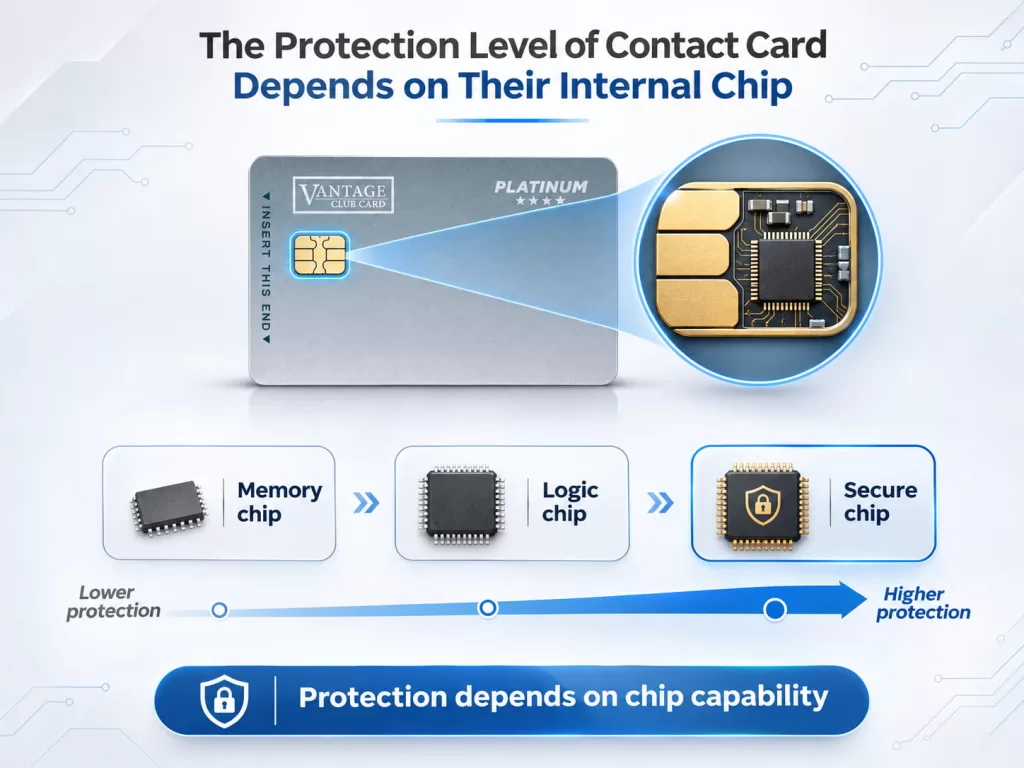
The Protection Level of Contact Card Depends on Their Internal Chip
Within the broad category of contact cards, different products may utilize standard EEPROM, password-protected memory, secure memory, or programmable microprocessor chips. The level of protection each architecture provides varies.
For example, DCCO TECH’s contact card product line includes the AT24C memory card, the SLE4442 and SLE4428 memory cards with protection features, and the AT88SC secure memory card. Although these products all use the ISO/IEC 7816 standard contact interface, this does not mean they provide the same level of protection.
Standard EEPROM Cards and PSC Cards Offer Different Basic Protection Mechanisms
Standard contact-based memory cards using EEPROM chips are primarily used for data storage. They can retain information when power is off, but ordinary EEPROMs do not inherently support password authentication or encryption. If the card reader and chip allow unrestricted read access, anyone with compatible hardware and the necessary commands can potentially access the stored information.
PSC cards, on the other hand, incorporate basic security mechanisms. Here, “PSC” stands for “Programmable Security Code,” commonly found in chips such as the SLE4442.
For example, the SLE4442 provides 256 bytes of EEPROM storage; users must verify the correct three-byte PSC before modifying or erasing data. In addition, it features a built-in error counter and supports setting permanent write-protect bits for specific memory regions. Note that even if PSC authentication fails, data in the general-purpose memory regions can still be read. (See the SLE4442 Technical Specifications)
This means that PSC protection is primarily used to control “modification” operations on data, rather than to provide complete data confidentiality.
The difference between the two in practical applications lies in:
| Contact Card Type | Main Protection | Important Limitation |
|---|---|---|
| Standard EEPROM | Basic data storage | No inherent password protection or encryption |
| PSC memory card | Password-controlled write/erase access | Data reading may remain unrestricted |
| AT88SC secure memory | Access control, authentication, and encrypted communication | Requires correct security configuration and key management |
| Java Card CPU card | Programmable application security and cryptographic operations | Protection depends on chip, applet, and implementation |
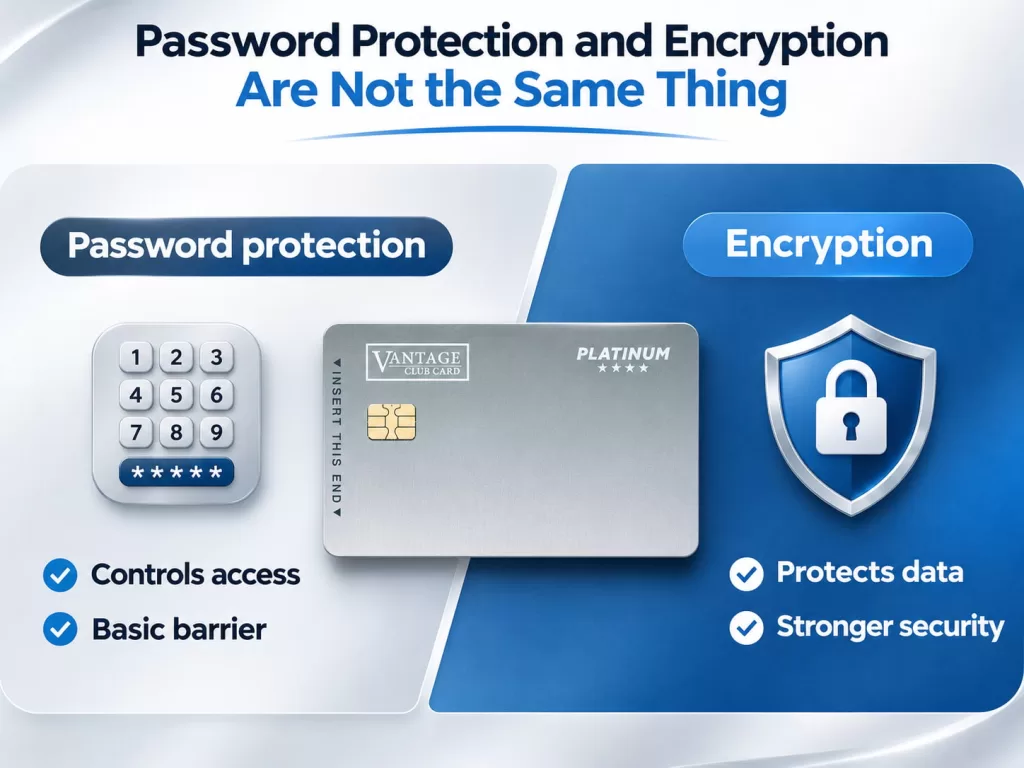
Password Protection and Encryption Are Not the Same Thing
When purchasing contact-based chip cards, people often mistakenly believe that “password protection” is the same as “encrypted stored information.”
These are, in fact, two distinct security features.
Password protection determines whether a user or card reader has the authority to access or modify specific storage areas. Encryption, on the other hand, transforms data into a special format that users cannot decipher without the corresponding encryption key. Users can configure a card to “control write access via a password” while still allowing readers to access its stored information. Conversely, secure storage chips combine access authentication with encrypted communication to provide a higher level of protection.
How PSC and Protected Storage Work
In cards such as the SLE4442 that use the PSC (Password Security Control) mechanism, the chip compares the submitted security code with an internally stored reference value. If the verification passes, the system grants write or erase operations according to the chip’s preset protection rules.
If users enter an incorrect password, the system reduces the number of available verification attempts. Once users exhaust the error counter, the system locks subsequent PSC authentication and data modification operations.
The key point is that PSC protects the permission to “modify data,” not the permission to “read data.” Therefore, PSC memory is suitable for simple application scenarios primarily intended to prevent “unauthorized modification”; however, it should not be regarded as “encrypted memory” for storing confidential information.
How does AT88SC CryptoMemory differ from standard EEPROM?
Microchip’s AT88SC series (also known as CryptoMemory) integrates security features directly into the memory chip, eliminating the need for a full Java Card operating system.
Its key features include:
- Configurable user storage regions, each with independent access permissions;
- Cryptographic authentication mechanisms for read and write operations;
- Mutual authentication between the host and the chip;
- Hardware-based stream cipher technology to protect data communications;
- Data integrity verification and source authentication via Message Authentication Codes (MACs).
Taking the AT88SC0404C contact card as an example, it provides 4 Kbit of user storage space, divided into four configurable regions. Users can set different access requirements for each region; for example, they can store general information in one region while requiring stricter authentication to access another.
In other words, the functionality provided by the AT88SC goes far beyond simple password verification: it integrates access control, authentication, communication encryption, and integrity verification into a single solution.
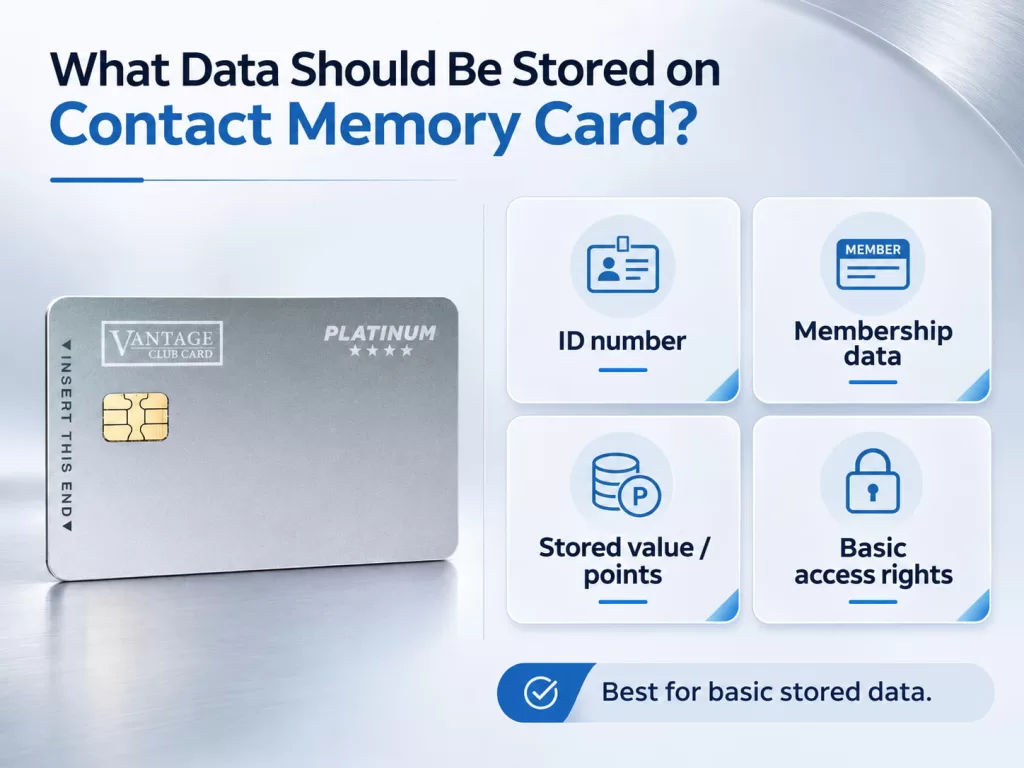
What Data Should Be Stored on Contact Memory Card?
The choice of card type depends on the sensitivity of the information being stored and the potential consequences if an attacker exploits it.
For public identifiers, product information, or simple records that do not require confidentiality, a basic EEPROM card may be sufficient. PSC cards offer additional protection against unauthorized data tampering. If the information requires a higher level of confidentiality and access control, the AT88SC secure storage card provides more comprehensive security mechanisms.
However, even secure storage cards have limitations. Developers must properly personalize their security features, carefully manage passwords and keys, and ensure that the selected chip meets the intended application requirements.
Matching Data Sensitivity to the Card’s Protection Capabilities
The following is a practical selection guide:
| Data Type | Basic EEPROM / PSC Card | AT88SC Secure Memory |
|---|---|---|
| Public identification number | Suitable | Suitable |
| Product or membership information | Suitable | Suitable |
| Data requiring write protection | PSC may be sufficient | Suitable |
| Confidential application records | Not recommended | Consider with proper zone protection and encryption |
| Authentication secrets and sensitive credentials | Not recommended | Requires careful security assessment |
| High-value private keys and payment secrets | Not suitable | Prefer a dedicated secure-element or Java Card solution |
For example, a membership card may only need to store an identification number and account status. If the primary requirement is to prevent unauthorized tampering, then a PSC card (Protected Storage Card) may be sufficient.
In contrast, if a project involves storing authentication credentials or confidential application data, developers must implement stronger control measures. Although the AT88SC chip provides protected storage areas, two-factor authentication, and encrypted data exchange capabilities, developers should not treat it as a direct substitute for Java Card, which can securely generate and use encrypted private keys.
For highly sensitive application scenarios involving digital signatures, payment credentials, government identification, or cryptocurrency wallets, it is generally more appropriate to use a dedicated Java Card security element, as it provides the corresponding cryptographic functions and application-level security safeguards.
What Level of Data Protection Do Contact Smart Card Actually Provide?
Depending on the chip architecture, contact-based smart cards can provide varying levels of protection, ranging from basic storage protection and cryptographic access control to more advanced cryptographic security mechanisms.
These primarily include the following:
Standard EEPROM: Used solely for storing information; it does not inherently provide confidentiality protection or access authentication.
PSC Memory: Restricts unauthorized write and modification operations but may still allow unrestricted read access.
AT88SC CryptoMemory: Adds configurable access permissions, two-way authentication, encrypted communication, and data integrity verification.
Java Card: Provides a programmable secure environment suitable for applications with higher security requirements, such as those involving cryptographic operations and sensitive credentials.
The contact interface itself does not determine data security. The chip’s internal protection mechanisms ultimately determine which information users can read, modify, or securely exchange.