
 English
 Español



The J3R150 Java Card suits applications that require encryption, support for multiple applications, and flexible communication interfaces but do not need the large storage capacity of high-end platforms. Based on NXP’s JCOP 4 P71 platform, this card offers 150 KB of user memory, supports the Java Card 3.0.5 and GlobalPlatform 2.3 standards, and includes cryptographic algorithms such as RSA, ECC, AES, and SHA. Its contact and dual-interface (contact/contactless) configurations make it suitable for a wide range of payment and identity verification scenarios.
In practice, the J3R150 suits projects such as EMV payment cards, enterprise-level PKI certificates, digital signatures, electronic ID cards (eID), and electronic passports. Of course, not all smart card applications require this type of product; the specific selection depends on factors such as the number of applications, encryption requirements, memory usage, and reader infrastructure.
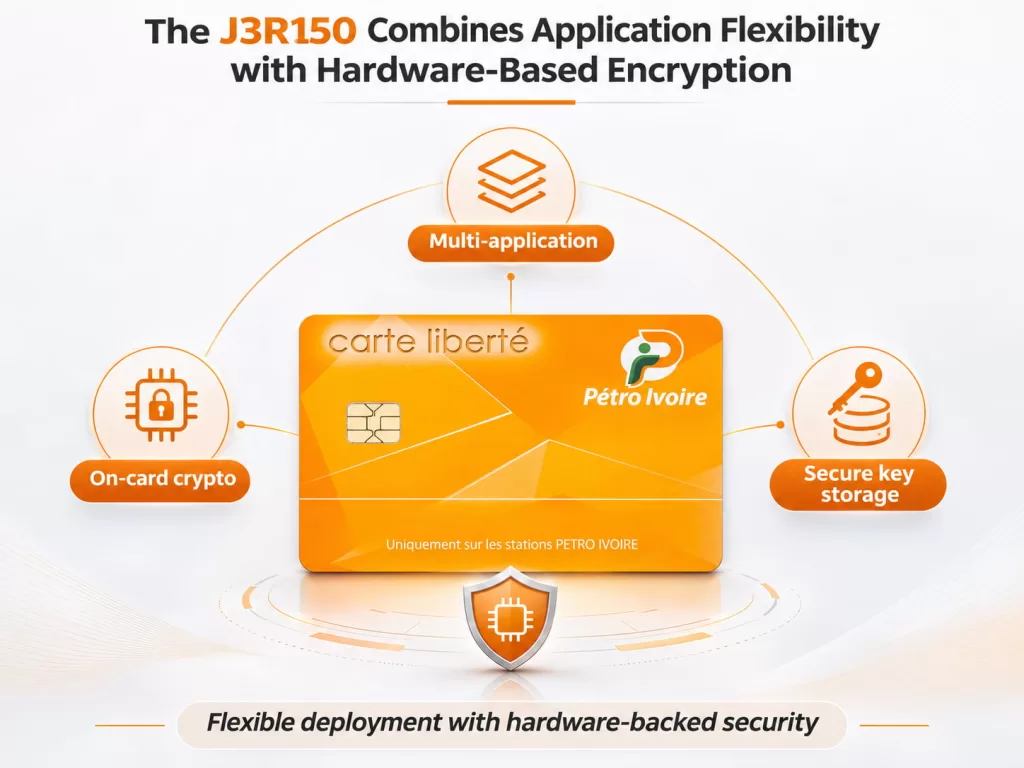
The J3R150 Combines Application Flexibility with Hardware-Based Encryption
The J3R150 is more than just a smart card for storing data. Its core value lies in seamlessly integrating a programmable Java Card environment with hardware-supported encryption and contact/contactless communication options. This makes it ideal for projects that require both secure credential storage and the ability to perform authentication or signing operations.
According to the product specifications, the J3R150 supports RSA, ECC, AES, DES/3DES, and SHA algorithms, and complies with the Java Card 3.0.5 and GlobalPlatform 2.3 standards. Additionally, it supports the GlobalPlatform SCP01/02/03 secure channel protocols. These features provide a solid technical foundation for a wide range of established smart card applications.
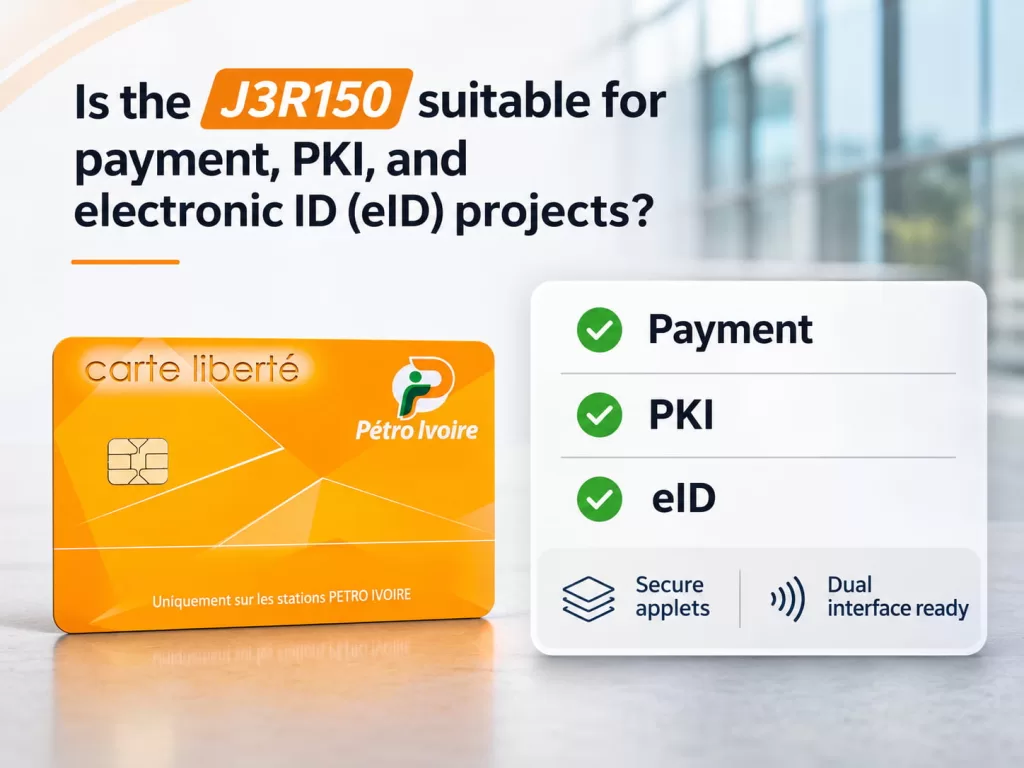
Is the J3R150 suitable for payment, PKI, and electronic ID (eID) projects?
Yes. These are the J3R150 smart card‘s primary application areas, although the specific use of its features varies within each domain.
| Project Type | Typical Application | Why J3R150 Fits |
| Payment | EMV credit and debit cards | Cryptographic processing and contact/contactless support |
| PKI | Enterprise authentication and digital signatures | RSA/ECC support and secure private-key storage |
| eID | Electronic passports and citizen identity cards | Identity authentication, certificate storage, and secure application execution |
In payment projects, the J3R150 supports applications related to major international payment organizations, including Visa, Mastercard, American Express, and Discover. The final cards must comply with each payment organization’s requirements and certification standards.
In PKI projects, the J3R150 Java Card’s RSA and ECC capabilities support certificate-based authentication and digital signature applications. As such, it suits scenarios such as employee credentials, government ID cards, and enterprise security systems.
In electronic identity (eID) projects, it supports electronic passports, European Citizen Cards, European Health Insurance Cards, and electronic identity services such as ePKI.
While the J3R150 suits specific security applications, it is not automatically suitable for all complex national-level identity platforms.
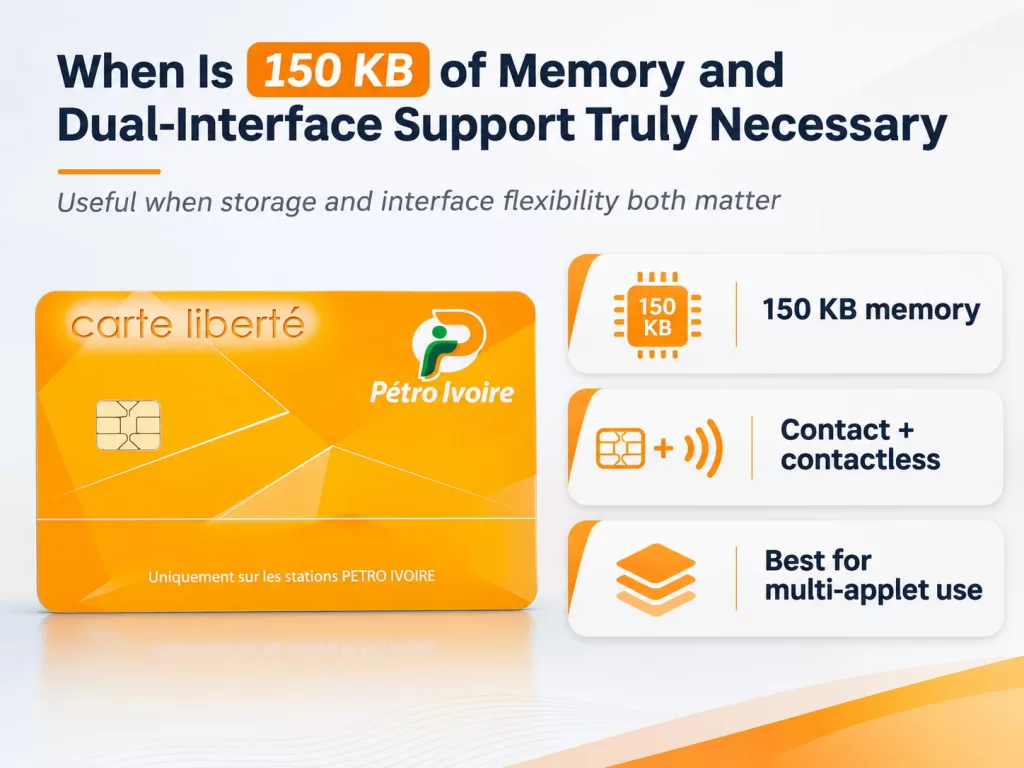
When Is 150 KB of Memory and Dual-Interface Support Truly Necessary?
150 KB of user memory and dual-interface capabilities do not mean every project needs both. These specifications only matter when they match the application or deployment requirements.
When making a purchase, ask two key questions: How much application data does the card need to store? How will users interact with the card? Answering these questions will help you determine whether the J3R150 Card offers the right balance or if another configuration would be more suitable.
Is 150 KB of memory sufficient for a custom Java Card project?
For many projects focused on PKI and electronic ID (eID), 150 KB of capacity is typically sufficient to meet application requirements.
Common configurations include:
– A primary identity or authentication applet;
– Digital signature functionality;
– Authentication certificates and key objects;
– PIN codes and application configuration data.
However, memory consumption depends on the specific application package and customization requirements. If a project integrates multiple functions—such as payment, identity verification, healthcare, and biometrics—it may require more storage space.
When Is Dual-Interface Support Required?
The J3R150 Java Card supports contact-based communication via the ISO/IEC 7816 standard and contactless communication via the ISO/IEC 14443 Type A standard. A dual-interface configuration is ideal when a single card needs to be used in both environments.
For example:
Contact-Based Operations
– Inserting an employee ID card or government-issued ID into a desktop card reader;
– Performing certificate-based authentication;
– Completing contact-based banking transactions.
Contactless Operations
– Swiping (tapping) a card on a payment terminal;
– Authenticating at an access control reader;
– Using contactless government or transportation services.
If a project involves only contact readers, configuring only contact functionality will suffice. However, a dual-interface configuration is especially necessary when existing contact infrastructure must coexist with contactless services, or when the card issuer requires both interaction methods.
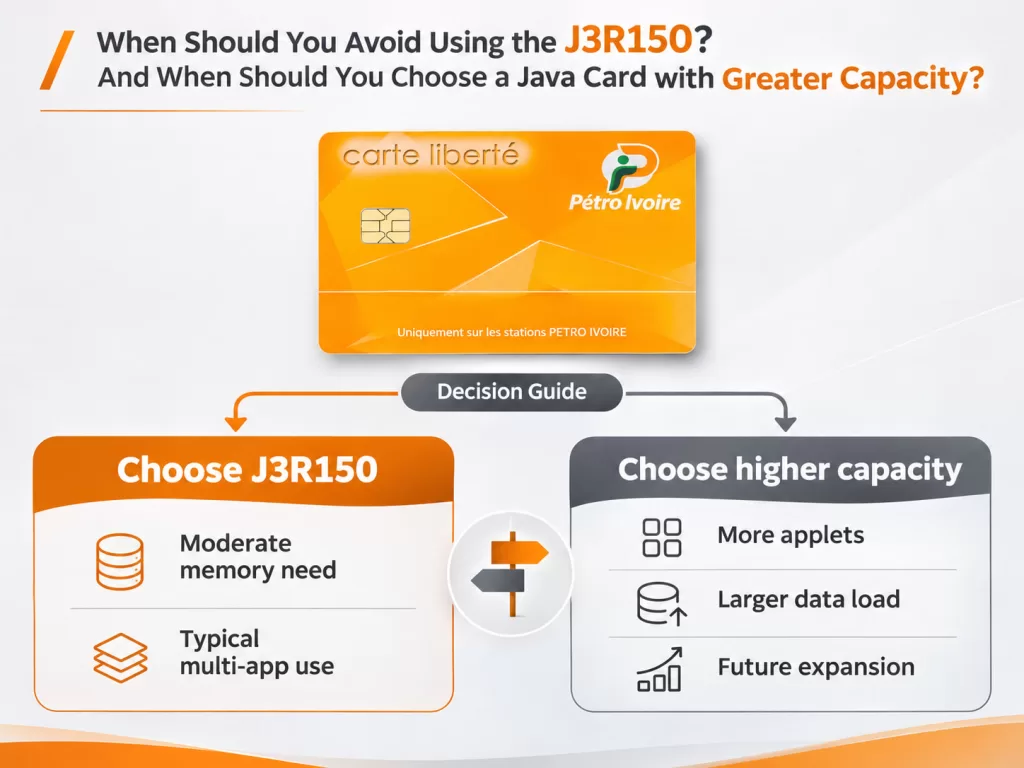
When Should You Avoid Using the J3R150? And When Should You Choose a Java Card with Greater Capacity?
If a project only needs to run a small authentication applet and perform basic contact-based communication, a Java Card with smaller capacity will meet the functional requirements, and the overall implementation cost will be lower.
On the other hand, if a project includes multiple resource-intensive applications, it may exceed the J3R150’s actual capacity. Therefore, the selection should be based on the actual application workload rather than made blindly.
Selecting the Right Model Based on Project Complexity
The following comparison serves as a practical reference for model selection:
| Project Requirements | Recommended Direction |
| One simple authentication applet with limited data | Smaller-capacity Java Card |
| Focused PKI, eID, or digital-signature application | J3R150 |
| Payment or identity with additional service applications | Evaluate J3R150 and J3R180 |
| Multiple government services and larger application footprint | J3R180 |
| Complex multi-application deployment requiring substantial storage | J3R452 |
DCCO’s J3R180 provides about 180 KB of user storage space, while the J3R452 offers about 450 KB of storage space and uses the newer JCOP 4.5 platform. These models can serve as alternatives when the application architecture requires more storage space or more powerful platform capabilities.
For Which Projects Is the J3R150 Java Card Best Suited?
The J3R150 Java Card is primarily designed for applications such as secure payments, PKI (Public Key Infrastructure), digital signatures, and electronic identification (eID). These projects typically require modern cryptographic capabilities, approximately 150 KB of user storage, and may require support for contact or contactless communication. The J3R150 Smart Card is an ideal choice for projects with a well-defined application structure that do not need the large storage capacity of more advanced multi-application platforms.
Specific project recommendations are as follows:
– Projects focused on payment, PKI, and electronic identification (eID): Consider the J3R150.
– Projects involving more applications and requiring larger storage capacity: We recommend evaluating the J3R180.
– Complex, large-scale multi-application projects: Consider the J3R452.
– Applications with simple requirements and limited functional needs: A Java Card with smaller capacity may be sufficient.