
 English
  Español


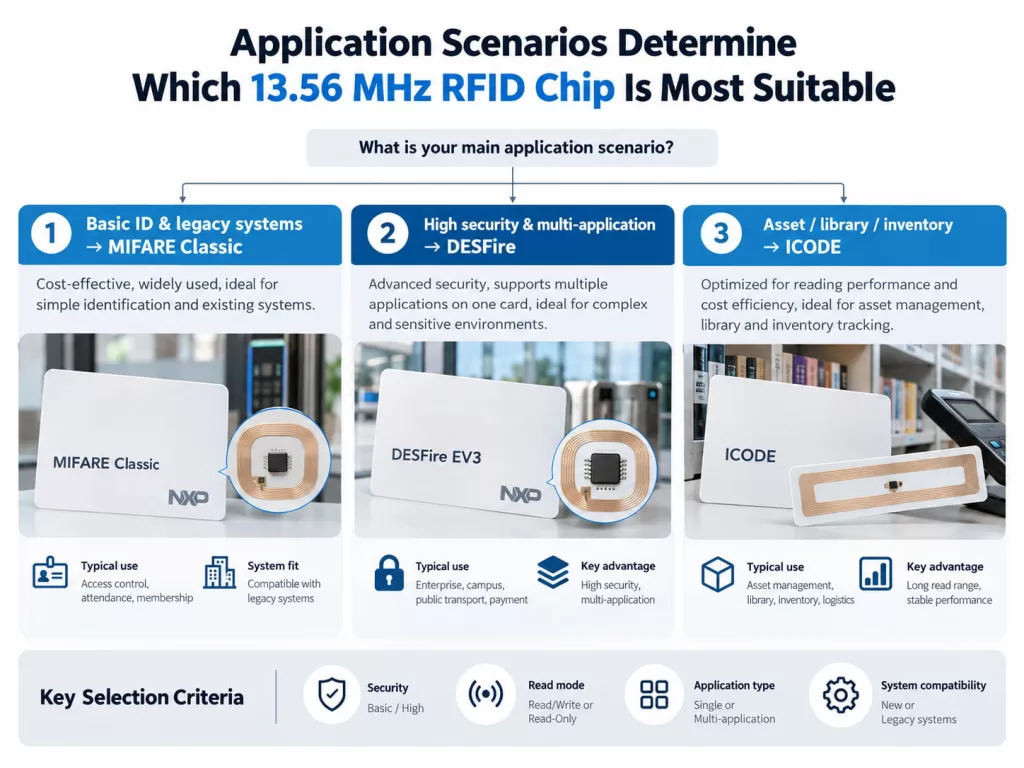
When choosing between the three 13.56 MHz RFID chip—MIFARE, DESFire, and ICODE—you should first consider the specific application of the card, rather than focusing solely on the fact that they all operate at 13.56 MHz. In procurement, the term “MIFARE” typically refers to MIFARE Classic, while DESFire itself is a higher-security branch of NXP’s MIFARE product family. 13.56 MHz MIFARE chip cards are typically suitable for short-range access control, campus cards, membership cards, or established closed-loop application systems. 13.56 MHz DESFire chip cards, on the other hand, are better suited for secure transportation ticketing, multi-application access control, and credential systems requiring protection based on the AES algorithm. ICODE smart cards, on the other hand, follow a different technical approach: with their long-range interface compliant with the ISO/IEC 15693 standard, they are better suited for scenarios such as library management, asset identification, inventory counting, and industrial tracking.
Therefore, we believe the most important consideration during procurement is to clarify:
Does the project require personnel to swipe cards using secure credentials, or does it require the system to identify and track a specific item?
This distinction typically helps narrow down the selection of chips quickly.
Application Scenarios Determine Which 13.56 MHz RFID Chip Is Most Suitable
Although these 13.56 MHz RFID chips operate at the same frequency, they are designed to meet different communication and security requirements. The MIFARE, DESFire, and ICODE chips are generally suitable for access control, transportation, NFC, and contactless identification, respectively.
The following list of application areas is provided for reference:
| Project Requirement | More Appropriate Direction | Main Reason |
|---|---|---|
| Employee access / established campus system | MIFARE Classic | Simple sector-based storage and broad installed-reader compatibility |
| Secure public transport / city card | DESFire | Strong cryptography, fast transactions, multi-application structure |
| High-security access credential | DESFire | AES support and flexible access rights |
| Library item identification | ICODE | ISO 15693 vicinity reading and anti-collision |
| Industrial asset tracking | ICODE | Better suitability for identifying objects across a wider reading zone |
| Simple loyalty / membership card | MIFARE Classic | Limited data requirement and straightforward reader integration |
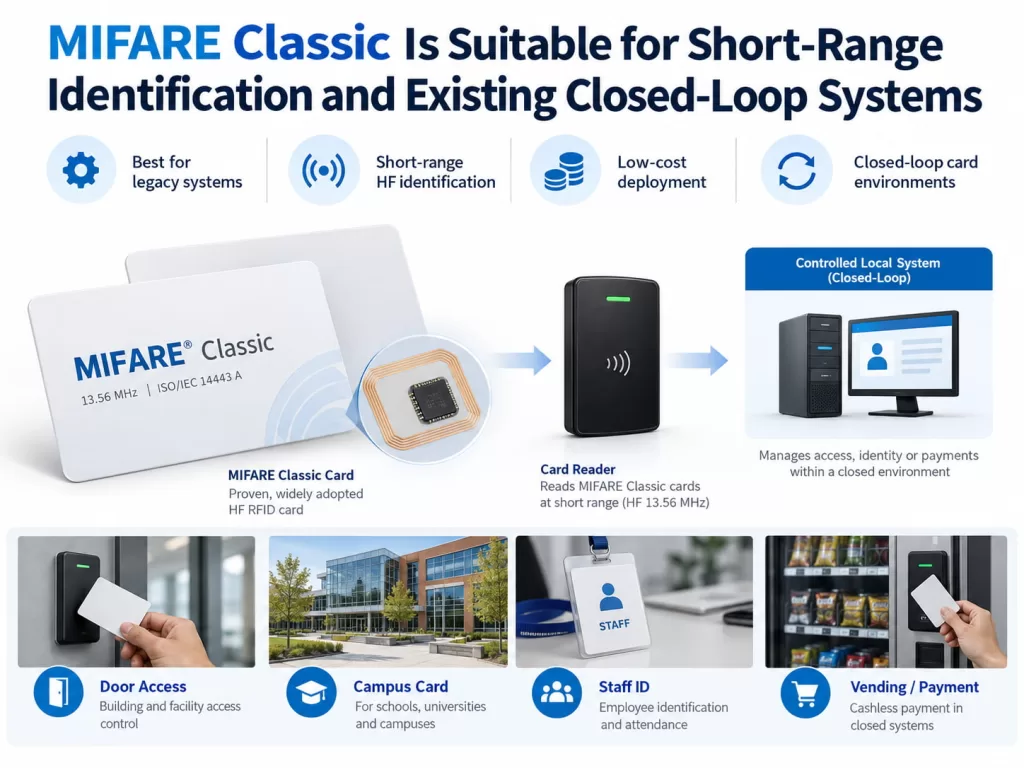
MIFARE Classic Is Suitable for Short-Range Identification and Existing Closed-Loop Systems
MIFARE Classic operates based on the ISO/IEC 14443 Type A standard and is available in common 1KB and 4KB capacity versions. Its “block-and-sector” storage architecture allows different keys to protect different data areas, making it widely used in access control, employee ID cards, campus systems, transportation, and other closed-loop applications.
For example, DCCO TECH currently offers MIFARE Classic EV1 1K card and MIFARE Classic EV1 4K card in its 13.56 MHz card product line.
Therefore, if a project has already deployed a MIFARE Classic reader infrastructure and only requires relatively simple identity verification, stored-value functionality, access control, or membership data storage, selecting a 13.56 MHz MIFARE chip card is a reasonable choice.
MIFARE Classic is primarily a choice that balances compatibility and cost, rather than the top recommendation for high-security credential applications.
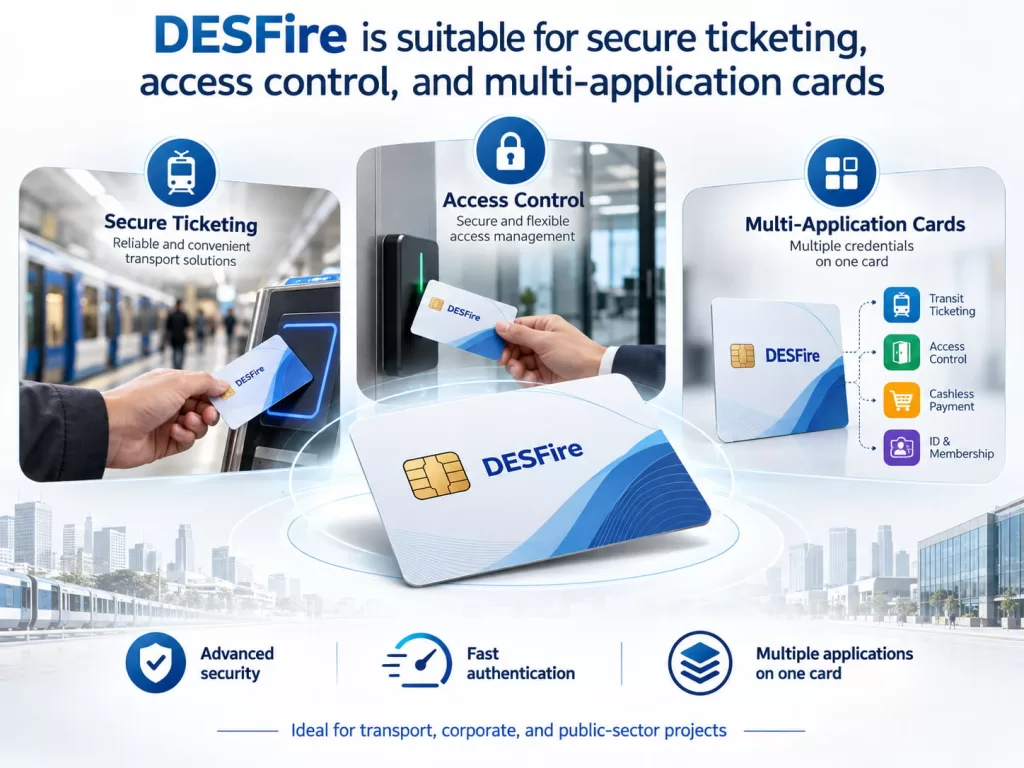
DESFire is suitable for secure ticketing, access control, and multi-application cards
DESFire is suitable for projects with higher levels of complexity.
MIFARE DESFire EV3 complies with the ISO/IEC 14443 Type A standard (supporting up to Layer 4), features a communication rate of up to 848 kbit/s, and offers a flexible file system that supports multiple applications and files. The current version offers non-volatile storage capacities of 2 KB, 4 KB, 8 KB, and 16 KB.
More importantly, DESFire provides hardware encryption capabilities including DES, 2K3DES, 3K3DES, and AES-128; NXP positions this product series for use in identity verification, access control, loyalty programs, micropayments, and transit ticketing systems. This makes the 13.56 MHz DESFire chip card particularly well-suited for scenarios requiring a single credential to perform multiple security functions. For example:
A campus card might need to support:
access control, public transportation, cafeteria accounts, and library services
A public transportation project might require:
passenger identification, prepaid ticketing, transaction records, and secure value management
Compared to simply partitioning limited fixed storage space into separate sectors, DESFire’s flexible application and file structure better meet these multi-service requirements. Furthermore, 13.56 MHz DESFire chip cards offer clearer security boundaries. If you need identity authentication, encrypted communication, transaction protection, or room to expand functionality in the future, you should generally prioritize DESFire cards.
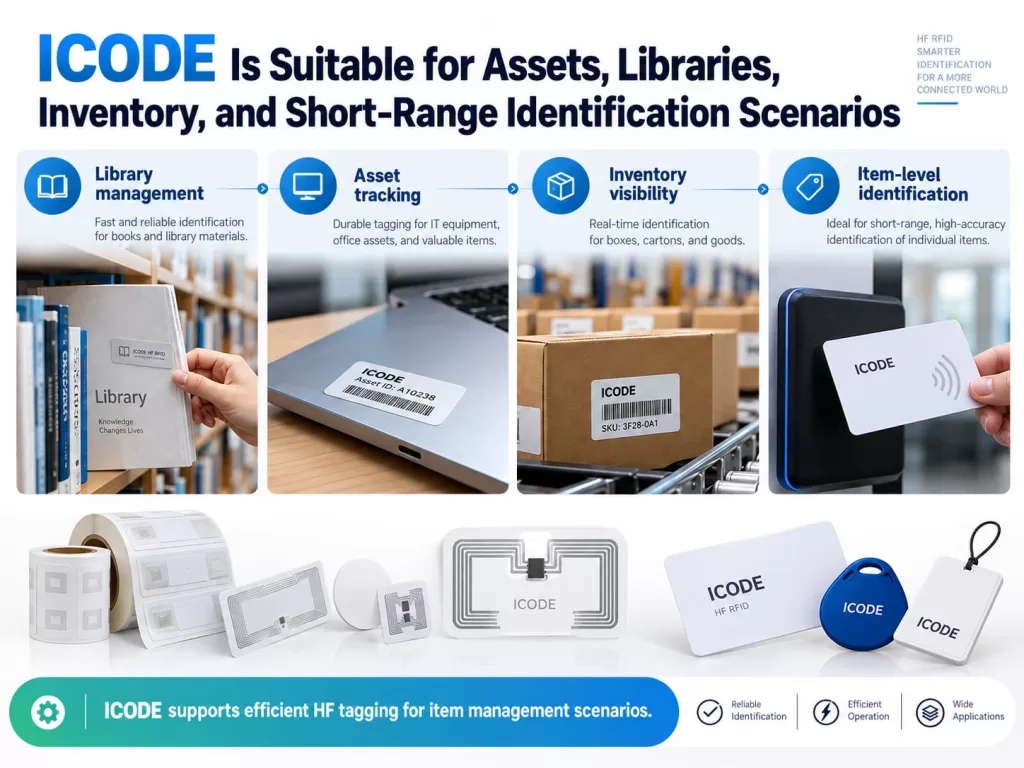
ICODE Is Suitable for Assets, Libraries, Inventory, and Short-Range Identification Scenarios
When selecting ICODE, one should not apply the same assumptions used for MIFARE Classic or DESFire products.
The primary difference between the two lies in the air interface standards.
Current ICODE products (such as ICODE 3) utilize ISO/IEC 15693 and NFC Forum Type 5 tag technology. NXP positions ICODE 3 for product tracking, inventory management, brand protection, smart device consumables, and related Internet of Things (IoT) applications. It offers 2,400 bits of user memory and features designed specifically for tag identification and protection, rather than for card-based transactional applications. Citation:
Early ICODE SLIX products were also designed specifically for smart labels, libraries, production management, and product authentication. They feature anti-collision capabilities, allowing multiple tags to operate simultaneously within the reader’s range.
Therefore, when the core questions are:
“What is this item? Can it be identified efficiently?”
13.56 MHz ICODE chip cards or tags become the more suitable choice.
Protocol, Security, and Storage Capacity Determine the Selection of 13.56 MHz RFID Chips
Once you’ve defined your application requirements, we recommend considering these three technical factors together as you choose a smart card, rather than focusing on storage capacity alone.
First, the Radio Frequency (RF) Protocol
MIFARE Classic and DESFire both follow the ISO/IEC 14443 Type A standard and primarily support close-range card interactions. DESFire also supports the ISO/IEC 14443-4 communication standard, which enables it to handle more complex transactions. ICODE adopts the ISO/IEC 15693 standard, a technology suitable for vicinity cards and tags, making it better suited for applications requiring wide-range read zones and batch identification (such as inventory counting).
This leads to a practical approach for selection:
User actively swipes or taps a credential → ISO 14443 is typically the better starting point
The system needs to identify objects within a wider high-frequency (HF) read range → ISO 15693 is generally more suitable
The second factor is security
For hotel guest rooms, employee access control systems, or existing campus deployments with moderate security requirements, MIFARE Classic remains a practical choice. When credentials involve access control to high-value areas, transit payment accounts, or multiple service functions, DESFire offers stronger architectural safeguards thanks to its AES-based security mechanisms and flexible access control. Although ICODE also offers password protection, authentication, privacy protection features, and ECC-based authentication and signing capabilities in newer products, its original design focus remains on identification and tagging applications, rather than the smart card application model supporting secure transactions, as seen with DESFire.
The third factor is storage capacity, but the choice of capacity should be based on the data model
MIFARE Classic typically offers 1 KB or 4 KB of storage space. DESFire provides larger and more flexible, application-oriented configuration options; in contrast, ICODE employs a smaller, tag-oriented storage approach, as asset tags typically store only identifiers and limited application data, without needing to support multiple transaction-based applications.
Therefore, when selecting a 13.56 MHz RFID chip, one should not focus solely on:
“Which chip has the largest storage capacity?”
Instead, one should consider:
“What data needs to be stored, what are the access security requirements, and what is the required communication distance between the reader and the tag?”
Choosing the 13.56 MHz RFID Chip That’s Right for You
These three types of chips are designed for distinctly different application needs.
- If your project is based on established ISO 14443A infrastructure and requires only simple, short-range access control, membership management, or campus applications, we recommend selecting 13.56 MHz MIFARE chip cards.
- If your project involves secure ticketing (such as transit cards), high-security access control, multi-application cards, protected transactions, or AES-based authentication, we recommend selecting 13.56 MHz DESFire chip cards.
- If your application needs shift from secure, close-range interactions between people and devices to tasks such as library identification, inventory counting, asset tracking, production management, or product anti-counterfeiting, we recommend choosing ICODE smart cards. They’re especially suitable when you need long-range reading and simultaneous multi-tag support under the ISO/IEC 15693 standard.
Although all three are 13.56 MHz RFID chips, they are not interchangeable simply because they share the same frequency. Selecting the appropriate chip depends on the specific application interaction model, required security level, reader protocol, and data structure—not solely on the 13.56 MHz operating frequency.