
 English
  Español


Choosing an algorithm is first and foremost a compatibility decision, followed by performance considerations. When choosing between ECDSA and Ed25519 for a Java Card crypto card, the first question is: Which signature algorithm does the target blockchain or wallet protocol require?
Both ECDSA and Ed25519 are elliptic curve digital signature algorithms, and when properly implemented, both offer strong security. However, they differ in terms of curve selection, signing processes, key formats, and protocol ecosystems. As a professional Java Card manufacturer, we believe the correct decision-making process is as follows:
Blockchain/Protocol → Required Curves and Signing Schemes → Java Card Platform Support → Applet Implementation → Performance and Security Validation
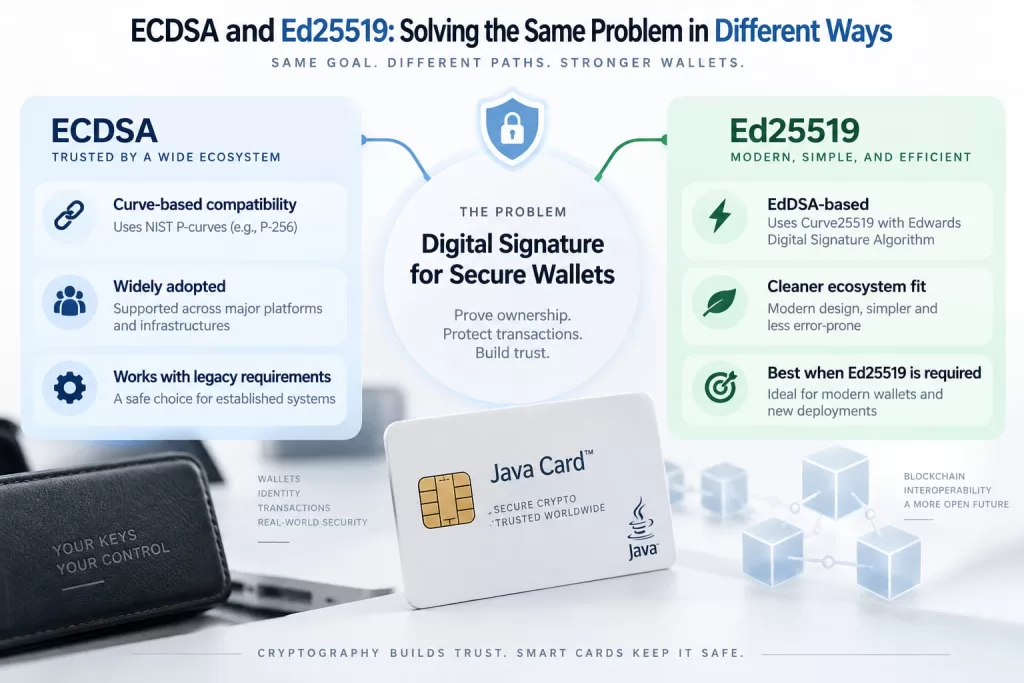
ECDSA and Ed25519: Solving the Same Problem in Different Ways
Both algorithms allow a Java Card crypto card to store private keys within the Secure Element and return only the digital signature to the host application. Their main differences lie in how they generate signatures and the ecosystems they support.
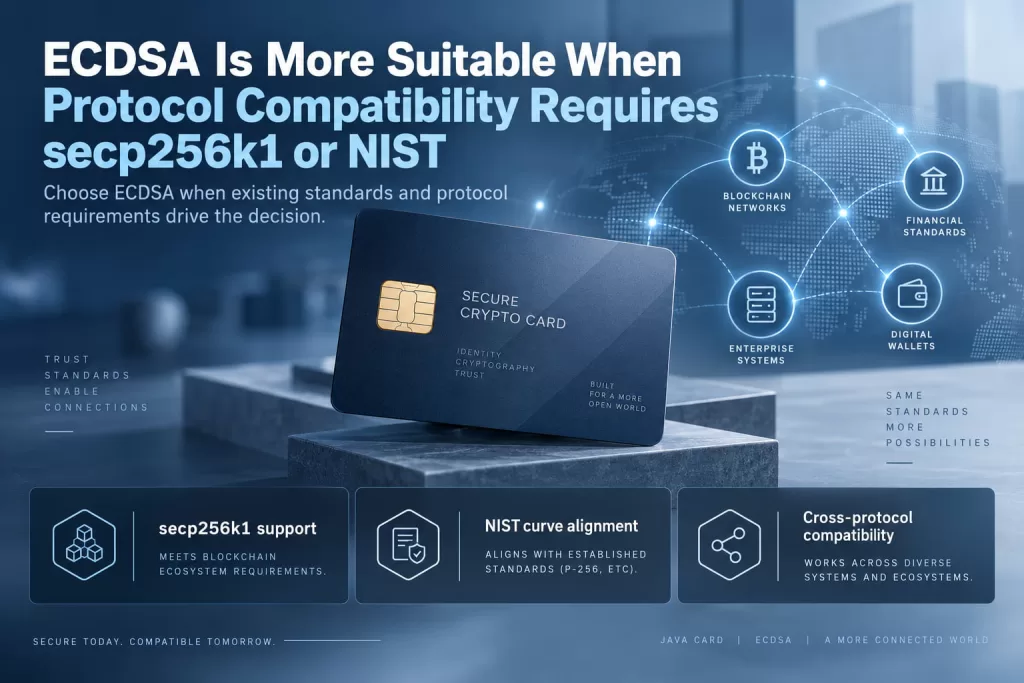
ECDSA Is More Suitable When Protocol Compatibility Requires secp256k1 or NIST
ECDSA is widely supported across various Java Card platforms. The existing Java Card API defines ECDSA signing mechanisms that combine SHA-224, SHA-256, SHA-384, and SHA-512, while the EC key parameters determine the specific elliptic curve.
For cryptographic applications, the most important example is secp256k1.
Bitcoin has historically used ECDSA based on secp256k1 for standard transaction signatures, and Ethereum transaction signatures also rely on secp256k1. ECDSA is the natural choice when Java Card cryptographic cards need to support the following scenarios:
- Ethereum wallets;
- Bitcoin transaction types that require ECDSA;
- Existing wallet infrastructure based on secp256k1;
- Legacy wallet software designed around ECDSA;
- Multi-chain environments that still require ECDSA as a mandatory signing scheme.
Traditional ECDSA requires a unique value for each signature; if random number generation is mishandled, it may compromise private key security. However, modern systems can also adopt deterministic ECDSA, a generation method recognized by NIST in RFC 6979.
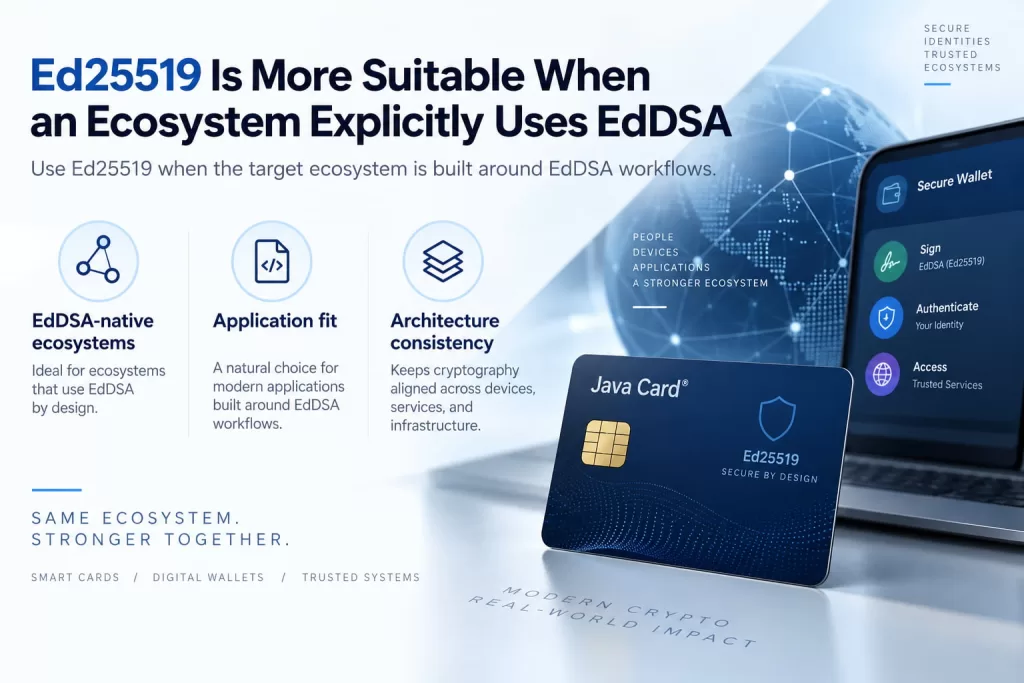
Ed25519 is more suitable when an ecosystem explicitly uses EdDSA
Ed25519 is a specific EdDSA algorithm based on the Edwards25519 curve. RFC 8032 defines Ed25519 as a deterministic signature scheme. It derives its signature nonce from the key and the message, eliminating the need to rely on new random data for each signature. This mitigates a class of implementation risks caused by insufficient randomness in individual signatures.
Ed25519 also employs a compact format:
- A 32-byte private key seed;
- A 32-byte public key;
- A 64-byte signature.
Its deterministic behavior and standardized encoding make it an ideal choice for modern digital asset and authentication systems. However, the main reason to choose Ed25519 is protocol compatibility, not theoretical superiority. If a blockchain, wallet, authentication system, or custody protocol requires Ed25519, Java Card must provide native or verified support for the algorithm.
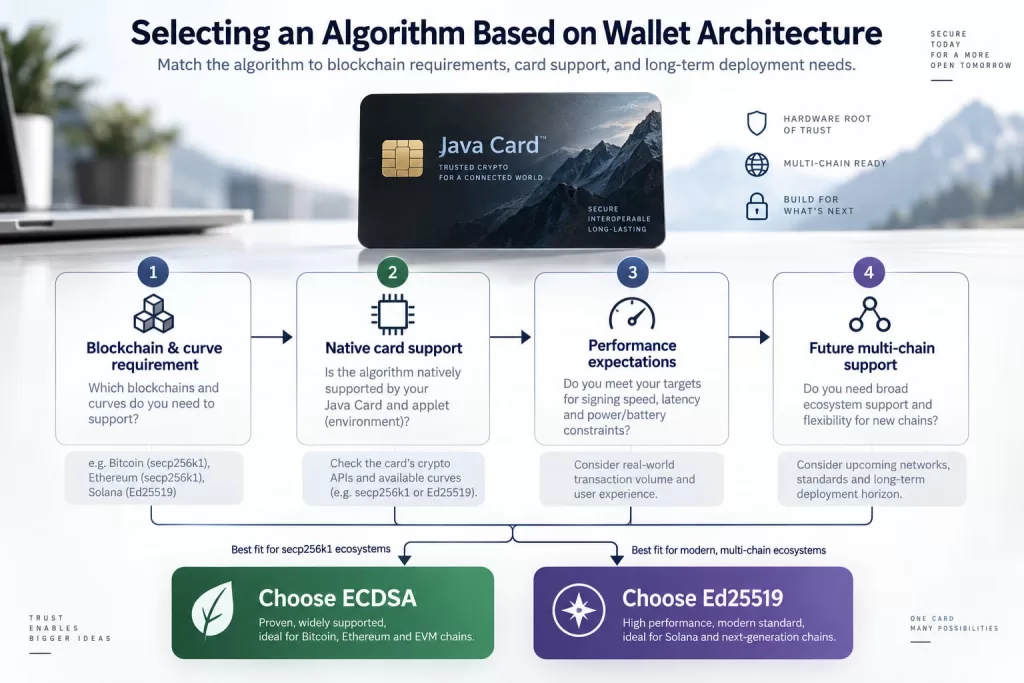
Selecting an Algorithm Based on Wallet Architecture
When choosing between ECDSA and Ed25519, you can also approach the decision from a wallet-architecture perspective rather than in isolation. The target blockchain, required elliptic curve, Java Card implementation, expected signing performance, and future multi-chain development plans will all influence the final decision. Therefore, a suitable Java Card must not only support the required signature algorithm but also align with specific curves, applet workflows, and long-term wallet strategies. We present four factors that provide a practical framework for making this choice.
Starting with Blockchain and Elliptic Curve Requirements
This should serve as the primary screening criterion.
| Project Requirement | Preferred Direction |
| Ethereum transaction signing | ECDSA / secp256k1 |
| Traditional Bitcoin ECDSA transactions | ECDSA / secp256k1 |
| Bitcoin Taproot | Neither alone—BIP340 Schnorr support required |
| Ed25519-based blockchain | Ed25519 |
| Existing NIST-curve PKI application | ECDSA |
| Multi-chain crypto card | May require both |
The Bitcoin Taproot upgrade is a prime example, demonstrating that manufacturers should not limit wallet algorithm choices to a binary choice between “ECDSA and Ed25519.” The BIP340 specification requires Schnorr signatures on the secp256k1 curve; therefore, to support modern Bitcoin features, the relevant card may need to implement an additional signing algorithm beyond the two options discussed in this article.
Verifying Native Java Card Support Capabilities
The next question is whether the selected Java Card can execute the required algorithms within the Secure Element.
For ECDSA, the following must be confirmed:
secp256k1 or the required NIST curve;
SHA functions;
signature encoding format;
nonce generation or support for deterministic ECDSA.
For Ed25519, the following must be confirmed:
Support for the Ed25519 curve;
EdDSA signing API;
On-card key generation;
On-card signing;
Whether applets can call the required implementations.
The J3R452 Java Card not only offers standard ECC capabilities but also supports EdDSA/Ed25519, making it ideal for projects that require both modern cryptographic wallet algorithms and a robust Java Card application environment.
Never Assume That Ed25519 Is Necessarily Faster on Java Card
Ed25519 is often considered highly efficient, but actual Java Card signing performance depends largely on:
hardware acceleration capabilities;
secure element architecture;
native cryptographic implementations;
APDU overhead;
applet design.
If a chip has powerful native ECDSA acceleration, its performance may exceed platforms with less efficient Ed25519 implementations. Therefore, we recommend measuring the following metrics on actual production cards:
Key generation time + signing time + APDU transaction time + verification compatibility.
Consider Long-Term Support for Multiple Blockchains
Cryptographic Java Cards dedicated to a single blockchain can be optimized for a single algorithm.
In contrast, multi-chain wallets may need to support multiple algorithms.
For example:
Ethereum → ECDSA/secp256k1
Chains based on Ed25519 → Ed25519
Bitcoin Taproot → Schnorr/secp256k1
Therefore, the most suitable platform is not necessarily the fastest for a single algorithm, but the one that supports the required signature schemes without exposing private keys outside the secure chip.
Should Java Card cryptographic cards use ECDSA or Ed25519?
For a Java Card crypto card, neither ECDSA nor Ed25519 is inherently superior or inferior.
If the target blockchain or existing wallet infrastructure requires an ECDSA-compatible curve (specifically secp256k1), choose ECDSA.
When the target blockchain or authentication protocol explicitly requires Ed25519, select Ed25519. Its deterministic signature model, along with fixed-size keys and signature formats, makes it an ideal choice for modern cryptography.
For smart cards, best practice is to select a Java smart card that supports both algorithm families, rather than forcing all blockchains to adopt a single signature scheme.