
 English
  Español


Smart cards may appear ordinary on the outside. Still, their internal structure integrates a variety of technologies, including embedded chips, operating systems, security applications, personalized data, communication interfaces, and physical manufacturing processes. If issues are discovered after mass production begins—even minor defects—they can result in significant financial losses, including production delays, material waste, certification risks, and project schedule setbacks. Therefore, smart card manufacturer do not proceed directly to mass production after design approval. Instead, they establish a comprehensive “pre-sample testing” process to rigorously validate every critical element before delivering samples to customers. These testing procedures are designed to confirm that the card design, chip selection, application configuration, and manufacturing processes meet project requirements.
A reliable testing process typically covers the following:
Material and structural validation;
Chip functionality testing;
Electrical and communication testing;
Application and operating system validation;
Security performance evaluation;
Personalization compatibility testing;
Manufacturing consistency validation.
Through these processes, smart card manufacturers can identify potential issues before delivering samples, providing customers with stable smart cards ready for mass production.
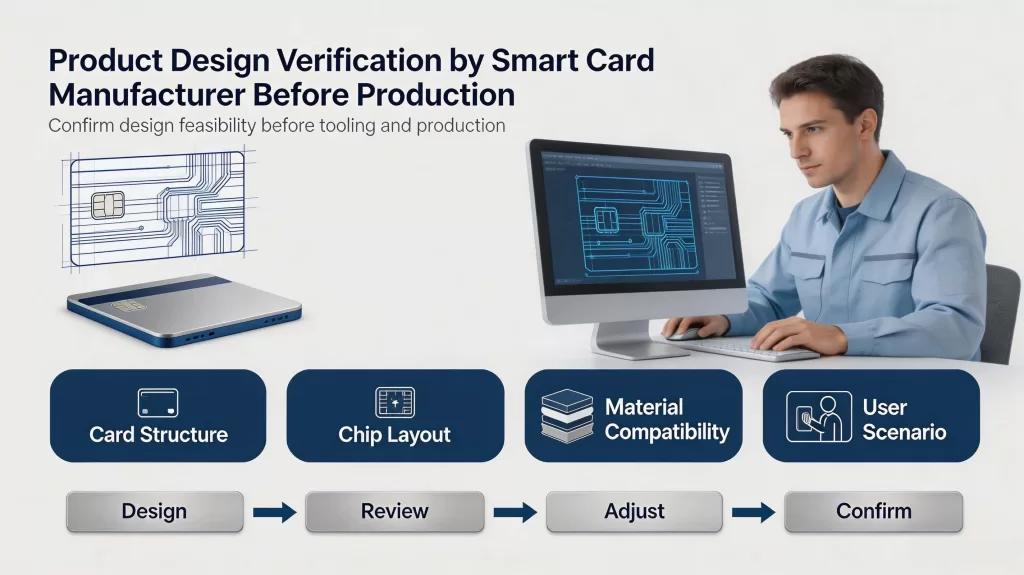
Product Design Verification by Smart Card Manufacturer Before Production
Before manufacturing physical samples, professional smart card manufacturers first conduct a comprehensive design verification process. The purpose of this stage is to confirm that the proposed card structure, components, and technical specifications meet the customer’s application requirements. Many production issues stem from design inconsistencies. Therefore, verifying each technical element before sample production helps mitigate risks and ensures the final product meets expectations.
Reviewing Smart Card Project Requirements
The first step is to analyze the complete project requirements. Professional manufacturers will evaluate:
Application scenarios;
Required chip functions;
Communication interfaces;
Security requirements;
Expected card lifespan;
Personalization requirements;
Compliance standards.
Understanding these requirements enables manufacturers to select the correct chip platform and card architecture.
Chip and Module Compatibility Verification
The chip is the core component of every smart card. Before producing samples, smart card manufacturers must verify that the selected chip is compatible with the card design, application requirements, manufacturing equipment, communication protocols, security features, and other components.
Professional manufacturers evaluate the following factors:
Chip Performance:
The chip must have sufficient processing power to meet the demands of the intended application. For example, financial applications may require stronger encryption capabilities than basic identity verification applications.
Operating System Compatibility:
The chip’s operating system must support the required applications and security features. For Java Card projects, manufacturers must confirm compatibility among the following:
The Java Card platform;
Application applets;
The secure element;
The development environment.
Module Integration:
The chip module must be compatible with the physical card structure. Incorrect module selection may result in:
Poor electrical connections;
Reduced durability;
Communication failures.
Therefore, chip validation is an essential step before sample production.
Physical Structure and Material Testing
Although smart cards contain advanced electronic components, their physical structure also determines their long-term reliability. Before sample production, professional smart card manufacturer evaluate card thickness, material selection, layered structure, chip placement, antenna positioning, and printing requirements.
Common card materials include PVC, ABS, and composite materials. Different materials offer distinct advantages. Manufacturers must ensure that the selected materials are suitable for the project environment.
Electronic Performance and Communication Testing by Smart Card Manufacturer Before Sample Approval
Once the product design has been finalized, the next phase focuses on verifying electronic performance. The operation of a smart card relies on precise communication between the embedded chip and external devices. Whether using contact, contactless, or dual-interface technology, stable communication is essential. Professional smart card manufacturer verify electronic performance before providing samples to customers.

Chip Functionality Testing
The first stage of electronic testing involves verifying that the embedded chip is functioning properly. Test items typically include:
Chip activation;
Data read/write;
Command response;
Memory functionality;
Processing performance.
For Java Card products, testing also includes application loading, applet execution, secure data access, and application response time. This ensures that the smart card can perform all expected functions before entering the customer evaluation phase.
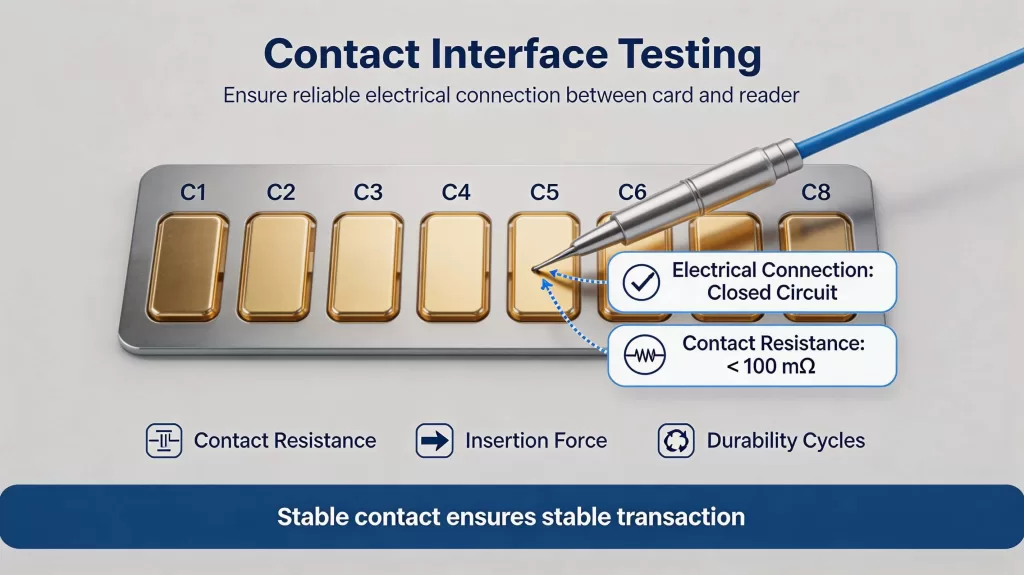
Contact Interface Testing
For contact-based smart cards, the electrical interface must maintain stable communication with the card reader. Testing includes contact resistance, signal transmission, voltage stability, and communication accuracy. Poor contact performance can lead to transaction interruptions, authentication failures, and a degraded user experience. Therefore, smart card manufacturer must verify contact reliability before delivering samples.
Contactless Communication Testing
For smart cards based on RFID and NFC technologies, communication stability depends on antenna design and radio frequency (RF) performance. Professional manufacturers evaluate the following metrics: read range, signal stability, response speed, and reader compatibility.
These tests are critical for products such as RFID cards, transit cards, and contactless payment cards. A thoroughly tested contactless smart card should maintain reliable performance across a variety of reader environments.
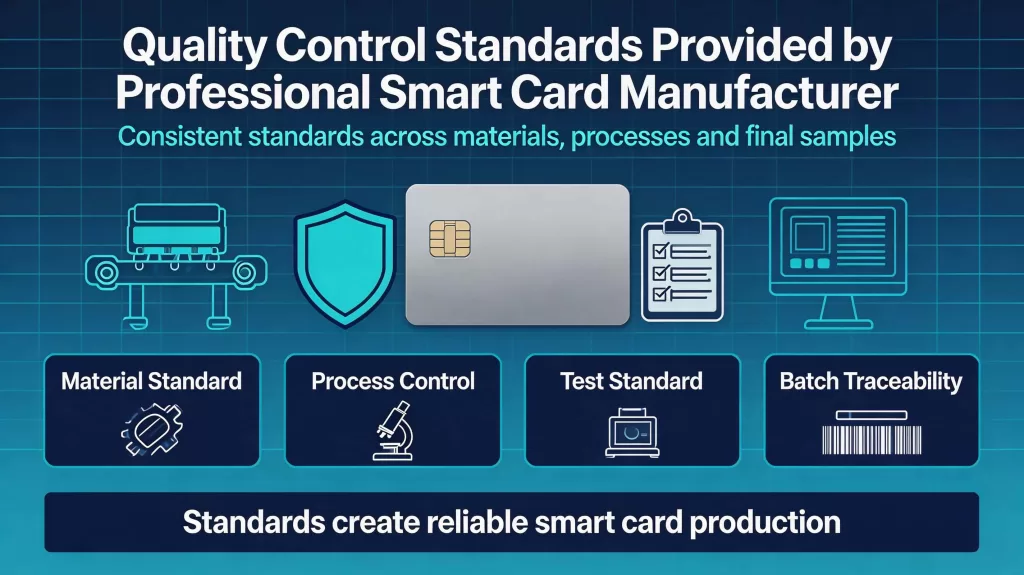
Quality Control Standards Provided by Professional Smart Card Manufacturer
Pre-production sample testing is not an isolated step but rather part of a comprehensive quality management system designed to ensure that smart card projects transition smoothly from prototype development to commercial mass production. For customers selecting a smart card manufacturer, the quality control capabilities underlying the testing process are often just as important as the technical capabilities of the smart card itself.
Professional manufacturers must establish standardized inspection procedures to ensure that every sample accurately reflects the quality of the final mass-produced product.
Establishing a Multi-Stage Quality Inspection System
Reliable smart card manufacturers typically implement multi-stage inspections throughout the entire product development process. Rather than relying solely on final inspections, manufacturers evaluate product quality from various perspectives.
This multi-stage approach enables manufacturers to identify potential issues early on and prevent them from affecting subsequent production. This process is particularly critical for advanced products such as Java Card, as the final product integrates hardware, software, and security features.
Providing a Comprehensive Pre-Sample Testing Process
For any smart card project, the transition from product concept to mass production requires careful validation and technical verification. Professional smart card manufacturers should provide a comprehensive pre-sample testing process to ensure that all aspects of the product meet customer expectations before formal production begins.
The pre-sample testing process should include:
- Product design verification;
- Chip and module compatibility testing;
- Smart card communication testing;
- Java Card application validation;
- Security performance evaluation;
- Personalization compatibility testing;
- Production process validation;
- Reliability and quality inspection.
These procedures enable manufacturers to identify potential issues early, optimize product design, and ensure that approved samples accurately represent the future mass-produced products. Manufacturers must not only verify that the cards function properly but also confirm that they provide long-term security, stability, and scalability.