
 English
  Español


Unlike RFID cards, which are primarily used for short-range identification and personal authentication, UHF cards offer longer read ranges, faster data capture speeds, and more robust large-scale identification capabilities. These advantages make them particularly well-suited for applications in logistics, warehousing, retail, manufacturing, healthcare, and enterprise asset management. While LF and HF RFID cards remain valuable in applications such as access control, payments, and personal identification, UHF cards are designed for scenarios where organizations need to quickly and efficiently identify multiple objects over a larger area. UHF RFID cards enable long-range communication, batch reading capabilities, and seamless integration with automated management systems.
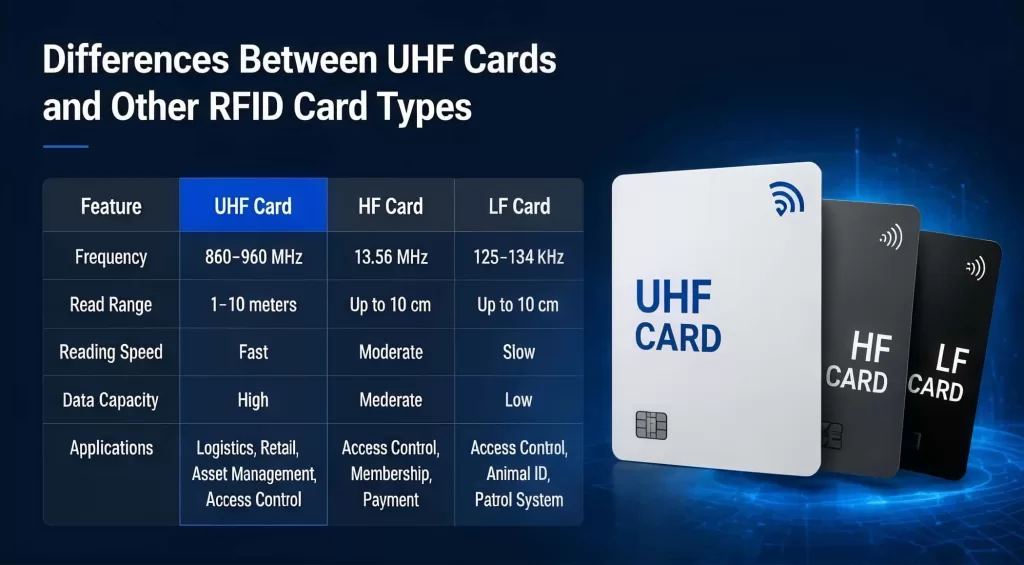
Differences Between UHF Cards and Other RFID Card Types
RFID technology is typically divided into three major frequency categories:
- Low Frequency (LF)
- High Frequency (HF)
- Ultra-High Frequency (UHF)
Although all RFID cards use wireless communication technology, their operating frequencies directly affect performance characteristics such as read range, communication speed, and application suitability.
| RFID Type | Frequency Range | Typical Reading Distance | Common Applications |
|---|---|---|---|
| LF RFID Card | 125–134 kHz | Short distance | Animal identification, basic access systems |
| HF RFID Card | 13.56 MHz | Several centimeters | Payment, NFC, ID cards, smart cards |
| UHF RFID Card | 860–960 MHz | Several meters | Logistics, inventory, asset tracking |
Application Limitations of Traditional RFID Cards
High-frequency (HF) RFID cards and contactless smart cards are widely used because they offer exceptional security and reliable communication for personal identification.
Typical applications include:
- Employee access cards
- Campus cards
- Bank cards
- Government ID cards
- NFC applications
However, these technologies are optimized for short-range communication. For example, when a user holds a contactless smart card near a reader, the system can verify only one card at a time. This makes HF technology an ideal choice for access control environments. However, many industrial applications require a different approach. In these environments, requiring each RFID card to be scanned individually is inefficient and time-consuming.
This is precisely where UHF cards offer significant advantages.
UHF Cards Designed for Large-Scale Identification
The key distinction between UHF cards and other types of RFID cards lies in their ability to support long-range, high-speed identification. Depending on environmental conditions and system design, UHF RFID cards can communicate with readers from several meters away. This enables organizations to identify multiple cards simultaneously, automate inventory processes, reduce the need for manual scanning, enhance operational visibility, and improve data collection efficiency. For businesses managing large numbers of assets, this capability can significantly boost productivity.
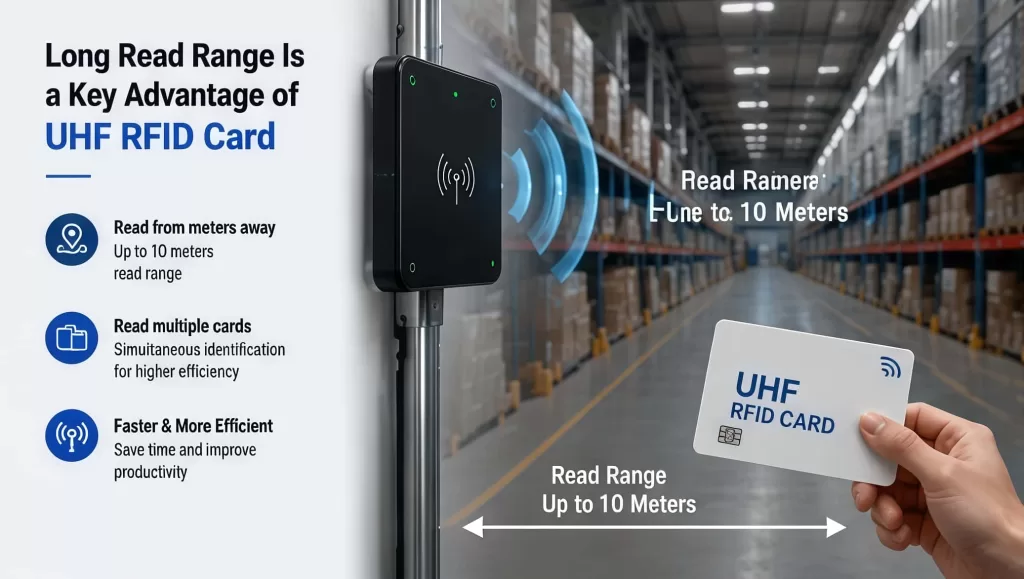
Long Read Range Is a Key Advantage of UHF RFID Card
One of the most important advantages of UHF RFID cards is that their read range is significantly longer than that of traditional RFID card technologies. While HF RFID cards typically require the card and reader to be in very close proximity, UHF cards can be identified from much greater distances. This difference opens up new possibilities for automatic identification.
For example:
Warehouse Management:
Staff can carry multiple tagged items through an RFID scanning zone. The system can automatically capture information without needing manual scanning of each card.
Transportation Management:
Vehicles, containers, or cargo units can be identified as they pass through checkpoints.
Manufacturing Automation:
Production materials can be automatically tracked as they move between different processing stages.
Contactless Operation Reduces Human Interaction
Another key advantage of UHF cards is that they reduce reliance on manual operations. Traditional identification systems typically require users to physically present their cards to a reader, align the card correctly, and scan each item individually. UHF technology enables organizations to move toward automated identification processes. This improves processing speed, labor efficiency, data accuracy, and system reliability. For large-scale industrial environments, reducing manual intervention is one of the most valuable benefits of UHF RFID technology.
From a manufacturing perspective, the longer communication range provides system designers with greater flexibility. UHF RFID card systems can be designed for:
- Entrance gates;
- Warehouse doors;
- Production lines;
- Smart shelves;
- Logistics channels.
Readers do not need to be placed very close to the cards, which simplifies installation and enhances user convenience. For companies planning large-scale digital transformation projects, this flexibility makes UHF RFID cards more scalable than short-range RFID solutions.
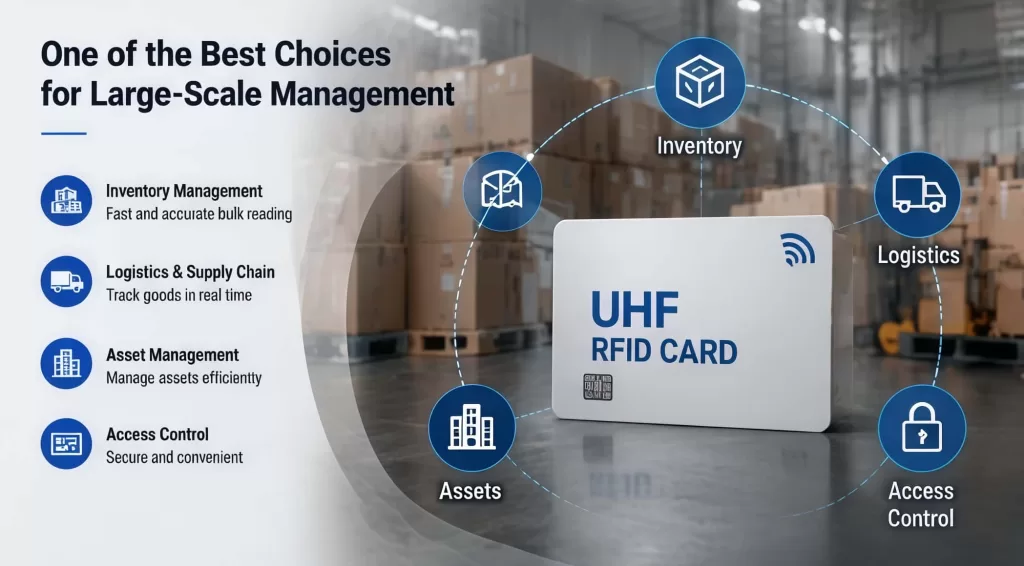
One of the Best Choices for Large-Scale Management
One of the most significant advantages of UHF card is their long read range, but their ability to identify multiple cards simultaneously is equally important. For industries that manage large volumes of products, assets, or materials, processing speed directly impacts operational efficiency. From the perspective of a professional RFID card manufacturer, the true value of UHF RFID cards lies not only in their wireless communication capabilities but also in their ability to support automated, high-volume identification environments.
Multi-Card Recognition Improves Processing Efficiency
Traditional RFID card systems are typically designed around one-to-one interactions. For example:
- An employee presents an access card;
- A customer uses a payment card;
- A user authenticates with an identity credential.
These applications work effectively because the system only needs to identify one RFID card at a time. However, industrial and commercial environments often require a different approach. A warehouse receiving area may need to identify hundreds of packages simultaneously. A retail distribution center may need to verify thousands of products before shipment. A manufacturing plant may need to monitor the flow of large numbers of parts on the production line.
In these situations, scanning individual RFID tags causes unnecessary delays. UHF tags solve this problem by allowing readers to communicate with multiple tags within the same reading zone.
- This enables organizations to:
- Speed up inventory processing;
- Reduce manual scanning operations;
- Improve data accuracy;
- Automate identification workflows.
UHF cards support faster data acquisition.
Modern manufacturing increasingly relies on real-time information. Factories need to track raw materials, production components, products under development, finished goods, and equipment assets. UHF RFID tags enable manufacturers to create a connected production environment that automatically identifies materials and products throughout the manufacturing process. For example, as components move between production stages, UHF readers can automatically record a product’s location, processing status, movement history, production information, and more. This reduces the need for manual record-keeping and enhances transparency in the production process.
Faster Processing Speeds and Longer Read Ranges
Compared to other types of RFID cards, UHF cards offer unique advantages that make them particularly well-suited for large-scale identification and automation applications. While LF and HF RFID cards remain valuable for short-range authentication scenarios such as access control, payments, and personal identification, UHF RFID cards are designed for environments where organizations require faster processing speeds, longer read ranges, and the ability to identify multiple items simultaneously.
The core advantages of UHF technology include:
Longer communication range;
High-speed batch reading capability;
Better support for automated operations;
Robust scalability for industrial applications.
These characteristics make UHF cards ideal smart cards for industries such as logistics, warehousing, manufacturing, retail, and asset management.