
 English
  Español


Unlike traditional payment cards, digital currency hardware wallets must protect cryptographic keys, execute secure transactions, support offline payments, and maintain a seamless user experience—all while withstanding sophisticated physical and logical attacks. For the digital yuan (e-CNY), the security requirements are even higher. Hardware wallets need to operate in a wide range of environments, from public transportation and retail payments to government services and financial inclusion initiatives. These devices must integrate high-performance cryptography, low power consumption, secure application management, and long-term reliability into a compact hardware platform. This is precisely where the J3R452 Java smart card demonstrates its value.
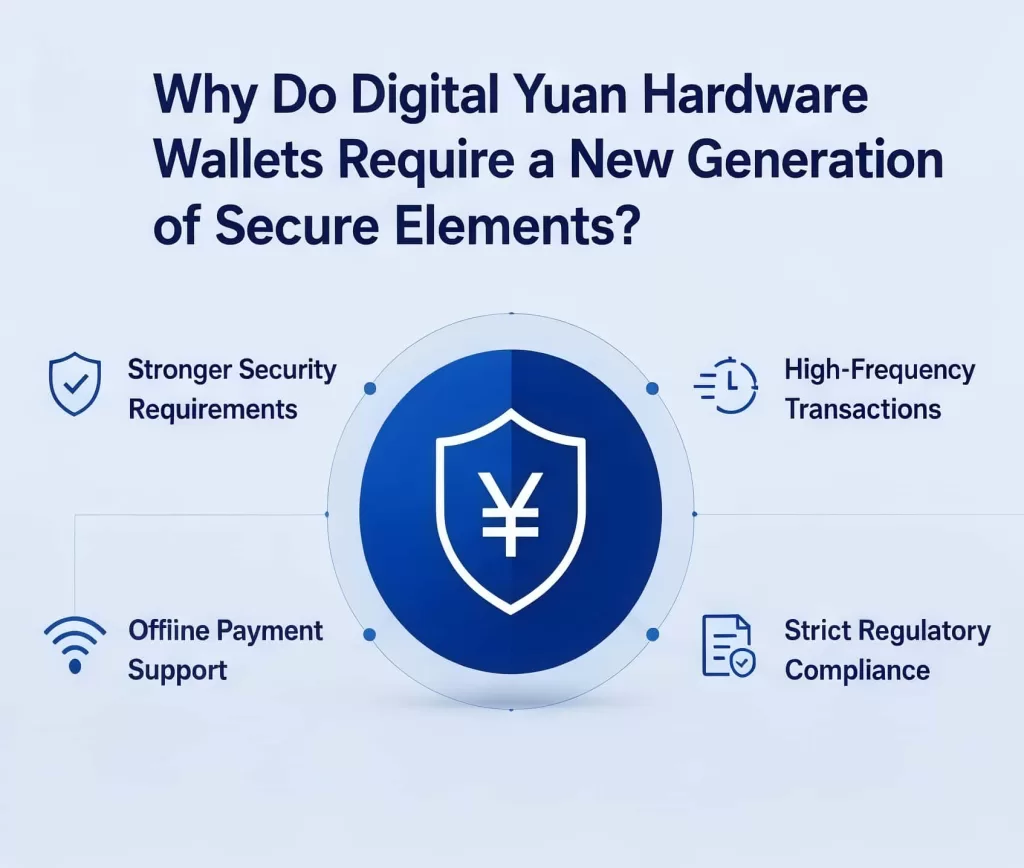
Why Do Digital Yuan Hardware Wallets Need a New Generation of Secure Elements?
Digital yuan hardware wallets differ significantly from traditional payment cards. They do not merely store payment credentials; rather, they serve as trusted execution environments that protect digital assets throughout the transaction lifecycle. As the digital currency ecosystem continues to evolve, hardware wallets must meet increasingly complex technical requirements while maintaining a simple user experience.
Digital Yuan Hardware Wallets Face Higher Security Expectations
Unlike traditional payment applications, digital yuan transactions involve cryptographic assets that must be protected under all operating conditions. Secure hardware wallets typically need to perform the following key functions:
- Securely store private keys
- Execute digital signature operations
- Verify transaction authenticity
- Protect confidential user credentials
- Prevent unauthorized extraction of sensitive data
- Support secure application lifecycle management
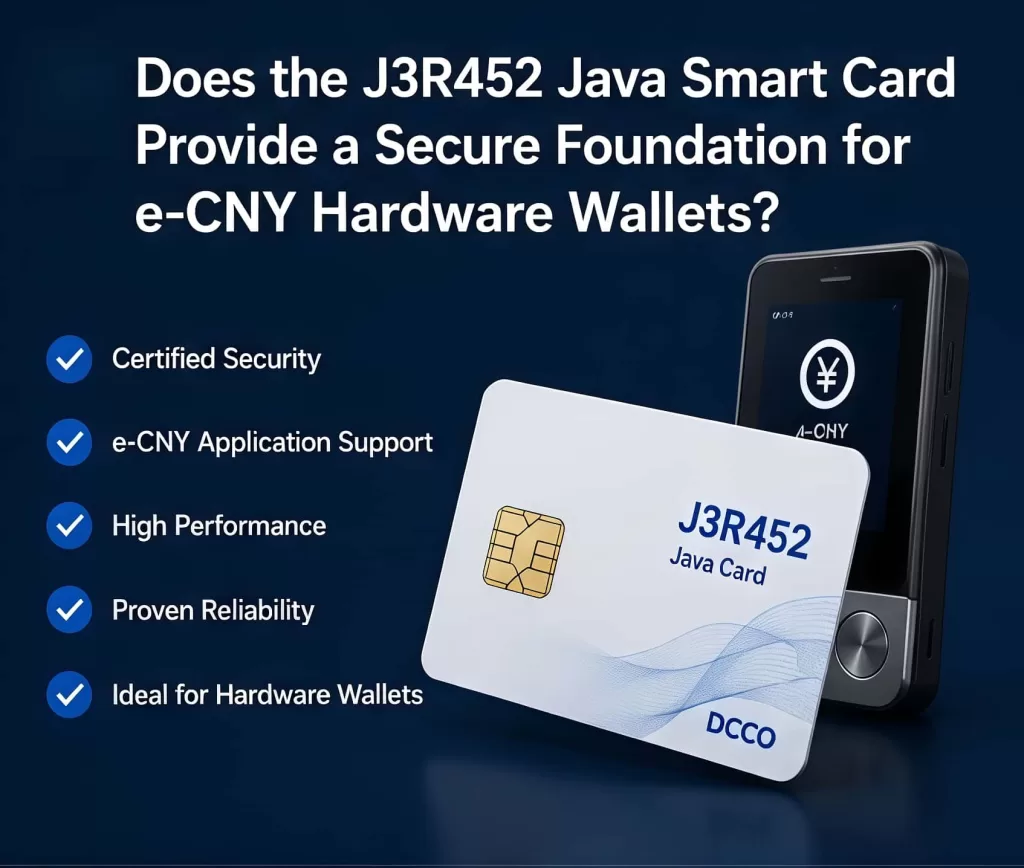
Software-based protection alone cannot meet these requirements. Instead, they require a dedicated secure element capable of isolating sensitive operations from the rest of the system. The J3R452 Java Smart Card provides precisely this secure execution environment, making it ideal for hardware wallet applications that demand both security and operational flexibility.
Why Is Java Card Technology Suitable for Digital Currency Applications?
One of the greatest advantages of Java Smart Card is its programmable architecture. Developers can build secure applications within a standardized Java Card environment without having to develop a fully customized operating system for each hardware wallet project. This not only significantly reduces development complexity but also enhances interoperability and long-term maintainability.
For hardware wallet manufacturers, this offers several practical advantages:
| Traditional Secure Chip | J3R452 Java Smart Card |
|---|---|
| Fixed application architecture | Flexible Java Card application platform |
| Limited service expansion | Multiple secure applications supported |
| More complex software maintenance | Easier lifecycle management |
| Vendor-specific development | Standards-based Java Card ecosystem |
As digital yuan services continue to evolve, this flexibility is becoming increasingly important. New applications, security policies, or financial services can be integrated without redesigning the underlying hardware architecture.
Does the J3R452 Java Smart Card Provide the Security Foundation for Digital Yuan Hardware Wallets?
At the heart of every hardware wallet is its secure element. This component protects cryptographic assets, performs trusted operations, and forms the foundation upon which the entire wallet ecosystem relies. The J3R452 Java smart card is specifically designed for environments that require both robust security and application flexibility.
Advanced Java Card Platform Supports Secure Application Management
Unlike traditional secure chips that can only execute predefined functions, the J3R452 card provides a programmable Java Card environment capable of supporting a variety of secure applications. This architecture enables hardware wallet manufacturers to build modular solutions rather than fixed-function products.
For example, a digital RMB hardware wallet can simultaneously support:
| Secure Application | Function |
|---|---|
| Digital RMB Wallet | Secure payment processing |
| User Authentication | Identity verification |
| Device Management | Secure lifecycle management |
| Digital Certificate Storage | Trusted authentication |
| Future Financial Services | Expandable applications |
Each application runs within its own independent, protected security domain. Even if one application requires an update or new features are added, the integrity of the remaining applications remains intact. This modular architecture offers significant advantages for long-term product development.
Multi-Application Isolation Enhances Security
A notable feature of the J3R452 Java smart card is its secure application isolation model. Each application runs independently within a secure execution environment, preventing unauthorized access between applications. For digital RMB hardware wallets, this separation is particularly important because different services typically handle different categories of sensitive information.
For example: payment credentials, user identity, device authentication, administrative functions, and cryptographic keys.
By isolating these functions, the security platform minimizes risk while simplifying application management throughout the device’s lifecycle.
The J3R452 Java Smart Card: Designed for High-Assurance Financial Environments
Digital RMB hardware wallets must remain secure during years of continuous operation. Unlike consumer electronics, which may be replaced frequently, financial security devices typically require a long service life and continuous defense against evolving threats.
The J3R452 Java Card addresses these challenges through the following architectural advantages:
- Secure Execution Environment
- Hardware-Based Key Protection
- Secure Application Loading
- Controlled Application Lifecycle Management
- Robust Cryptographic Acceleration
- Low-Power Operation, Suitable for Portable Devices
Together, these features lay a solid foundation for deploying Digital RMB hardware wallets across sectors such as retail payments, transportation, government services, and financial inclusion.
Encryption Technology of the J3R452 Java Smart Card
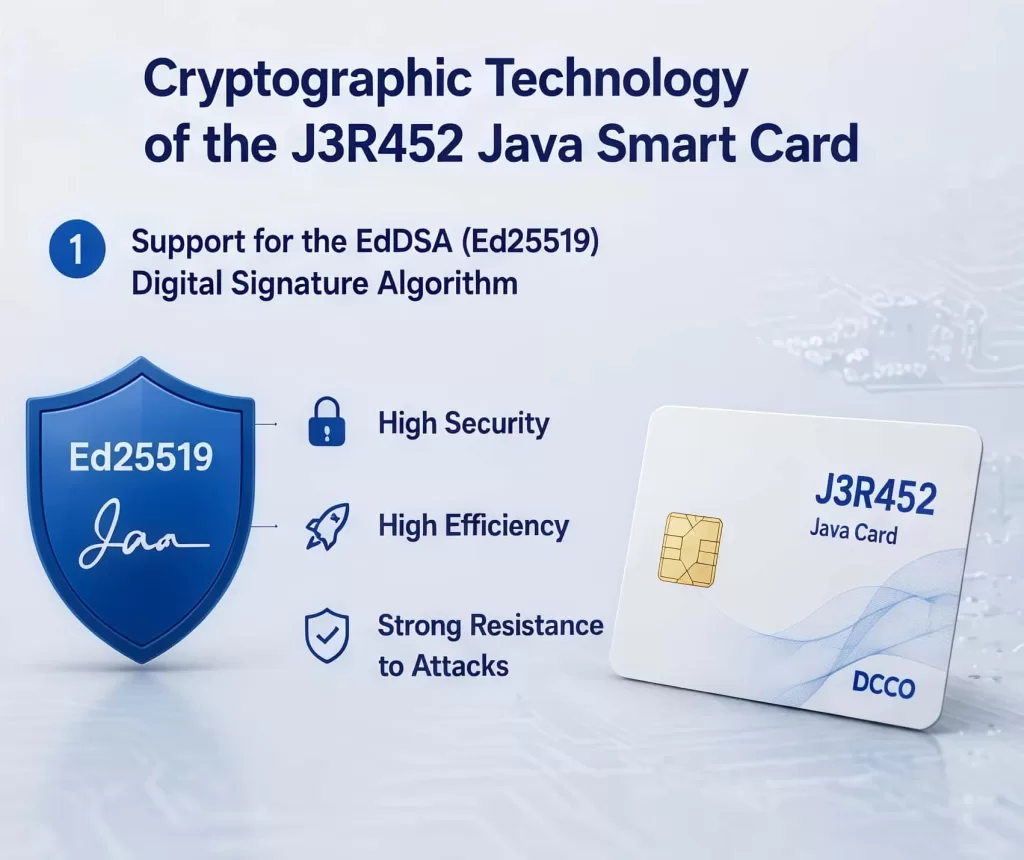
The most important cryptographic technology in the J3R452 Java card is its support for the EdDSA (Ed25519) digital signature algorithm. Digital signatures form the foundation of all secure transactions. Before authorizing a payment, a hardware wallet must verify the user’s credentials, generate a valid signature, and protect the private key throughout the process. Compared to many traditional public-key algorithms, Ed25519 offers several practical advantages for hardware wallet applications:
- Faster signature generation
- Reduced computational overhead
- Lower power consumption
- Smaller signature size
- High security and excellent performance
These characteristics make the algorithm particularly well-suited for portable payment devices, where processing efficiency and battery life are equally important. For Digital Yuan hardware wallets, faster cryptographic processing directly translates to shorter transaction times and a smoother payment experience.
Low-Latency Authentication Supports Real-Time Payment Scenarios
Consumers expect digital payments to be completed instantly. Whether paying at a retail checkout counter, entering a subway station, or purchasing food from a vending machine, authentication must be completed within a fraction of a second. The J3R452 card achieves this by accelerating cryptographic operations within the secure element itself, rather than relying on an external application processor.
This architecture offers benefits such as faster payment confirmation, reduced processor load, improved system responsiveness, lower overall power consumption, and consistent transaction performance. As a result, hardware wallet manufacturers can develop payment terminals that are both secure and responsive, even during peak transaction volumes.
Secure Key Protection Mechanisms Support Trusted Hardware Wallet Applications
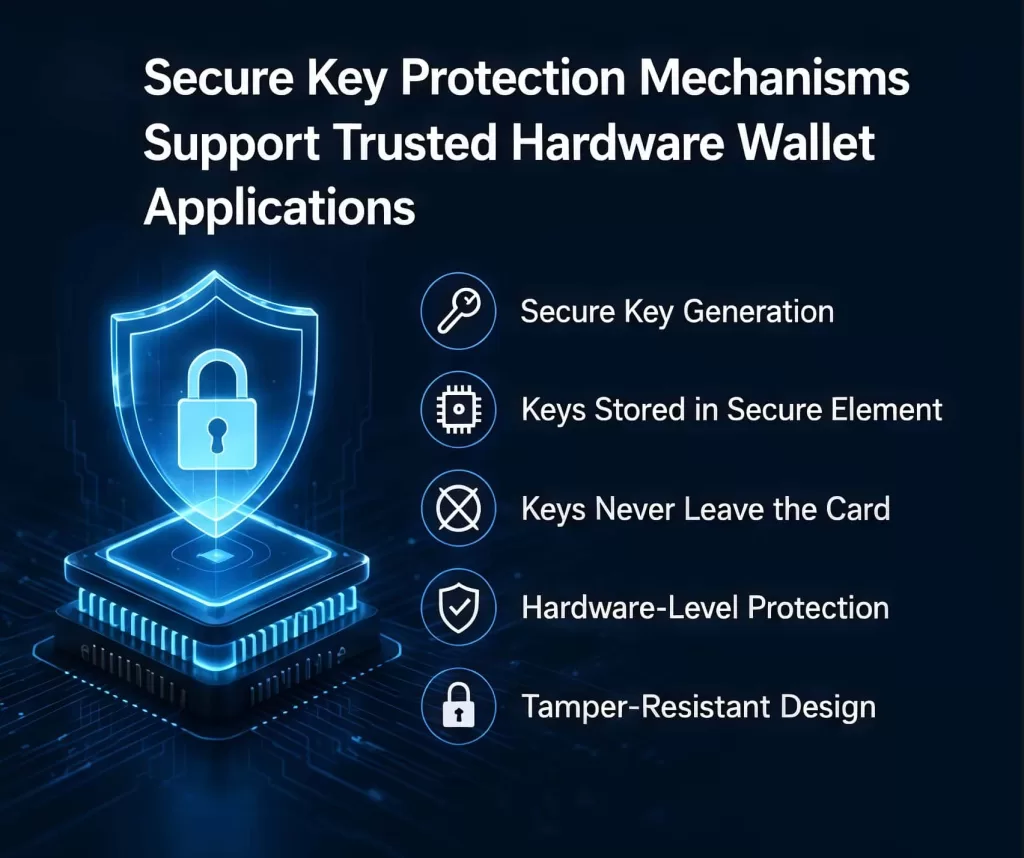
Cryptographic algorithms alone cannot guarantee security. The most valuable asset in any hardware wallet is the private key, and protecting it is the secure element’s primary responsibility. From the perspective of a professional Java Card manufacturer, effective key protection is what distinguishes true hardware wallets from software-based payment solutions.
Hardware-Level Isolation Protects Private Keys
One of the greatest advantages of the J3R452 Java smart card is that sensitive cryptographic material never leaves the secure chip. All sensitive operations are executed internally within a secure environment, rather than exporting private keys to the operating system or application processor. This means that the secure element always protects private keys; applications only receive the final encrypted results; external software cannot directly access confidential credentials; and physically extracting sensitive information becomes significantly more difficult.
For Digital RMB hardware wallets, this hardware-based isolation creates a trusted execution environment, thereby enhancing the overall security architecture.
Secure Transaction Signing Protects Every Payment
Every Digital RMB payment requires trusted transaction authorization. During the transaction process, the hardware wallet must verify payment information, generate a secure digital signature, and prevent unauthorized modifications. The J3R452 Java card performs these operations internally, thereby reducing the risk of external threats while maintaining transaction integrity.
This secure signing process offers the following key advantages:
| Security Capability | Value for Digital RMB Hardware Wallets |
|---|---|
| Internal Key Storage | Prevents private key exposure |
| Secure Signature Generation | Protects transaction authenticity |
| Tamper-Resistant Execution | Reduces attack opportunities |
| Hardware-Based Cryptography | Improves overall payment security |
By executing these operations within the secure element, the J3R452 helps establish a trusted payment environment suitable for financial applications.
The Ideal J3R452 Java smart card for Digital RMB Hardware Wallets
Since the J3R452 Java Card is built on a proven platform, development teams can focus on creating innovative wallet features rather than building the underlying security functions from scratch. This approach helps reduce development complexity, software maintenance effort, integration risk, and time-to-market. At the same time, it creates a standardized development environment that supports future application upgrades.
The J3R452 Java smart card meets these requirements by combining a programmable Java card platform with advanced cryptographic capabilities, secure application management, and efficient, low-power operation. Its support for Ed25519 (EdDSA) enhances digital signature performance, while its secure execution environment helps protect sensitive credentials throughout the transaction lifecycle.