
 English
  Español


At first glance, contact smart card and contactless smart cards appear very similar. In reality, however, they function quite differently, follow distinct communication protocols, and serve different business objectives. As a smart card manufacturer, we often encounter situations where many customers ask right off the bat which type of card is better. But the real question is: Which card best meets the project’s practical application needs, infrastructure, security requirements, and user experience? Therefore, it is necessary to clarify this topic so that everyone understands the differences between the two.
Contactless and Contact Smart Card Have Different Communication Modes
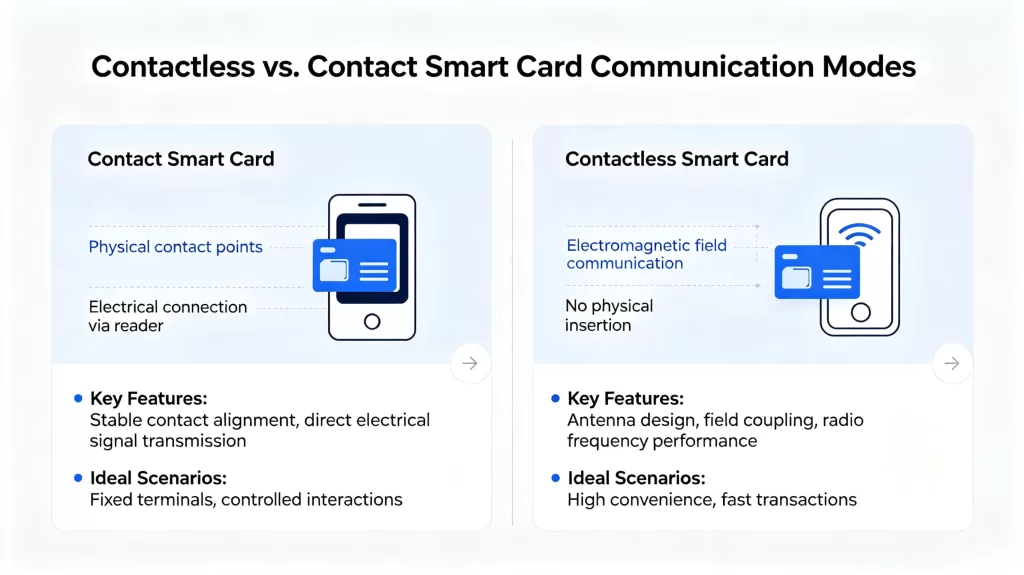
The most fundamental difference between the two card types lies in how they communicate with the reader. Contact cards use physical contact points. The reader establishes communication through an electrical connection, and the card is inserted into the terminal. Contactless smart cards use electromagnetic fields to communicate without requiring insertion. This distinction impacts both the user experience and engineering requirements. Contact cards rely on stable contact alignment and direct electrical signal transmission. Contactless cards, on the other hand, depend on antenna design, field coupling, and radio frequency performance.
The communication mode is not merely a technical detail; it directly influences the entire deployment strategy. Contact smart cards are suitable for scenarios with fixed terminals and controlled interactions. Contactless smart cards, however, are ideal for scenarios that demand high levels of convenience and transaction speed.
How Contact Smart Cards Work?
Contact smart cards are designed for direct interaction with terminals. The card must be inserted into the reader, which provides the electrical path required for communication. This mode features a rigorous and mature structure, making it particularly suitable for security-controlled environments. From a manufacturing perspective, contact cards require precise contact positioning, stable lamination, and consistent surface quality. A reliable electrical connection must be maintained with every use. If the physical interface is weak, the overall user experience will rapidly deteriorate.
How Contactless Smart Cards Work?
Contactless smart cards do not require insertion into a device. They communicate with a reader via near-field induction, typically by tapping or holding the card close to the terminal. The reader generates a magnetic field to power the card and facilitate data exchange. This approach delivers a faster and more convenient user experience, making it particularly suitable for environments where people frequently pass through checkpoints or turnstiles. Additionally, since there is no need to repeatedly insert the card, mechanical wear is reduced.
Differences in User Experience and Transaction Processes
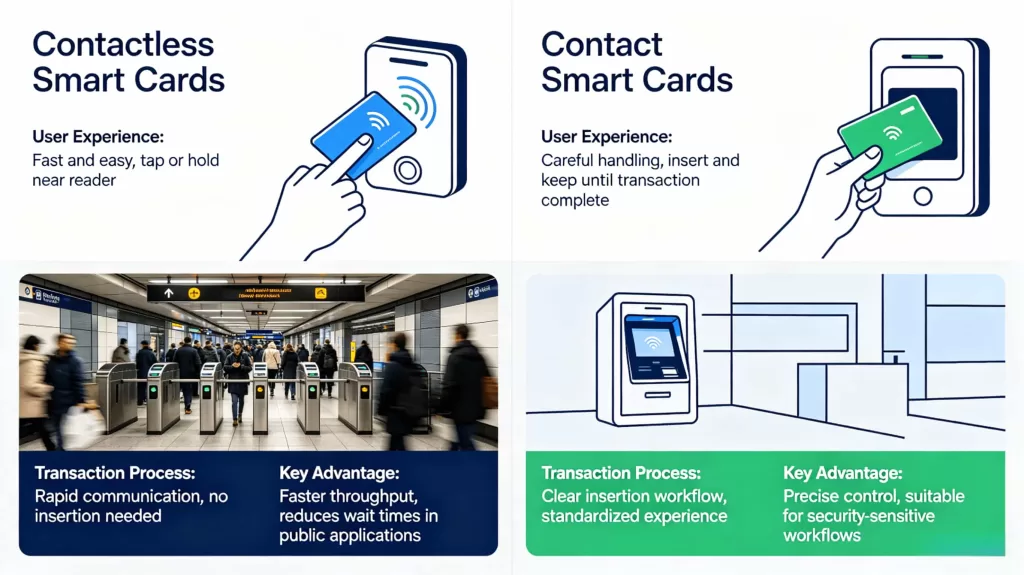
One of the most noticeable differences between contact and contactless smart cards lies in the transaction process and user experience. In daily use, contactless cards are faster and easier to operate. Users need to tap the card against the reader or hold it near the reader to initiate communication. Contact cards, on the other hand, require more careful handling. Users must insert the card into the reader and keep it inserted until the transaction is complete. While this process is not a drawback in itself, it does create a different rhythm and experience.
Contactless Smart Cards Support Faster Throughput
In high-traffic environments, speed is often the primary consideration. Public transportation systems, building entrances, and event access systems all benefit from rapid card swiping. Contactless smart cards reduce wait times and improve access efficiency. When tens of thousands of users pass through a system daily, even a slight reduction in transaction time can have a significant impact. This is one reason contactless cards are widely used in public applications. They are efficient, intuitive, and easy to use.
Contact Smart Card Support for More Precise Workflows
When processes require stricter control, contact smart cards are often the better choice. In banking, government identification, and other security environments, terminal interactions are typically designed around a clear insertion workflow. This approach facilitates better control over transactions and provides a more standardized user experience.
Differences in Security Design Between Contact and Contactless Smart Cards
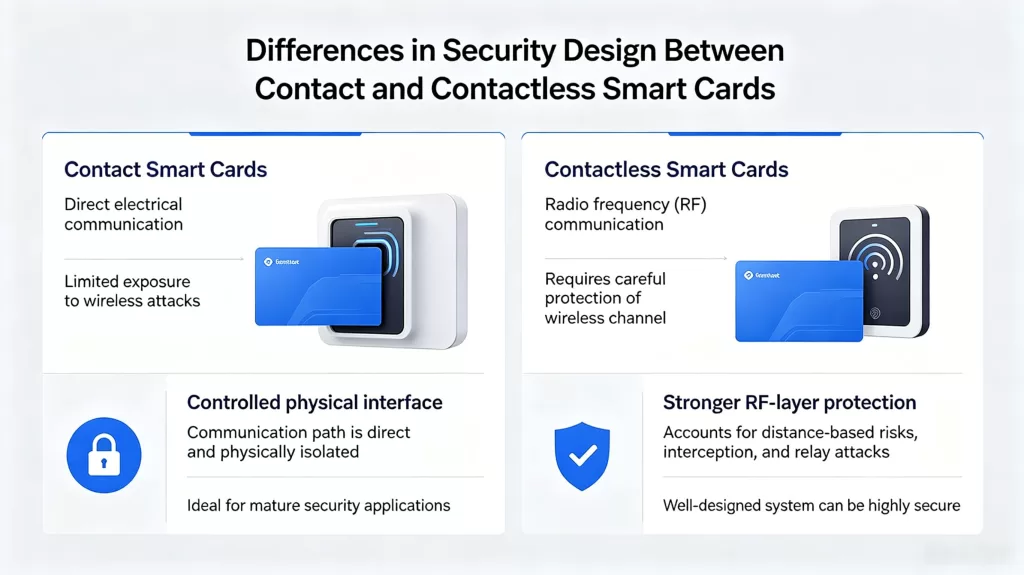
Security is one of the key distinctions between the two card types. However, the crux of the matter is not that one format is inherently more secure than the other. The real difference lies in the distinct types of risks they face, which necessitate different security design priorities. Contact smart cards use direct electrical communication, which limits their exposure to wireless attacks. In contrast, contactless smart cards rely on radio frequency (RF) communication, necessitating careful protection of the wireless channel.
Contact Smart Cards Rely on a Controlled Physical Interface
For contact cards, the communication path is direct and physically isolated. This offers advantages in security environments where readers are strictly controlled, and the entire system design is part of a trusted infrastructure. This makes contact cards an ideal choice for many mature security applications. Their operating model is familiar, stable, and widely accepted.
Contactless cards require stronger RF-layer protection.
Since contactless smart cards rely on wireless communication, their security model must account for distance-based risks, interception, and relay attacks. This does not imply that contactless cards are less secure. A well-designed contactless card system can be highly secure. The key lies in ensuring that authentication, encryption, and transaction logic align with the intended threat model.
Different Choices for Application Scenarios
Contact Smart Cards Are Suitable for Controlled Environments
For secure end-user applications such as payments, government identification, and regulated authentication processes, contact cards are typically the ideal choice. These scenarios benefit from direct insertion, predictable communication, and stable workflows. Contact cards are particularly effective when the reader environment is fixed, and the process requires greater control.
Contactless smart cards are suitable for high-throughput environments.
Contactless smart cards are typically the better choice for applications such as transportation, access control, time and attendance, and event admission. These scenarios place high demands on speed, ease of use, and user throughput. When the primary goal is to quickly move people through a system and minimize friction, contactless technology is often the more effective option.
Making the Right Choice for Your Situation
The primary differences between contact and contactless smart cards lie in their communication methods, user experience, security design, manufacturing structure, and application scenarios. Contact cards use direct electrical contact and are generally better suited for controlled terminal environments. Contactless smart cards use RF communication and are generally better suited for fast, convenient tap-and-go applications. If customers require control, structured management, and direct card-to-reader connections, contact smart cards are usually the appropriate choice. If customers require speed, convenience, and a smoother transaction process, contactless smart cards are typically the better option.