
 English
  Español


A financial-grade smart card solution must be capable of protecting data, supporting secure personalization, operating reliably in real-world applications, and withstanding rigorous scrutiny from auditors, card issuers, and payment solution partners. Therefore, they need to assess whether “the smart card manufacturer has a comprehensive certification system in place to support financial-grade deployment.” In practice, this certification system typically includes quality management, environmental and security controls, information security, secure printing, product-level security assessments, payment ecosystem certifications, and, where applicable, Java Card and GlobalPlatform certifications.
Management System Benchmarks Every Smart Card Manufacturer Should Meet
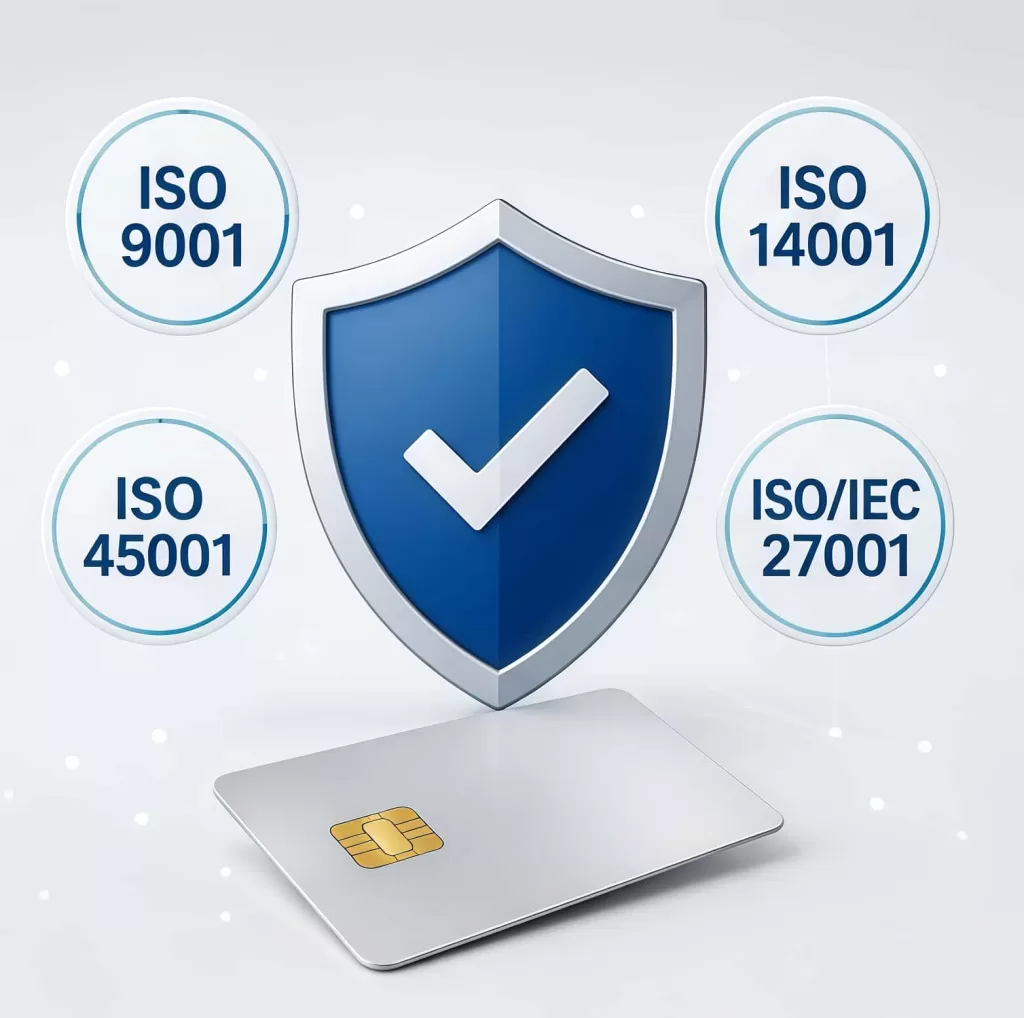
If a smart card manufacturer wishes to compete in financial-grade projects, the primary requirement is operational compliance. ISO 9001, ISO 14001, ISO 45001, and ISO/IEC 27001 constitute the most obvious benchmarks.
For financial-grade operations, these management certifications are crucial because they demonstrate to clients that the smart card supplier can maintain controlled processes—not merely provide compliant samples. ISO 9001 helps demonstrate consistent quality and continuous improvement. ISO 27001 certification is required when manufacturers handle personalized data, issuer keys, production files, or cardholder information. While ISO 14001 and ISO 45001 may not be the first standards banks inquire about, they enhance a supplier’s reliability and reduce operational risks throughout the card’s lifecycle.
Why is ISO 9001 an essential quality benchmark?
Smart card suppliers without ISO 9001 certification find it more difficult to demonstrate their ability to deliver consistent, repeatable products under the pressures of actual production. ISO describes ISO 9001 as a framework that helps organizations deliver consistent products and services, improve efficiency, and meet customer and regulatory expectations. For financial-grade smart card projects, this is precisely the level of rigor that card issuers expect. It is not enough for a single pilot production batch to appear flawless; manufacturers must demonstrate that the same results can be consistently replicated in mass production.
The Importance of ISO/IEC 27001
Smart card manufacturers handle highly sensitive assets, such as personalization databases, key material, card production files, and, in some cases, secure delivery instructions. ISO/IEC 27001 is the leading ISMS standard for managing these risks. The ISO/IEC 27001 standard defines the requirements for establishing, implementing, maintaining, and continuously improving an information security management system.
Secure Printing and Personalization Certification
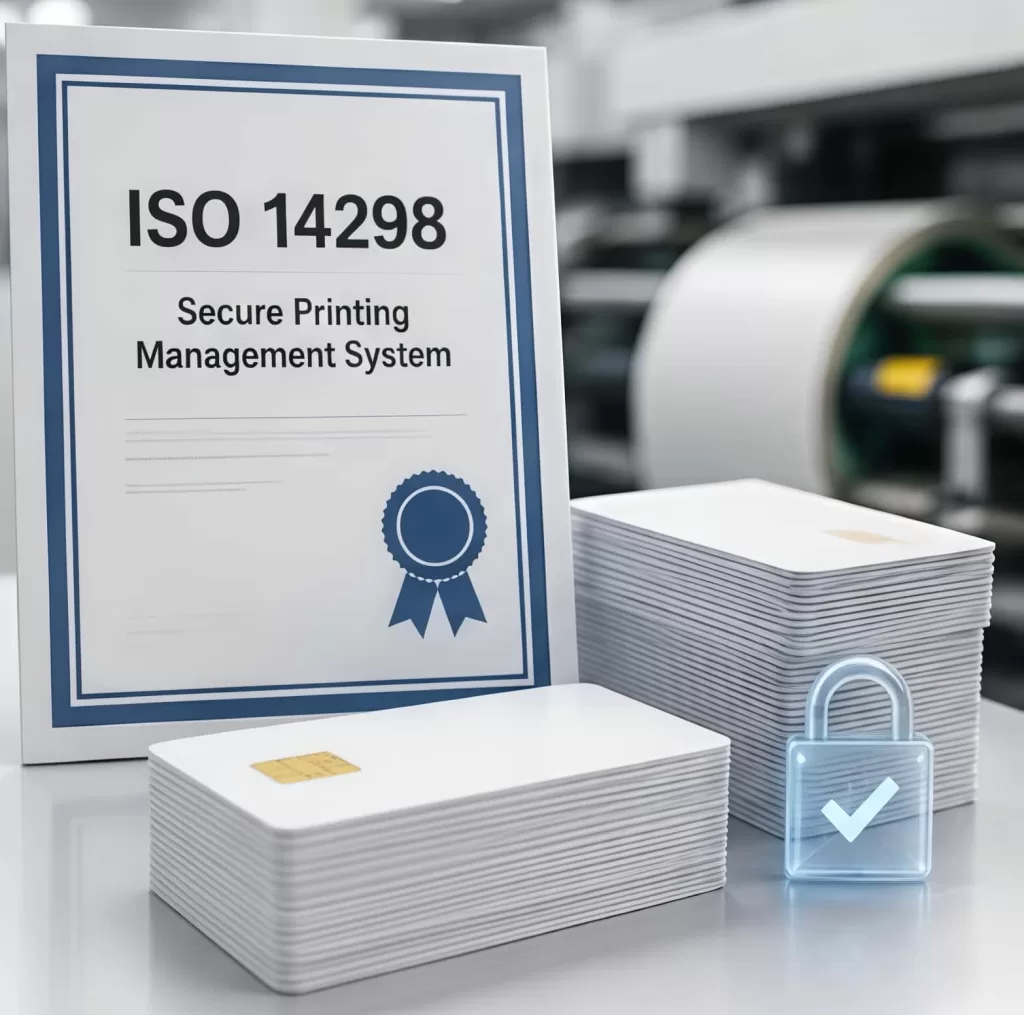
A financial-grade smart card is not complete once the chip is embedded. It must also undergo processes such as printing, personalization, packaging, and shipping to ensure security. Therefore, smart card manufacturers must comply with ISO 14298. ISO 14298:2021 defines the requirements for a secure printing management system and establishes a minimum framework for secure printing organizations.
That is because financial cards carry more than just design graphics—they also include the cardholder’s identity details, unique data, and, in many cases, information that must stay confidential throughout production. If a smart card supplier adopts processes compliant with ISO 14298, the supplier will have a stronger competitive edge when banks, card issuers, or project managers inquire about how the supplier controls access to design graphics, personalization security, production isolation, and post-printing handling.
The Importance of ISO 14298 for Card Personalization
In financial smart cards, personalization is not merely the final step—it is a security measure in its own right. By focusing on the secure printing process itself, ISO 14298 provides a management framework for this phase. In custom smart card projects, this encompasses the controlled handling of printing surfaces, encoded data, serial numbers, and customer materials. For smart card manufacturers, this certification demonstrates to buyers that their production lines possess the management capabilities required for secure card issuance—not just decorative printing.
EMVCo-certified smart card manufacturer
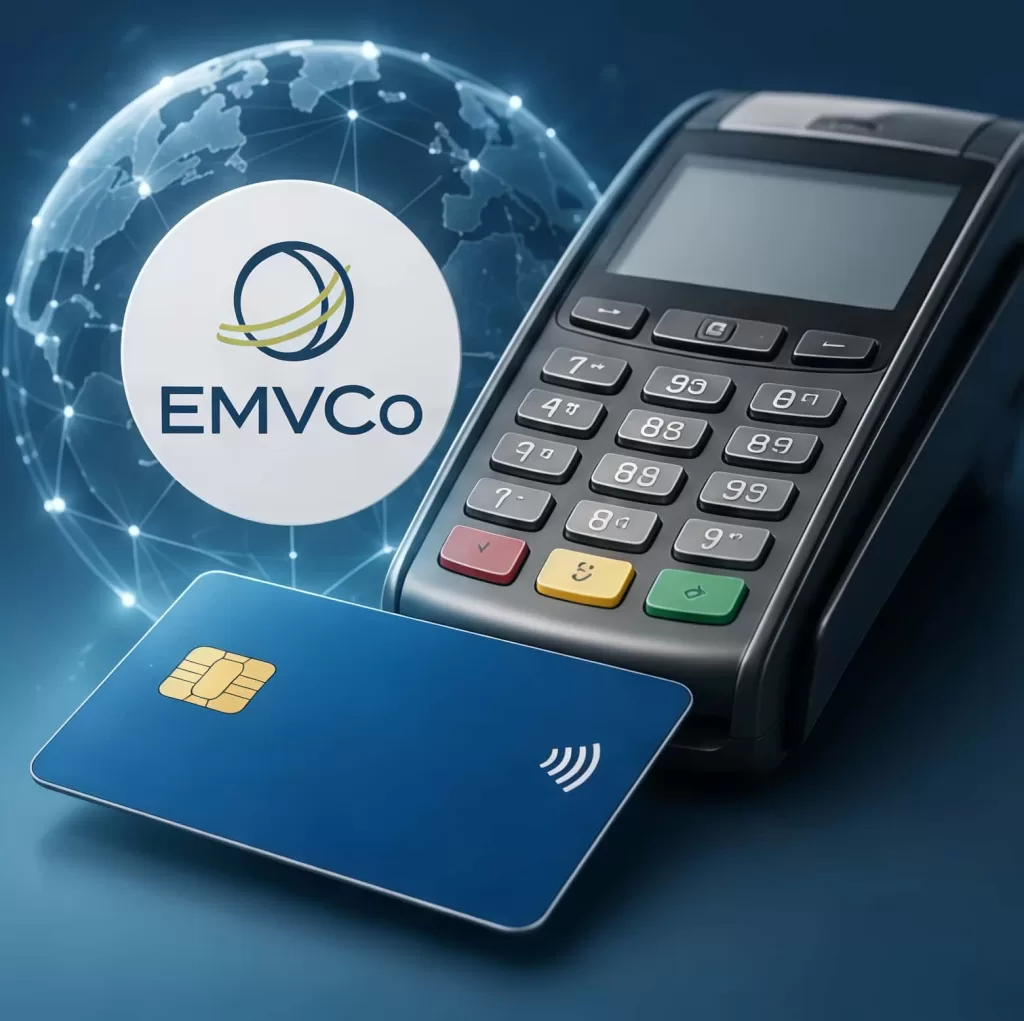
If a project involves payments, EMVCo is one of the most important organizations within the entire certification system. EMVCo manages the EMV specifications and related procedures to enable secure card payments worldwide. EMVCo also maintains dedicated approval processes for EMV contact and contactless chip products, making it central to both contact and contactless financial card projects.
Card issuers require products that function properly in real-world environments, not just in laboratory settings. The EMV specifications define the technical requirements that support global interoperability, while the EMVCo certification program helps verify that chips or payment interfaces operate as intended. If a card is used for in-person swipe payments, compliance with EMV standards is not a marketing advantage but a prerequisite for practical deployment.
Java Card and GlobalPlatform Credentials
For financial-grade projects using Java Card, smart card manufacturers require different levels of certification. Only Java Card-authorized entities may distribute Java Card products, and these entities receive the relevant TCK to ensure compliance with the Java Card specification. Therefore, the relationship between Java Card authorization and the TCK is a core requirement for any smart card manufacturer offering Java Card-based financial products.
GlobalPlatform’s card specifications support dynamic post-issuance management, allowing applications to be added or modified after deployment. They also support secure element management and security lifecycle controls. For smart card manufacturers, this certification is essential when customers seek to use a single secure platform to implement multiple financial or identity-related functions. Smart card vendors that cannot support GlobalPlatform-based management typically cannot develop financial-grade Java Cards.

Core Certifications Required for Smart Card Manufacturer Producing Financial Smart Cards
For financial-grade projects, the core certification framework for smart card manufacturers typically begins with ISO 9001, ISO 14001, ISO 45001, and ISO/IEC 27001. Then it extends to ISO 14298, the Common Criteria, EMVCo certification, Java Card certification and GlobalPlatform certification, as required when the project uses programmable secure elements. These certifications and approvals ensure the trustworthiness of smart cards when used in financial environments.